This performance agreement is between
The Performer is a
The Buyer wishes to engage the Performer as an independent contractor for the purpose of performing at the premises known as
The parties therefore agree as follows:
1. PURPOSE.
The Buyer hereby engages the Performer, and the Performer hereby accepts such engagement, to provide the performance and services described in section 3 (the "Performance").
2. COMPENSATION.
- (a) Performance Fee.
As full compensation for the Performance, the Buyer shall pay the Performer by cash, or by money order or check made payable to a total sum of $ less any taxes legally required to be withheld by the Buyer, as set forth in section (the "Performance Fee").The Buyer shall pay the Performance Fee in full before the start of the Performance. in full within days after the Performance. In two installments as follows: (i) a deposit amount of $ (the "Deposit"), to be subtracted from the Performance Fee, payable no later than to secure the Performer for the Performance; and (ii) the remaining balance of the Performance Fee to be paid in full prior to the start of the Performance. in full within days after the Performance. - (b) Additional Services. The Buyer may purchase the following Additional Services at the following rates:
- (i) additional performance time, if requested by the Buyer and agreed to by the Performer, will be provided at the rate of $
per minutes. - (ii) if the Venue requires extra set-up or take-down time, of if equipment must be carried by the Performer distances greater than
feet, an additional labor fee of $ per minutes. (iii) .
- (i) additional performance time, if requested by the Buyer and agreed to by the Performer, will be provided at the rate of $
3. DATES, TIMES, AND PLACE OF PERFORMANCE.
In exchange for the Performance Fee, as set forth in section 2, the Performer shall provide the Performance as follows:
- (a) Performance Venue. The Performance will be held at the Venue. The address of the Venue is
, , . - (b) Date(s) and Time(s). The Performance will take place on the following date(s) and time(s):
| Date | Time | ||||||||||||||||
| between |
|||||||||||||||||
(c) Length of Performance. The Performance will be no fewer than minutes, and no more than minutes with -minute breaks every minutes . (c) (d) Description of Performance. The Performer will provide the following Performance:. (d) (e) Performance Content. The Performer shall have sole control and responsibility for all content and creative elements of the Performance.However, the Performance shall not include any of the following: . (e) (f) Set-up and Take-down.The Performer may begin set up for the Performance hours minutes before the Performance. The Performer shall complete take down for the Performance no later thanhours minutes after the Performance.(f) (g) .
4. RESPONSIBILITIES.
- (a) Of the Performer. The Performer shall:
- (i) provide the Performance, asset forth in section 3 above;
- (ii) devote as much productive time, energy, and ability to the Performance and rehearsal of the Performance as may be necessary;
- (iii) complete the Performance safely, with professional effort and skill, and using adequate equipment in good working order;
- (iv) comply with any royalty fees, performance fees, or other obligations of any organizations, including unions, to which the Performer is subject, contractually or otherwise;
- (v) arrive at the Venue at least
hours minutes prior to the Performance; - (vi) control and direct the production and presentation of the Performance;
- (vii) supply all equipment and personnel necessary for the Performance other than the equipment and personnel to be supplied by the Buyer;
- (viii) arrange any travel and lodging in connection with the Performance and pay for any travel, lodging, or other expenses incidental to the Performance
, including meals ;and (ix) provide the Buyer with the Performer's biographical information and photographs . ; and (ix) (x) .
- (b) Of the Buyer. The Buyer shall:
- (i) provide reasonable assistance and cooperation to the Performer to enable the Performer to complete the Performance;
- (ii) take reasonable steps to secure the safety of the Performer and the Performer's property and personnel;
- (iii) provide appropriate working conditions for the Performance, including suitable space, power, electricity, sound, and other services, as set forth in this agreement;
- (iv) provide a stage
feet by feet for the Performance and, on the request of the Performer, for no more than rehearsals; - (v) supply power, lighting, and sound as set forth in more detail in a technical rider signed by the parties and attached to this agreement as Exhibit A;
- (vi) supply the following equipment:
; - (vii) supply
clean, well-lighted, ventilated, dressing room(s) with locks; - (viii) provide reasonable security to protect the Performer and the Performer's property on the stage and in any backstage areas, and ensure that no unauthorized people will have access to those areas. The cost of repairs, replacement, or medical treatment for any damages incurred to the Buyer's property, person, or personnel due to a lack of reasonable protection, except in the case of gross negligence on the part of the Performer, will be payable by the Buyer;
(ix) provide parking for vehicle(s) of the Performer for a period of hours, beginning hours before the Performance, at a location close to the Venue; (ix) (x) supply personnel to assist with the Performance and the set-up and take down of the Performance as follows: ; (ix) (x) (x) (xi) provide consecutively numbered tickets and offer tickets for sale for the Performance at whatever price it deems appropriate $ per ticket , ushers, ticket takers, and front-of-house staff. All revenue from ticket sales shall be retained by the Buyer; (ix) (x) (x) (x) (xi) (xi) (xi) (xii) provide complimentary tickets for guests of the Performer; (ix) (x) (x) (x) (x) (xi) (xi) (xi) (xi) (xi) (xi) (xii) (xii) (xii) (xii) (xiii) provide an allowance of hot and cold beverages in the dressing room; and (ix) (x) (x) (x) (x) (x) (xi) (xi) (xi) (xi) (xi) (xi) (xi) (xi) (xi) (xi) (xii) (xii) (xii) (xii) (xii) (xii) (xii) (xii) (xii) (xiii) (xiii) (xiii) (xiii) (xiii) (xiv) provide programs in sufficient quantity for the Performance . ; and (ix) (x) (x) (x) (x) (x) (x) (xi) (xi) (xi) (xi) (xi) (xi) (xi) (xi) (xi) (xi) (xi) (xi) (xi) (xi) (xi) (xii) (xii) (xii) (xii) (xii) (xii) (xii) (xii) (xii) (xii) (xii) (xii) (xii) (xii) (xii) (xii) (xii) (xii) (xiii) (xiii) (xiii) (xiii) (xiii) (xiii) (xiii) (xiii) (xiii) (xiii) (xiii) (xiii) (xiii) (xiii) (xiv) (xiv) (xiv) (xiv) (xiv) (xiv) (xv) provide meal(s) for the Performer.
5. TERM; TERMINATION.
- (a) Term. This agreement shall become effective as of the Effective Date and, unless otherwise terminated in accordance with subsection (b), will continue until the Performance has been completed and the Performer has been paid in full for the Performance (the "Term").
- (b) Right to Terminate. This agreement may be terminated and the Performance cancelled:
- (i) by either party immediately on notice to the other party in the event of accidents, fire, earthquake, flood, explosion, strike, riot, war, terrorism, or similar legitimate event beyond that party's reasonable control (each a "Force Majeure Event"). In the event of a Force Majeure Event, both parties shall be released and discharged from any obligations and liabilities under this agreement, including the Buyer's obligation to make any payments to the Performer, and the Performer shall promptly refund the Buyer any payments, including the Deposit, already made by the Buyer in connection with the Performance;
(ii) by the Performer, if his or her ability to perform is demonstrably impaired by illness or injury. If this occurs, the Performer shall return any Deposit or other payment to the Buyer; or (ii) (iii) by the Buyer on written notice to the Performer. However,if the Buyer terminates the agreement after , the Buyer shall forfeit any payments , including the Deposit, already made to the Performer in connection with the Performance, and immediately pay any remaining balance of the Performance Fee, to the Performer (the "Termination Fee"). After the Buyer pays the Termination Fee, the Buyer will be released from any obligations under this agreement; and (ii) (iii) (iii) (iv) by the Performer on written notice if the Buyer fails to pay the Deposit. If this occurs, the Performer will be released from any obligations under this agreement.
6. RECORDING OF PERFORMANCE.
The Buyer shall use reasonable efforts to prevent the photographing, recording, broadcasting, transmission, or reproduction of the Performance. The Performer and his or her representatives may record the Performance and use any recording of the Performance for any purpose. The Buyer shall have no interest in any of the Performer's recordings of the Performance.
(a) Insurance Requirements. Before the Performance, the Performer shall acquire commercial general liability insurance coverage for personal injury, bodily injury, and property damage with a minimum combined single limit of $ per occurrence, $ aggregate. If these policies are cancelled or materially changed, the Performer shall provide 30 days' prior written notice to the Buyer. The Performer is solely responsible for paying premiums and deductibles for this insurance. (b) Certificates. The Performer shall provide certificate(s) to the Buyer evidencing the insurance coverage in subsection (a), with a statement that the Buyer is an additional insured and that the insurance is primary insurance as to any other valid and collectible insurance in force, before the Performance begins.
(a) Sales. The Performer shall not be entitled to sell any goods, products, merchandise,or services at the Venue before, during, or after the Performance. have the right, at the Performer's option, to sell the following goods, products, merchandise, or services at the Venue before, during, and after the Performance: . (b) Location. The Buyer shall provide appropriate and prominent space, including table and chairs, to the Performer at the Venue to facilitate the Performer's sales. (b) (c) Revenue Sharing. The Performer shall pay a fee of % of gross sales of all merchandise to the Buyer, payable to the Buyer within of the end of selling. The Buyer shall have no right to any portion of the proceeds from the sale of the Performer's merchandise. (c) (d) No Other Sales. No other sales or distributions of merchandise including the Performer or his or her image or trademarks, may be made at the Venue.
12. INDEMNIFICATION.
- (a) Of Buyer by Performer. The Performer shall at all times indemnify the Buyer against any award, charge, claim, compensatory damages, cost, damages, exemplary damages, diminution in value, expense, fee, fine, interest, judgment, liability, settlement payment, penalty, or other loss (a "Loss") or any attorney's or other professional's fee and disbursement, court filing fee, court cost, arbitration fee, arbitration cost, witness fee, and each other fee and cost of investigating and defending or asserting a claim for indemnification (a "Litigation Expense") arising out of any breach of any of the representations or agreements made by the Performer under this agreement.
- (b) Of Performer by Buyer. The Performer shall at all times indemnify the Buyer against any Loss or Litigation Expense arising out of any breach of any of the representations or agreements made by the Buyer under this agreement.
13. NATURE OF RELATIONSHIP.
- (a) Independent Contractor. The Performer shall provide the Performance under solely as an independent contractor. Nothing in this agreement maybe construed as creating a joint venture, partnership, franchise, agency, employer/employee, or similar relationship between the parties, or as authorizing either party to act as the agent of the other. The Performer is and will remain an independent contractor in its relationship to the Buyer.
- (b) Taxes. The Buyer shall not be responsible for withholding taxes with respect to the Performer's compensation hereunder
except as follows: .
14. GOVERNING LAW.
- (a) Choice of Law. The laws of the state of
govern this agreement (without giving effect to its conflicts of law principles). - (b) Choice of Forum. Both parties consent to the personal jurisdiction of the state and federal courts in
County, .
15. AMENDMENTS.
No amendment to this agreement will be effective unless it is in writing and signed by a party or its authorized representative.
16. ASSIGNMENT AND DELEGATION.
- (a) No Assignment. Neither party may assign any of its rights under this agreement, except with the prior written consent of the other party. All voluntary assignments of rights are limited by this subsection.
- (b) No Delegation. The Performer may not delegate any performance under this agreement, except with the prior written consent of the Buyer.
- (c) Enforceability of an Assignment or Delegation. If a purported assignment or purported delegation is made in violation of this section, it is void.
17. SEVERABILITY.
If any one or more of the provisions contained in this agreement is, for any reason, held to be invalid, illegal, or unenforceable in any respect, that invalidity, illegality, or unenforceability will not affect any other provisions of this agreement, but this agreement will be construed as if those invalid, illegal, or unenforceable provisions had never been contained in it, unless the deletion of those provisions would result in such a material change so as to cause completion of the transactions contemplated by this agreement to be unreasonable.
18. NOTICES.
- (a) Writing; Permitted Delivery Methods. Each party giving or making any notice, request, demand, or other communication required or permitted by this agreement shall give that notice in writing and use one of the following types of delivery, each of which is a writing for purposes of this agreement: personal delivery, mail (registered or certified mail, postage prepaid, return-receipt requested), nationally recognized overnight courier (fees prepaid), facsimile, or email.
- (b) Addresses. A party shall address notices under this section to a party at the following addresses:
- If to the Performer:
- If to the Buyer:
- (c) Effectiveness. A notice is effective only if the party giving notice complies with subsections (a) and (b) and if the recipient receives the notice.
19. WAIVER.
No waiver of a breach, failure of any condition, or any right or remedy contained in or granted by the provisions of this agreement will be effective unless it is in writing and signed by the party waiving the breach, failure, right, or remedy. No waiver of any breach, failure, right, or remedy will be deemed a waiver of any other breach, failure, right, or remedy, whether or not similar, and no waiver will constitute a continuing waiver, unless the writing so specifies.
20. ENTIRE AGREEMENT.
This agreement constitutes the final agreement of the parties. It is the complete and exclusive expression of the parties' agreement about the subject matter of this agreement. All prior and contemporaneous communications, negotiations, and agreements between the parties relating to the subject matter of this agreement are expressly merged into and superseded by this agreement. The provisions of this agreement may not be explained, supplemented, or qualified by evidence of trade usage or a prior course of dealings. Neither party was induced to enter this agreement by, and neither party is relying on, any statement, representation, warranty, or agreement of the other party except those set forth expressly in this agreement. Except as set forth expressly in this agreement, there are no conditions precedent to this agreement's effectiveness.
21. HEADINGS.
The descriptive headings of the sections and subsections of this agreement are for convenience only, and do not affect this agreement's construction or interpretation.
22. EFFECTIVENESS.
This agreement will become effective when all parties have signed it. The date this agreement is signed by the last party to sign it (as indicated by the date associated with that party's signature) will be deemed the date of this agreement.
23. NECESSARY ACTS; FURTHER ASSURANCES.
Each party shall use all reasonable efforts to take, or cause to be taken, all actions necessary or desirable to consummate and make effective the transactions this agreement contemplates or to evidence or carry out the intent and purposes of this agreement.
[SIGNATURE PAGE FOLLOWS]
Each party is signing this agreement on the date stated opposite that party's signature.
Date: _________________ |
By:__________________________________________ |
| Name: |
|
Date: _________________ |
By:__________________________________________ |
| Name: |
[PAGE BREAK HERE]
EXHIBIT A
Attach technical rider with sound and lighting specifications.
How-to guides, articles, and any other content appearing on this page are for informational purposes only, do not constitute legal advice, and are no substitute for the advice of an attorney.
Performance agreement: How-to guide
Musicians, comedians, actors, professional speakers, and other entertainers frequently perform at clubs, restaurants, festivals, parties, conferences, and other venues. This may include music concerts, stand-up comedy shows, motivational speeches, and more.
However, certain things can go wrong before, during, and after a performance.
To avoid misunderstandings, the artist and the event organizer can use a performance agreement to establish the necessary details about the performance. A well-drafted agreement benefits both parties involved, clarifies the process, and makes the performance a great success.
This article covers the essentials of drafting a performance agreement and can be a good starting point.
What are the key aspects to consider in a performance agreement?
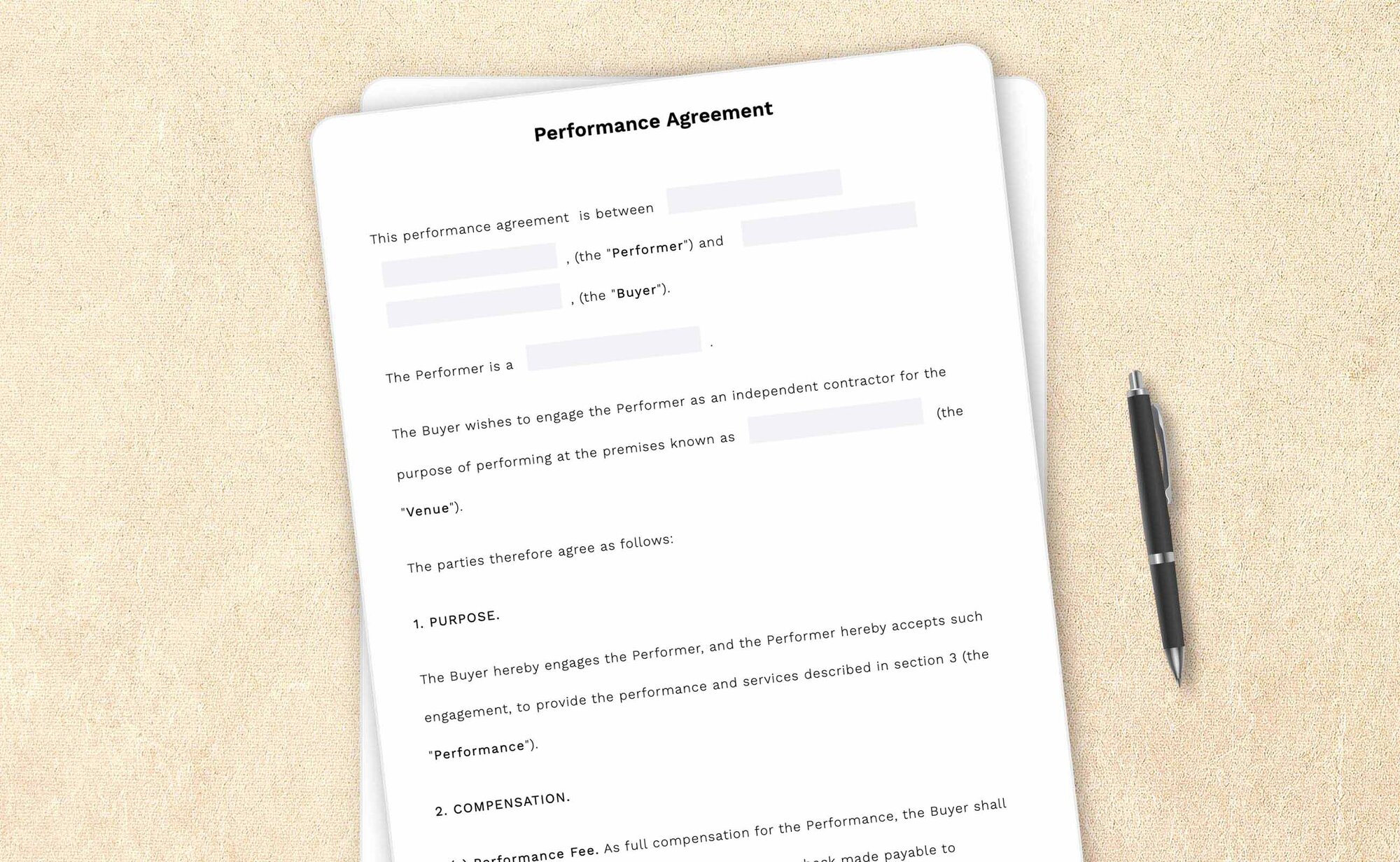
A performance agreement is a formal agreement that protects the parties' rights during the contracted term. Before finalizing the terms, however, it is crucial to discuss what the performer agrees to perform and the applicable rates.
1. Performance expectations and payment terms
As the hiring party, you must first decide your organizational goals and then the results-oriented goals. It can contain any agreed-on terms but should, at a minimum, include:
- A description of the performance and specific performance expectations
- The amount to be paid as the performance fees, the payment terms
- The location (performance venue), date, time, and duration of the performance
- Required equipment(s) along with specific requirements like sound check services for music concerts
- Timelines for venue set-up and take-down process
- Specific set-up requirements by the performer—dressing rooms, electricity, sound equipment, and lighting needs after discussing with the venue owner
- Insurance obligations
- Ticket sales figures, including gross sales of tickets, merchandise, and advertising
- Other miscellaneous requirements like arranging transportation, lodging, or meals for a performer
Clarify the terms and conditions of your agreement before memorializing them in writing. Use the professionally-vetted performance agreement template given on this page to start drafting your agreement. LegalZoom provides various other agreement form formats that are simple and easy to use for your personal and commercial needs.
2. Review and revisions
Allow each party to spend time reviewing the agreement once it is drafted. This will reduce the likelihood, or at least the efficacy, of a claim that a party didn't understand any terms or how those might affect the agreement as a whole.
3. Conformity with the laws
- If the performer is under 21, review your state's laws about agreements with minors and labor laws applicable to child performers.
- While creating your performance agreement, review your state's laws governing performers. In recent years, many states have enacted laws establishing precise requirements for the level of control an event organizer can have over performers.
- Review your state's law governing non-resident entertainers and performers. Some states require that a purchaser withhold taxes if the performer is from out of state.
- Review IRS regulations and other applicable federal laws if the performer is foreign.
4. Document records
Both parties must discuss the terms of their agreement, settling questions about the nature of the performance, services that'll be provided, payment process, and responsibilities of both parties.
Once the agreement is drafted, the parties must sign two copies. The hiring party keeps one, and the other is given to the performer.
Once you have agreed on contract terms and have signed the attached document, each party can focus on its area of expertise: the entertainer on the performance and the organizer on the event.
Understanding the clauses in performance agreements

The provisions provided below will guide you through the terms of performance agreements, section by section, to help you understand the process better.
1. Introduction
In this section, mention the relevant details of the involved parties and, if applicable, what type of organization(s) they're (e.g., individual, corporation, partnership). The party who hires the performer shall be addressed as the "purchaser," the party performing is called the "performer." Briefly describe the company's business here.
Additionally, you must provide the date the agreement will become effective (often when signed).
2. Purpose
Here, you explain why the parties are entering the agreement. This section confirms the parties' agreement that the performer will perform.
3. Compensation
This explains the parties' promise that the purchaser will pay for the performer's services, including the performance.
4. Date, time, and place of performance
This explains that additional information about the performance, like the date, time, venue size, and location, will be included in the agreement.
5. Responsibilities
This section lists each party's responsibilities under the agreement. This means that the performer agrees to provide the performance and related services with adequate attention and care to make it a great success. The purchaser agrees to provide assistance and appropriate workspace. You can also mention any additional obligations here.
6. Representations and warranties
This mentions the parties' promises under the agreement, which means that the parties agree to enter the agreement based on the conditions listed in this section.
7. Term
Indicates that the agreement will last until termination by either party or until the performance and payments are completed.
8. Termination
This section outlines the specific circumstances that would result in the termination of the agreement, such as providing written notice or committing a material breach (before the services and performances are completed or the end of the term). Mention the notice period a party must give for an earlier termination or to notify the other party of a breach.
The parties can terminate the contract if an event (like a fire, personal injury, accident, or earthquake) interferes with the performance or if the other party breaches an obligation and doesn't fix this breach. In both cases, the party seeking to end the contract must give written notice. Mention the duration of the notice period.
9. Additional services
This section indicates that if the purchaser wants to extend the performance or to include additional services, the purchaser will pay for these add-ons at the rates initially discussed by both parties.
10. Recording of performance
This section of the performance agreement explains that the purchasers will try to prevent photographing and videotaping of the performance unless the performer agrees to allow it.
11. Exclusive performance
This optional section prevents the performer from performing near the venue during a specific period. The purchaser can only allow this by giving specific written consent to outside performance.
12. Promotion
This optional section allows the purchaser to promote and advertise the performance, ensuring it achieves its intended success, and use the performer's name, picture, and biographical information.
13. Merchandise
This optional section mentions whether the performer can sell merchandise during the performance and the terms of doing so.
14. Right-to-end performance
This optional provision states that a performer reserves the right to stop the performance if they're legitimately concerned about someone's safety or the safety of their property.
15. Indemnification
This section states that if the performer causes a financial loss to the purchaser due to their performance, the performer will have to pay the compensatory damages. Such provision also applies to the purchaser. If the purchaser causes the performer a financial loss, they must make up for it by paying the compensatory damages to them. However, both parties will only be held responsible if they cause the problem on purpose.
16. Nature of the relationship
This part explains the relationship of the performer with the purchaser. It states that the performer isn't an employee, partner, or agent of the purchaser. The relationship clause is a critical distinction for legal reasons, including requirements for health insurance coverage, liability, and taxes. List any specific taxes the purchaser must or will withhold on the performer's behalf.
17. Authority to sign the agreement
This explains that if someone else is signing on behalf of the performer (for example, a manager, agent, or another party), that individual has the power and authority to sign the agreement for the performer.
18. Assignment
This section states that neither party may assign obligations and interests under the agreement without the other party's consent.
19. Successors and assigns
This section states that the parties' rights and obligations will be passed on to heirs or, in the case of companies, successor organizations, or organizations to which rights and obligations have been permissibly assigned.
20. Modification
This part of the agreement clarifies that any changes to the agreement are only effective if they're made in writing and signed by both parties.
21. Notice
This section mentions the respective addresses to which all official or legal correspondence should be delivered. Write the mailing address for both the performer and the purchaser.
22. Governing law
This section allows the parties to choose the governing laws of the state to interpret the document. Note that this isn't a venue provision.
23. No implied waiver
This clause states that if one party permits the other to disregard an obligation under the agreement, it doesn't waive any future rights of the other party to fulfill those or any other obligations.
24. Severability
This protects the terms of the agreement as a whole, even if one part is later invalidated. For example, if a state law is passed prohibiting choice-of-law clauses, it won't undo the entire document. Only the section of the agreement regarding choice of law would be nullified, while the rest remains enforceable.
25. Counterparts; electronic signatures
This clause may seem intricate, but it is easy to understand: It simply states that regardless of where the parties sign the agreement or how they transmit signatures (via electronic devices such as computers or fax machines), all of the separate pieces will be considered as part of the same agreement. This provision is beneficial today, where signing parties are often located in different cities and can't be physically present in the same room. It ensures that business can be conducted efficiently without compromising the validity of the agreement.
26. Entire agreement
The parties' agreement that the document they're signing is "the agreement" about the issues involved. Unfortunately, while this provision won't prevent a party from arguing that other enforceable promises exist, it'll protect you from these claims.
27. Headings
This section explains that the headings at the beginning of each section are meant to organize the document and shouldn't be considered operational parts of the performance agreement.
Frequently asked questions
What's a performance agreement?
A performance agreement details the responsibilities and expectations of the performer(s) and the party hiring them.
What are the essential elements of a performance agreement?
The agreement should cover essential elements such as the performance location, date, time, and promotional aspects. It should also specify the dispute resolution mechanism and the grounds on which performances may be canceled.
What information is needed to complete a performance agreement?
- Who it's coming from: Determine if a business or individual is sending the document and have the name and contact information ready
- Whom it's going to: Know who'll have the document, an individual or business, and keep the names and contact information ready
- Subject matter: Be clear about the general subject and terms of the agreement, including the performance itself, as well as fees, deposits, and other financial considerations
- Special circumstances: For a live performance, some unique conditions are often required to allow the performer to give their best performance. Be prepared for information relating to details such as dressing room accommodations, electrical and other tech requirements, and additional personnel. This will take a little time, but it's to protect your interests now so you don't have issues later
- Date and time: Have your requirements for the date and time of the performance, but also the length of the performance, breaks (if any), and the time to set up and take down

Performance Agreement Template

Related templates

Consignment Agreement
Protect the interests of both parties involved in a consignment relationship. A consignment agreement helps establish clear terms on the sale, promotion, or distribution of goods.

Distribution Agreement
Formalize the agreed-upon terms on how the distributors can promote, deliver, and sell your products. Create a distribution agreement and ensure that your products hit the right market at the right time.

Exclusive Sales Representative Agreement
Get your sales rep started on the right foot with an exclusive sales representative agreement. Clearly define terms for sales territory, products, targets, and commissions to boost your business and support your reps.

Independent Contractor Agreement
Clearly define project terms and responsibilities when hiring contractors for your company. An independent contract agreement helps to lay out work schedules, payment terms, and other essential details.

Non-exclusive Sales Representative Agreement
Clearly define territories, products, commissions, and other essential terms with a non-exclusive sales representative agreement. Ensure transparency and build successful partnerships with your sales executives.

Sale of Goods Agreement
Govern the terms of sale and purchase of goods with a sale of goods agreement. Outline the responsibilities of buyers and sellers throughout their partnership.