This bill of sale is between
The parties agree as follows:
1. SALE OF VEHICLE.
The Seller hereby sells to the Buyer and the Buyer purchases from the Seller, the following motorcycle (the "Motorcycle"):
- Location:
, - Make:
- Model:
- Motorcycle Engine No.:
- Year:
- Vehicle I.D. No. (VIN):
2. PURCHASE PRICE.
On or before the Delivery Date (as defined in section
3. SELLER'S REPRESENTATIONS.
The Seller represents to the Buyer that:
- (a) the Seller has good and marketable title to the Motorcycle, with full authority to enter into the transactions contemplated by this bill of sale and to sell the Motorcycle in accordance with this bill of sale;
- (b) the Motorcycle is free of all encumbrances, liabilities, and adverse claims
; , except held by , and held by , and held by , and held by , and held by ; - (c) the Seller will fully indemnify the Buyer from any lawful adverse claim to the Motorcycle
; and except for any claim of or or or or named in (b) above; and - (d) to the best of the Seller's knowledge, the information disclosed in this bill of sale about the Motorcycle and its title are correct in all material respects.
The individual signing this agreement on behalf of the Buyer represents to the Seller that he or she has the power and authority to complete this transaction on behalf of the Buyer.
Except for the representations provided in section 3, the Buyer acknowledges that the Motorcycle is being sold "as is," without warranty, whether express or implied, about the condition of the Motorcycle. The Buyer must satisfy itself as to what is offered for sale, and by purchasing will be held to have satisfied itself that the Motorcycle is satisfactory in all respects. All defects and repairs are the sole responsibility of the Buyer. The Seller neither assumes, nor authorizes any other person or entity to assume on its behalf, any liability in connection with the sale of the Motorcycle. The Seller's disclaimers of warranty do not affect the terms or applicability of any warranty from the Motorcycle's manufacturer that may be applicable to the Motorcycle.
The Motorcycle has
To the best of its knowledge, the Seller believes that the Motorcycle is being sold in good operating condition
The Seller shall deliver the Motorcycle, and the Buyer shall take possession of the Motorcycle, at the Seller's address as listed above, on or before
The Seller shall convey title to the Motorcycle to the Buyer when the Motorcycle is delivered to the Buyer and the Purchase Price has been paid in full. The Seller shall execute all documents presented by the Buyer that are necessary to finalize transfer of title and registration of the Motorcycle to the Buyer.
Unless prohibited by applicable law, the Buyer will cancel any insurance coverage, license, tags, plates, or registration maintained by the Seller on the Motorcycle when the Buyer takes possession of the Motorcycle.
This bill of sale will become effective when all parties have signed it. The date this bill of sale is signed by the last party to sign it (as indicated by the date associated with that party's signature) will be deemed the date of this bill of sale.
[SIGNATURE PAGE FOLLOWS]
Each party is signing this bill of sale on the date stated opposite that party's signature.
Date: _________________ |
By:__________________________________________ |
| Name: |
|
Date: _________________ |
By:__________________________________________ |
| Name: |
|
[PAGE BREAK HERE]
ODOMETER DISCLOSURE STATEMENT
The Seller hereby discloses to the Buyer that at the time of the transfer, the odometer read
- Make:
- Model:
- Motorcycle Engine No.:
- Year:
- Vehicle I.D. No. (VIN):
| Seller's Information: | Buyer's Information: |
Name: |
Name: |
| Address: |
Address: |
| City: |
City: |
| State: |
State: |
| ZIP Code: |
ZIP Code: |
Signatures: |
|
_______________________________________________ |
_______________________________________________ |
| Seller | Date |
_______________________________________________ |
_______________________________________________ |
| Buyer | Date |
How-to guides, articles, and any other content appearing on this page are for informational purposes only, do not constitute legal advice, and are no substitute for the advice of an attorney.
Motorcycle bill of sale: How-to guide
A motorcycle bill of sale is a legally binding document that documents the transfer of a motorcycle from one owner to another. It records the terms and conditions that the buyer and seller agreed upon and acts as proof of the transaction.
The purpose of a motorcycle bill of sale is to document the sale process of a motorcycle and establish a legal record of the transaction. It outlines important details such as the buyer and seller information, motorcycle description, purchase price, and payment details. In this guide, we will look at all the components of this document, why and when you need it, the laws associated with it, and how to create one efficiently. Let’s dive in.
What are the elements of a motorcycle bill of sale?
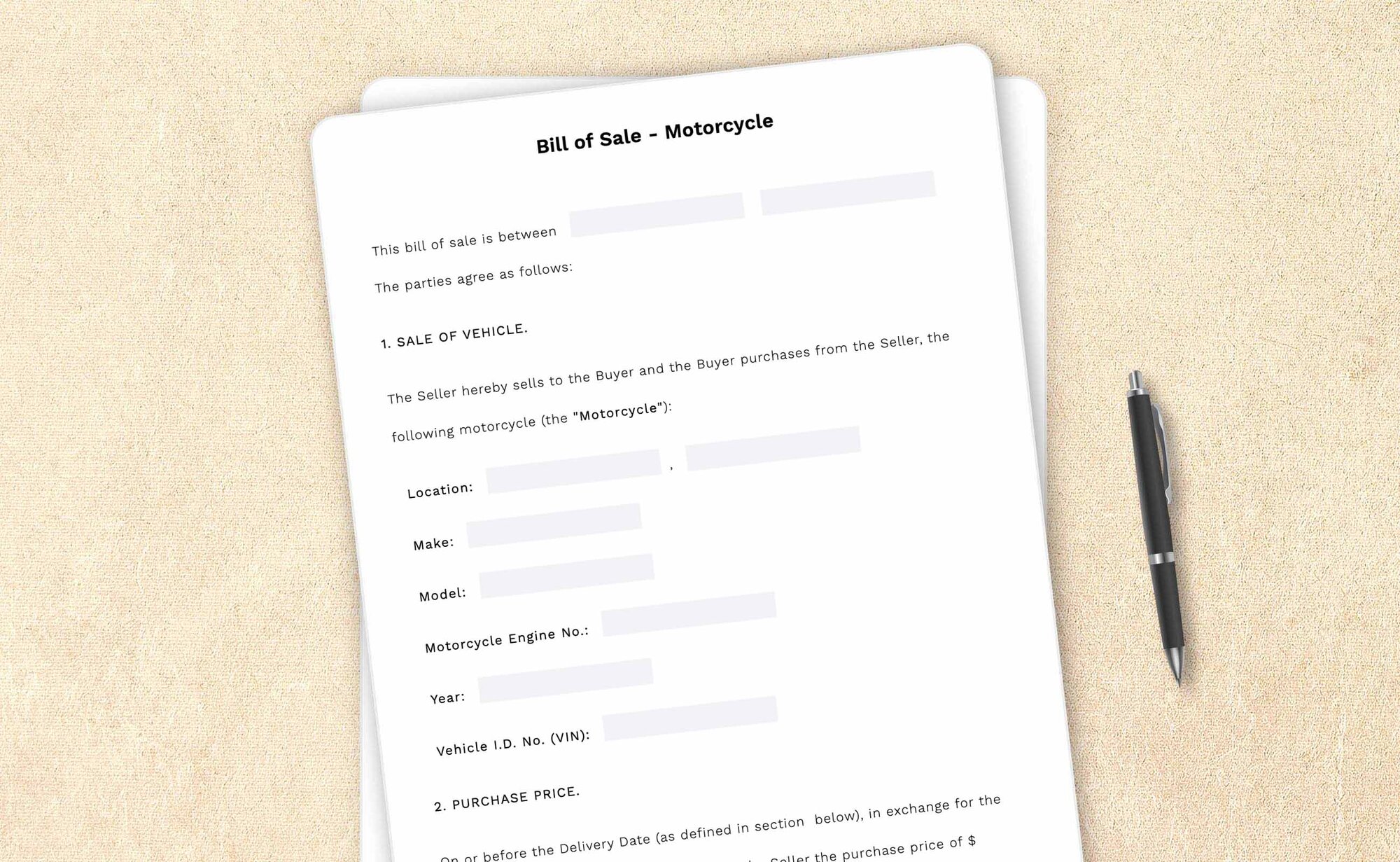
A simple motorcycle bill of sale or the sale form typically includes the following elements:
1. Buyer and seller information
First and foremost, it's necessary to include the full names and addresses of both the buyer and seller. Make sure to add contact information such as phone numbers and email addresses.
2. Model and make of the motorcycle
Clearly state the make (brand) and model of the motorcycle being sold. This information helps identify the specific vehicle involved in the transaction.
3. Vehicle Identification Number (VIN)
Include the unique Vehicle Identification Number (VIN) or the model vehicle identification number assigned to the motorcycle. The VIN serves as a distinct identifier for the vehicle and helps prevent confusion or misidentification.
4. Date of sale
In the sale form, indicate the date of the sale transaction. This helps determine the date of ownership transfer and ensures clarity on the sale's timing.
5. Purchase price and payment method
Clearly state the agreed-upon listing price for the motorcycle in both numeric and written form. Additionally, specify the method of payment (e.g., cash, check, money order) agreed upon by the buyer and the seller.
6. Signatures of buyer, seller, and notary public (if applicable)
Both the buyer and seller will have to sign the bill of sale in order to acknowledge their agreement to the terms of the transaction. If required by state law or for added legal validity, the document may need to be signed and notarized by a notary public.
A sample motorcycle bill of sale is attached at the top of this page for your reference.
Important tips for a motorcycle bill of sale
Creating and using a motorcycle bill of sale or the sale form involves a few important steps:
Filling out the form correctly: Make sure that all required information is entered and that all fields on the bill of sale form are accurately filled out. Include all of the above-mentioned information, including the seller's and buyer's names, motorcycle description, listing price, and payment method.
Retaining copies for both parties: Once the bill of sale is ready, make copies for the buyer's and seller's records. This allows all parties to have documentation of the deal for use later or for legal purposes.
Compliance with the laws: Compliance with legal regulations is important to prevent future legal problems or disputes. Failure to align with applicable laws may result in penalties, fines, or the sale being declared invalid.
Making the contract legally binding: A properly executed bill of sale ensures that the sale transaction is legally binding. This includes accurately recording the conditions of the sale, obtaining the required signatures, and following any state-mandated notarization or witness requirements.
Why do you need a motorcycle bill of sale?
A motorcycle bill of sale is essential for several reasons:
1. Legal protection for buyer and seller
It covers the rights of both the buyer and the seller by listing the terms and conditions of the motorcycle sale in a legal document. In case of a dispute or disagreement, this bill of sale serves as a written record of the agreed-upon terms.
2. Proof of ownership transfer
The bill of sale acts as evidence that ownership of the motorcycle has been transferred from the seller to the buyer. This documentation is crucial for the buyer to register the motorcycle in their name and obtain a new title.
3. Documentation for the registration process
Many states ask for a bill of sale as part of the paperwork to register a motorcycle in the buyer's name. The buyer may face delays or denials in the registration procedure if there isn't a valid bill of sale.
4. Preventing disputes and fraud
By documenting the sale details, including the asking price, payment method, and condition of the motorcycle, the bill of sale helps prevent disputes and fraudulent activities. It provides clarity and transparency to the transaction, reducing the risk of misunderstandings or misrepresentations.
When do you need a motorcycle bill of sale?
A motorcycle bill of sale is necessary in various situations:
1. Selling a used motorcycle privately
A bill of sale is crucial when selling a used motorcycle directly to another individual without involving a dealership or third-party seller. It documents the sale agreement, protects both parties' interests, and provides legal proof of the transaction.
2. Buying or selling across state lines
If the buyer and seller reside in different states, a bill of sale may be required as part of the documentation for transferring ownership across state lines. It helps ensure compliance with state-specific laws and regulations governing vehicle sales.
3. Transferring ownership to a family member or friend
Even in informal transactions between family members or friends, transferring ownership of a motorcycle should involve a bill of sale.
4. Completing paperwork for registration or title transfer
Most states require a bill of sale when applying for registration or transferring the title of a motorcycle to a new owner. The bill of sale provides essential details needed by the Department of Motor Vehicles (DMV) or relevant authorities to process the registration or title transfer.
Where to obtain a motorcycle bill of sale form?
When in need of this sales document, consider the following sources:
1. Online platforms and resources like the LegalZoom templates
Utilize online platforms and resources that offer customizable templates for creating a motorcycle bill of sale. Platforms like LegalZoom provide easy-to-use bill of sale templates that can be tailored to meet specific needs. You can just follow the guided questionnaire and fill it out, customize it via the rich editor as per your requirements, and download the printable motorcycle bill of sale form in PDF format.
2. Local Department of Motor Vehicles (DMV)
Visit your local Department of Motor Vehicles (DMV) office, where you may find official forms and documents related to vehicle transactions, including bill of sale forms. DMV offices often provide resources and guidance for completing paperwork related to vehicle sales.
3. Legal document services and professional assistance from attorneys or notaries
Consider seeking professional assistance from attorneys who specialize in preparing and customizing legal documents like bill of sale forms. These services can provide professional guidance and ensure that the document complies with relevant laws and regulations.
Legal regulations governing motorcycle bill of sale
Understanding the legal regulations governing the sale form is crucial to maintaining compliance:
Understanding relevant U.S. laws
To make sure the transaction is carried out lawfully and without incident, it is important that you get familiar with the federal laws related to motorcycle sales. These rules, such as consumer protection laws and regulations, protect both buyers and sellers by setting clear guidelines for transactions.
For example: A buyer may wish to purchase a used motorcycle from a private seller. If the seller fails to disclose that the motorcycle has a salvage title, the buyer might face unexpected issues when trying to register the motorcycle.
When a vehicle has significant damage from an accident, flood, theft, or other event, an insurance company declares it as a total loss and issues a salvage title. These automobiles are normally considered hazardous to drive until they have been repaired and passed state inspections. After being restored, a salvage title can occasionally be rebranded as a rebuilt title, allowing the vehicle to be lawfully driven and registered.
Under federal consumer protection laws, such as the Federal Trade Commission (FTC) rules, sellers are required to provide accurate and truthful information about the vehicle's condition. Failure to comply could lead to disputes, financial losses, or legal penalties for the seller.
By understanding these laws, the buyer could request a vehicle history report or ensure that the bill of sale includes a clause verifying the condition of the motorcycle. This proactive step helps prevent misunderstandings, protects the buyer’s investment, and ensures the transaction is fully compliant with legal standards.
Uniform Commercial Code (UCC)
The Uniform Commercial Code (UCC), adopted by all states in some form, provides guidelines for commercial transactions, including the sale of goods like motorcycles. It outlines rules for contracts, warranties, and remedies in case of disputes.
State-specific regulations
Each state has laws and regulations governing vehicle sales, including requirements for documentation like the bill of sale. Complying with state-wise regulations is essential to ensure the legality of the transaction.
Tips for buying or selling a motorcycle
When buying or selling a two-wheeler, consider the following tips to ensure a smooth and successful transaction:
1. Conducting a test drive
Before finalizing the purchase, always conduct a test drive to assess the motorcycle's performance, handling, and overall condition. This allows the buyer to experience firsthand how the two-wheeler operates and identifies any potential issues.
2. Inspecting the motorcycle for any damage or missing parts
Thoroughly inspect the two-wheeler for any signs of damage, wear, or missing parts. Check crucial components such as brakes, tyres, lights, and engines for functionality and condition. Address any concerns before finalizing the sale.
3. Negotiating the purchase price
Be prepared to negotiate the price of purchase based on the motorcycle's condition, market value, and any additional features or accessories. Both the buyer and seller should communicate openly and fairly to reach a mutually acceptable price.
4. Using secure payment methods
For the transaction, pick safe payment options like cash, cashier's check, or electronic funds transfer (such as a bank transfer). Avoid making big purchases with cash, and make sure the money is sent and received safely.
5. Verifying the seller's ownership and title
Before closing the deal, confirm that the seller is the legitimate owner of the motorcycle and that the title is still valid. Make sure the title matches the seller's name and the vehicle details by requesting to see it. Additionally, make sure that the motorcycle is free of any liens or unpaid bills.
How to verify the motorcycle’s history before buying?
Before finalizing a private sale, potential buyers need to verify the motorcycle's history. Make sure to cover the following checks:
- Checking the VIN: Buyers should use the VIN to check the motorcycle’s history, including any past accidents, theft records, or recalls. This adds an extra layer of security before completing the sale.
- Reviewing service and maintenance records: Review service records to ensure the motorcycle has been well-maintained.
- Obtaining a vehicle history report: Buyers can consider purchasing a vehicle history report from multiple platforms to get a complete picture of the motorcycle’s past.
Additional documents required for the motorcycle sale
1. Title certificate
- Purpose: The motorcycle's ownership is attested by the title document. The buyer must get the original title from the seller, and in order to formally transfer ownership, both parties may need to sign the back of the title.
- Importance: Without the title, the buyer may face challenges when registering the motorcycle in their name.
2. Odometer disclosure statement
- Purpose: This statement records the motorcycle's mileage at the time of sale. It is often required by state laws to prevent odometer fraud.
- Importance: Providing an accurate odometer reading ensures transparency and helps avoid legal issues related to mileage discrepancies.
3. Lien release (if applicable)
- Purpose: If the motorcycle was financed and the loan has been paid off, the seller must provide a lien release document from the lender. This document confirms that there are no outstanding debts or liens on the motorcycle.
- Importance: A lien release is necessary to clear the title and ensure the buyer can register the motorcycle without issues.
4. Proof of identity
- Purpose: Both the buyer and seller should have valid identification, such as a driver's license or passport, to verify their identities during the transaction.
- Importance: Confirming identities helps prevent fraud and ensures that the transaction is conducted between legitimate parties.
5. Emissions certificate (if required by state)
- Purpose: In some states like California, motorcycles must pass an emissions test before they can be sold. The seller may need to provide an emissions certificate to show that the motorcycle meets environmental standards.
- Importance: Compliance with emissions regulations is essential for the buyer to register the motorcycle in certain states.
6. Insurance documentation
- Purpose: The seller should cancel their motorcycle insurance policy after the sale, while the buyer needs to obtain new insurance coverage. Providing proof of insurance helps facilitate this process.
- Importance: Insurance is legally required in most states for motorcycle operations, making it a necessary step in the transaction.
7. Sales tax documentation
- Purpose: Some states like Texas, Illinois, and California require the payment of sales tax on private vehicle sales. The buyer may need to present a receipt or documentation showing the tax amount paid during registration.
- Importance: Ensuring that the correct sales tax is paid is essential for legal compliance and a smooth registration process.
Conclusion
Finally, the motorcycle bill of sale is an important document in the buying and selling of motorcycles. It provides both the buyer and the seller clarity and protection by creating a legal record of the transaction. It outlines the terms and conditions agreed upon, including the price of buying, the method of payment, and vehicle details.
By creating and using this bill of sale, both parties can ensure a smooth and legally compliant transaction. The document helps prevent misunderstandings, disputes, and fraudulent activities by putting the details of the sale in writing.
Frequently asked questions
How to write a sale agreement for a motorcycle?
To write a sale agreement for a motorcycle, including essential data such as buyer and seller information, motorcycle description, buying price, the method of payment, and signatures. Ensure clarity, legality, and compliance with relevant laws and regulations.
Is the sale agreement valid?
Yes, it is considered valid if the sale agreement is properly executed, contains all necessary elements, and complies with relevant laws.
What should I do if I lose my motorcycle bill of sale?
If you lose your original bill of sale, you should immediately request a copy from the other party involved in the transaction. It’s also advisable to write down key details of the sale, such as the date, parties involved, and motorcycle information, for future reference.
Do I need a motorcycle bill of sale for a gift or donation?
Yes, even if you are gifting or donating a motorcycle, a bill of sale is necessary to transfer ownership legally. The sale price may be listed as $0, but all other information, including signatures, must be included.
How can I verify that the seller is the rightful owner of the motorcycle?
Before completing the transaction, ask the seller for the motorcycle’s title and verify that the name on the title matches the seller’s identification. Additionally, check for any liens or outstanding loans on the vehicle.

Motorcycle Bill of Sale Template

Related subcategories
Related templates

Automobile Bill of Sale with Promissory Note
Transfer ownership of an automobile from a seller to a buyer with a bill of sale. Seal the deal confidently.

Boat Bill of Sale
Transfer boat ownership easily with a boat bill of sale. Our template helps you create a comprehensive bill of sale with the boat's specifications, purchase price, representation, delivery details, and more.

Cat Bill of Sale
Simplify the process of officially adopting a cat with a cat bill of sale. Ensure a smooth ownership transfer.

Dog Bill of Sale
Simplify the process of officially adopting a new furry family member. A dog bill of sale serves as proof of purchase and transfer of the dog's ownership.

Vehicle Bill of Sale
Ensure a smooth ownership transfer of your automobile with a vehicle bill of sale.