This partnership dissolution agreement is between
RECITALS
The partnership was formed under the laws of
Under the terms of the Partnership Agreement, Partner Two made capital contributions totaling $
Under the terms of the Partnership Agreement, the Partners have
The partners now wish to dissolve the Partnership.
The partners therefore agree as follows:
1. DISSOLUTION.
2. TERMINATION OF BUSINESS.
Except for the purposes of carrying out the winding-up and liquidation of the Partnership, no partner may transact any business or incur any obligations on behalf of the Partnership after the effective date of this agreement, as provided in section
3. LIQUIDATING PARTNER
- (a) Naming of Liquidating Partner
s .Partner One Partner Two Partner Three Partner Four Partner Five The partners collectively and Partner One Partner Two Partner Three Partner Four Partner Five Partner Five and Partner One Partner Two Partner Three Partner Four Partner Five Partner Five and Partner One Partner Two Partner Three Partner Four Partner Five Partner Five (the "Liquidating Partners ") shall coordinate and besolely responsible for the liquidation of the Partnership Assets, the satisfaction of the Partnership Liabilities, and any other acts reasonably required to wind up the affairs of the Partnership. - (b) Timing. The Liquidating Partner
s shall useits their best efforts to complete the liquidation of the Partnership by. - (c) Powers of Liquidating Partner
s . The Liquidating Partners may:- (i) sell, transfer, or otherwise dispose of all of the Partnership's assets, in whole or in part, including its goodwill and name, for cash or a cash equivalent at a price and on terms that the Liquidating Partner
s deems necessary or appropriate to accomplish and order and timely liquidation; - (ii) act on behalf of the Partnership in all matters affecting the Partnership during the winding-up period, including the power to engage professional and technical services of others, and to institute and defend any legal proceedings that may be pending or brought by or against the Partnership;
- (iii) prepare, sign, file, record, and publish on behalf of the Partners and the Partnership any agreements, documents, or instruments connected with the dissolution and winding up of the business and affairs of the Partnership, including the publication of a notice of dissolution in a local newspaper and submitting a statement of dissolution to the Secretary of State;
- (iv) pay or otherwise settle all obligations and liabilities of the Partnership, whether known or unknown, whether asserted or unasserted, whether absolute or contingent, whether accrued or unaccrued, whether liquidated or unliquidated and whether due or to become due (collectively, the "Partnership Liabilities");
- (v) distribute any Partnership assets, rights, and properties owned by the Partnership on the Dissolution Date whether tangible or intangible, real, personal, or mixed, wherever located, and whether or not carried and reflected on the books of the Partnership, including all accounts receivable, inventory, equipment and improvements, contract rights, claims, and causes of action or rights of recovery or set-off of every kind and character, and all business records (collectively, the "Partnership Assets"), including the proceeds of any sale of assets remaining after payment of obligations; and
- (vi) take all other action necessary to the previous powers or the performance of the duties of the Liquidating Partner
s under this agreement.
- (i) sell, transfer, or otherwise dispose of all of the Partnership's assets, in whole or in part, including its goodwill and name, for cash or a cash equivalent at a price and on terms that the Liquidating Partner
- (d) Duties of Liquidating Partner
s . The Liquidating Partners shall devote as much time asit they deems necessary to liquidate the Partnership and shall:- (i) devote as much time as necessary to liquidate the Partnership as required by law and this agreement;
- (ii) provide
weekly semi-weekly monthly reports apprising the remaining partners about the status of the dissolution; - (iii) conduct and provide the other partners with an inventory of the Partnership Assets
no later than ; - (iv) provide the Partnership with an statement of account for the Partnership, which will include complete information about the Partnership Assets and Partnership Liabilities, and will become a matter of record in the Partnership's books
, no later than ; - (v) prepare and file all required federal, state, and local tax returns;
- (vi) pay all of the Partnership Liabilities; and
- (vii) distribute the Partnership Assets remaining after paying the Partnership Liabilities, if any, to the partners, pro rata in accordance with their respective ownership interests in the Partnership and with the procedures provided in the Partnership Agreement
, no later than .
- (i) devote as much time as necessary to liquidate the Partnership as required by law and this agreement;
- (e) Salary. As compensation for serving as the Liquidating Partner
s , the Liquidating Partners shall receive the sum of $. This compensation is an expense of winding up the Partnership's business and will not be charged to the capital account s of the Liquidating Partners as a withdrawal.
- (a) Of Each Other Partner. Each partner hereby indemnifies each other partner against any award, charge, claim, compensatory damages, cost, damages, exemplary damages, diminution in value, expense, fee, fine, interest, judgment, liability, settlement payment, penalty, or other loss (a "Loss") or any attorney's or other professional's fee and disbursement, court filing fee, court cost, arbitration fee, arbitration cost, witness fee, and each other fee and cost of investigating and defending or asserting a claim for indemnification (a "Litigation Expense") suffered by the other partner as a result of the partner's failure to pay and discharge any part of a Partnership Liability that the partner has assumed under this dissolution agreement.
- (b) Of the Liquidating Partner
S . Each partner hereby indemnifies the Liquidating Partners against any Loss or Litigation Expense relating toits their work in liquidating this Partnership, unless those Losses or Litigation Expenses result from the Liquidating Partners breach of this contract or unethical behavior.
The parties hereby release and forever discharge one another from all claims, demands, actions, losses, or damages relating to the Partnership. However, each partner remains responsible for any claims, demands, actions, losses, or damages arising or resulting from the terms of this dissolution agreement.
During the Partnership, the partners may have used services or equipment to complete tasks related to the Partnership, free of charge. The partners shall return these services or equipment to the Liquidating Partner
- (a) Choice of Law. The laws of the state of
govern this agreement (without giving effect to its conflicts of law principles). - (b) Choice of Forum. The parties consent to the personal jurisdiction of the state and federal courts in
, .
No amendment to this agreement will be effective unless it is in writing and signed by both parties.
If any provision in this agreement is, for any reason, held to be invalid, illegal, or unenforceable in any respect, that invalidity, illegality, or unenforceability will not affect any other provisions of this agreement, but this agreement will be construed as if the invalid, illegal, or unenforceable provisions had never been contained in this agreement, unless the deletion of those provisions would result in such a material change that would cause completion of the transactions contemplated by this agreement to be unreasonable.
- (a) Writing; Permitted Delivery Methods. Each party giving or making any notice, request, demand, or other communication required or permitted by this agreement shall give that notice in writing and use one of the following types of delivery, each of which is a writing for purposes of this agreement: personal delivery, mail (registered or certified mail, postage prepaid, return-receipt requested), nationally recognized overnight courier (fees prepaid), facsimile, or email.
- (b) Addresses. A party shall address notices under this section to a party at the following addresses:
- If to Partner One:
,
-
- If to Partner Two:
,
- If to Partner Two:
-
If to the Partner Three: ,
-
If to Partner Four: ,
-
If to Partner Five: ,
- (c) Effectiveness. A notice is effective only if the party giving notice complies with subsections (a) and (b) and if the recipient receives the notice.
No waiver of a breach, failure of any condition, or any right or remedy contained in or granted by the provisions of this agreement will be effective unless it is in writing and signed by the party waiving the breach, failure, right, or remedy. No waiver of any breach, failure, right, or remedy will be deemed a waiver of any other breach, failure, right, or remedy, whether or not similar, and no waiver will constitute a continuing waiver, unless the writing so specifies.
This agreement constitutes the final agreement of the parties. It is the complete and exclusive expression of the parties' agreement with respect to the subject matter of this agreement. All prior and contemporaneous communications, negotiations, and agreements between the parties relating to the subject matter of this agreement are expressly merged into and superseded by this agreement. The provisions of this agreement may not be explained, supplemented, or qualified by evidence of trade usage or a prior course of dealings. Neither party was induced to enter this agreement by, and neither party is relying on, any statement, representation, warranty, or agreement of the other party except those set forth expressly in this agreement. Except as set forth expressly in this agreement, there are no conditions precedent to this agreement's effectiveness.
The descriptive headings of the sections and subsections of this agreement are for convenience only, and do not affect this agreement's construction or interpretation.
This agreement will become effective when all parties have signed it. The date this agreement is signed by the last party to sign it (as indicated by the date associated with that party's signature) will be deemed the date of this agreement.
Each party shall use all reasonable efforts to take, or cause to be taken, all actions necessary or desirable to consummate and make effective the transactions this agreement contemplates or to evidence or carry out the intent and purposes of this agreement.
[SIGNATURE PAGE FOLLOWS]
Each party is signing this agreement on the date stated opposite that party's signature.
| Date:__________________________________ | By:____________________________________________________________ |
| Name: |
|
| Date:__________________________________ | By:____________________________________________________________ |
| Name: |
|
How-to guides, articles, and any other content appearing on this page are for informational purposes only, do not constitute legal advice, and are no substitute for the advice of an attorney.
Partnership dissolution agreement: How-to guide
A change in the business climate or individual goals may signal that it’s time to terminate a partnership and release the parties from their duties. If one of the partners retires, dies, or enters bankruptcy, the partnership may be dissolved automatically under the terms of the existing partnership agreement.
Alternatively, the partnership’s objectives may have been met, and the parties’ official relationship may no longer be necessary. Whatever the reason, a clean break will give peace of mind to all parties, discharging any remaining obligations and concluding the arrangement amicably.
Note that dissolutions don't end in themselves; they may open avenues of discussion with the other party or parties. You can review your mutual expectations and concerns, perhaps even laying the groundwork for future partnerships or agreements. Indeed, the termination of the partnership may signal a business’s success, but the end of the partnership may be the beginning of a new phase.
A well-drafted partnership dissolution agreement can terminate the parties’ commitments and help prevent future agreement conflicts. This article is designed to help you create such an agreement that will work for you and your business, but it is also just a starting point. Consult with your business partners or attorney to construct a dissolution agreement that suits your needs.
Points to note while drafting a partnership dissolution agreement
1. State the reason for your business partnership dissolution
The procedure for dissolving your business relationship depends on why you're dissolving. The original partnership agreement should provide specific details about termination procedures for several different circumstances. In some cases, you and your partners may need to take an official vote to make the dissolution effective.
Review your state's business regulations for additional assistance if your agreement doesn’t cover the procedures that apply to your situation. It is essential to ensure your partnership is completely and correctly dissolved, or your obligations under the arrangement will continue.
2. Verify the completion of duties
Ensure you and the other partners have performed your duties under the original agreement before signing the dissolution. Once the dissolution has been signed, the original agreement is void. Review the original agreement and draft a list of the partnership’s assets, rights, and duties. Take a moment to ensure that your interests have been satisfied.
3. File a statement of dissolution
It is essential to file a statement of dissolution (sometimes called a Certificate of Cancellation) with the government agency with which your business was initially registered. Check with your county clerk and secretary of state’s office for additional information about requirements in your area and applicable termination fees.
4. Cancel all licenses and permits
Terminate (or transfer) your partnership’s permits, licenses, and fictitious business name registrations. For example, a seller’s permit or a business license should be canceled by the agency that issued it. Abandoning a fictitious business name may require additional steps, including notification of your county recording officer and publication of the abandonment in your local newspaper.
5. Inform your employees about the dissolution
To dissolve the partnership, informing colleagues that the partners will no longer be responsible for each other’s debts and obligations is vital. Give actual written notice of the dissolution to all of the partnership’s suppliers, customers, and clients. Don’t assume that publishing a public notice of the dissolution in a newspaper (or where your state laws may otherwise require) is sufficient; in many cases, it is not.
Generally, the partner initiating the dissolution is responsible for sending notice of the end of the partnership. The remaining partners will take care of winding up activities for the partnership.
6. Check all partnership assets
Examine existing contracts, leases, loan agreements, and remaining assets when dissolving a partnership to see how your dissolution will affect them.
Agreements may contain provisions making them void if the partnership dissolves. Alternatively, those agreements may indicate that the partners must continue to perform during the contract period, even if the partnership is terminated. Consider assigning those agreements to two or more partners individually. In some cases, performing under the contract will be taken as a sign that the partnership hasn't been terminated, and new obligations may be forced onto the dissolved partnership.
7. Deposit payroll taxes
If you have (or had) employees in the partnership’s business, make sure that all payroll tax deposits have been made and that all of your employment tax paperwork is complete and on time. Inform all local, state, and federal tax agencies about the dissolution of your business.
8. Consult your accountant
The dissolution of a partnership can have severe tax and legal consequences. Talk with your accountant and lawyer before entering into a dissolution agreement for additional information about how those consequences might affect you and your business.
9. Review the partnership agreement
Both parties should be allowed enough time to read and sign the document carefully and to consult with a lawyer if needed. Doing so will lower the chances, or at least the effectiveness, of an argument that one party wasn't aware of the terms of the dissolution agreement.
10. Sign the separation agreement
Once all partners agree and sign the agreements, each partner should be given at least one original, signed copy of the dissolution agreement. Keep a copy of the signed partnership dissolution agreement with the original written agreement. Once the dissolution has been drafted and signed, it is the concluding part of the original agreement, and the agreement supersedes all oral agreements previously contracted.
Depending on the nature of its terms, you may decide to have your partnership dissolution agreement witnessed or notarized. This will limit later challenges to the validity of a party’s signature.
If the original agreement or the conditions of your dissolution are complicated, contact an attorney to help you draft a document that will meet your specific needs.
Key elements in a partnership dissolution agreement
The following instructions will help you understand the terms of your agreement. Please review the entire document before beginning your step-by-step process.
1. Introduction of parties
This section identifies the document as a dissolution agreement. Herein, add the effective date when the agreement was signed. If one or more partners enter into the agreement, add their information as well.
2. Recitals
The “whereas” clauses, referred to as recitals, define the world of the agreement and provide key background information about the parties. Add information such as the purpose of the partnership and the total capital contributions made by all partners before or during the working relationship.
If your prior agreements don’t have information about termination procedures, review your state’s laws governing partnership dissolution for additional assistance.
3. Dissolution
This section allows you to provide critical details about the partnership as a legal entity. Provide the name of your partnership and the state in which the entity was established. Add the current business address of your partnership.
4. Winding up
In this section, provide the specifics of the partnership’s dissolution, explaining that each partner will assume assets and liabilities in proportion to their interests. If you and the other partner want to construct a different arrangement—with one partner assuming more of the partnership’s assets and responsibilities—you can add it in this section.
5. Liquidating partners
This section allows the parties to assign (or share) primary responsibility for the administrative tasks of dissolution. You can also describe the tasks the liquidating partner will need to complete (e.g., termination of leases, filings with the state or local agencies, publication of dissolution notice in a newspaper, etc.).
6. Custodian of partnership books
In this provision, the partners involved can decide which of you will be responsible for the partnership’s records after the dissolution.
7. Indemnification
Here, as part of the dissolution, the partners agree to split the partnership's assets and debts on a pro-rata basis between them. This section guards against one party defaulting on its pro-rata share of obligations. If one party defaults, that individual will be forced to reimburse its partners for payments they made to cover that default.
8. Release and discharge
This section indicates that neither partner can bring a claim against the other for partnership-related issues after the dissolution. However, this section allows the parties to bring suit under the dissolution agreement (e.g., for failing to complete an obligation relating to dissolution) and related to the dissolution itself.
9. Amendments
This provision indicates that all changes to the agreement must be in writing and signed by all partners.
10. Governing law
This clause allows the parties to choose their state governing laws that will be used to interpret the document.
11. No implied waiver
In this section, explain that even if one party allows the other to ignore or break an obligation under the agreement, it doesn't mean that the party waives any future rights to require the other to fulfill those (or any other) obligations.
12. Counterparts; electronic signatures
This section mentions that even if the partners sign the agreement in different locations, manually or electronically, all the pieces will be considered part of the same agreement. This provision ensures that business can be transacted efficiently without sacrificing the agreement’s validity as a whole.
13. Severability
This clause protects the terms of the agreement as a whole, even if one part is later invalidated. For example, if a state law is passed prohibiting choice-of-law clauses, it won't undo the entire agreement. Instead, only the section dealing with the choice of law would be invalidated, leaving the remainder of the contract enforceable.
14. Headings
This section clarifies that the headings at the beginning of each section are organizational and not operational components of the agreement.
15. Entire agreement
The partners’ agreement that the document they’re signing is “the agreement” about the issues involved.
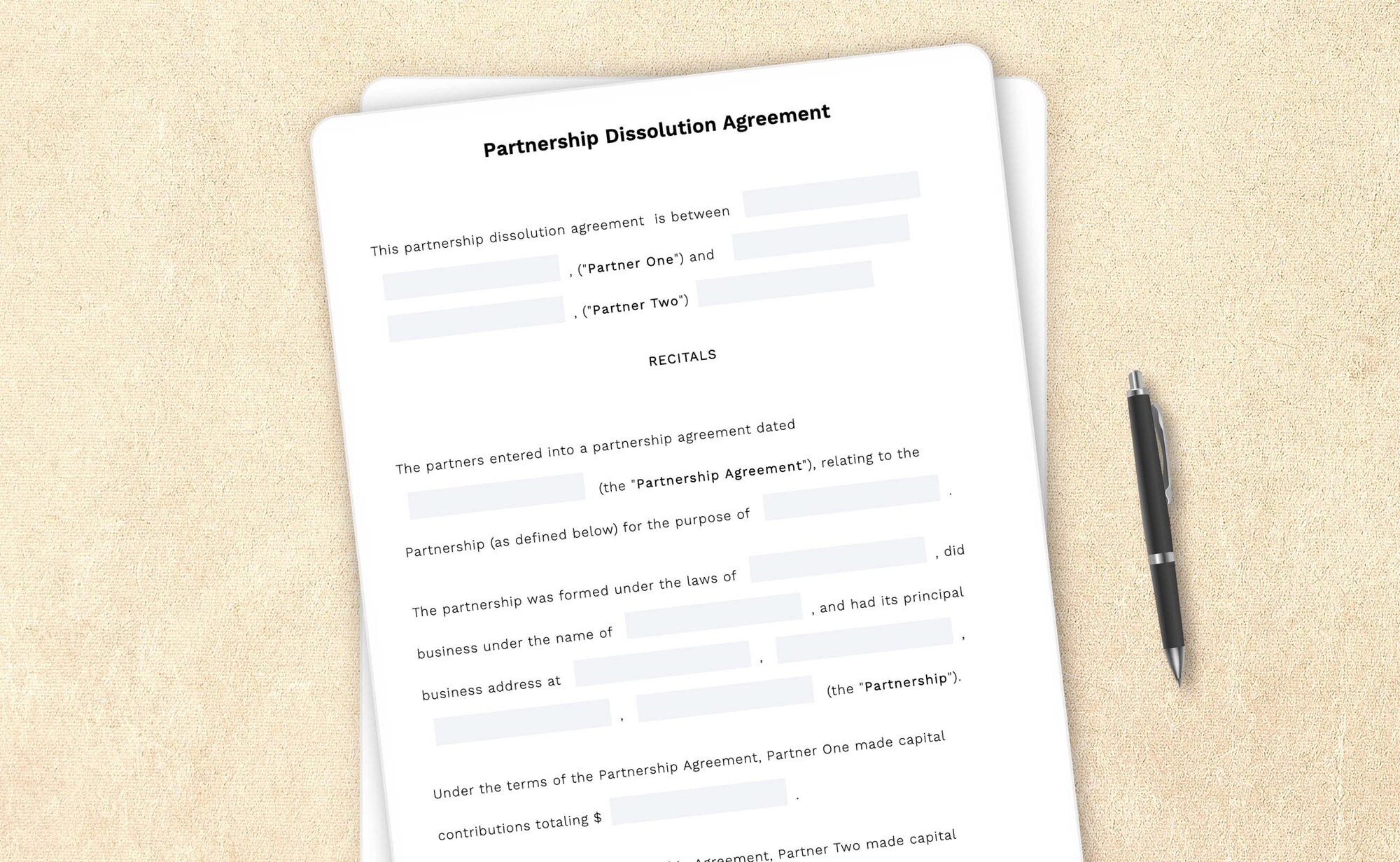
Including all relevant deal points in the document is important, even if it means being overly inclusive. Don't assume that any expectations or terms are agreed upon unless explicitly stated. You can use LegalZoom’s partnership dissolution agreement template provided on the page as a starting point to draft your document. LegalZoom’s simple agreement sample can be filled out easily. Just add the essential details on the blank placeholders provided, and if you want to edit the document, do it with the help of the rich editor and complete the document with ease.
Frequently asked questions
What is a partnership dissolution agreement?
The dissolution of a partnership might signal the start of a new chapter, the end of one that wasn't working, or even the restructuring of a booming business. Whatever the reason, a partnership dissolution agreement (also known as a partnership termination agreement) ties up the end of a business partnership, helps protect against disputes, and provides peace of mind.
What are the requirements for dissolution of partnership?
Here's the information you'll need to complete your partnership dissolution agreement:
- Who the partners are: Have their names and contact information ready
- Who the liquidating partners are: Have their names ready and any applicable deadlines
- Whether there's a records custodian: If you appoint one, have their information and deadlines ready

Partnership Dissolution Agreement Template

Related subcategories
Related templates

Amendment of Agreement
Revise your existing contracts with ease! Our amendment of agreement template lets you update terms based on your needs. Stay flexible and adapt to changing circumstances.

Assignment of Agreement
Transfer work responsibilities efficiently with an assignment of agreement. Facilitate a smooth transition from one party to another.

Consulting Services Agreement
Establish clear terms of service for successful engagements with consultants. Define the working relationship, including scope of work, compensation, and duration.

Extension of Agreement
Keep your successful collaboration going with an extension of agreement. Our template allows you to extend your partnership for a new time period easily.

General Agreement
Establish all the required terms and conditions of business relationships with the other party. Define crucial details, including the scope of work, expected outcomes, and governing laws.

Termination of Agreement and Release
When it's time to part ways, end agreements professionally with a termination of agreement and release template. Simplify the process and keep your business relationships respectful and conflict-free.