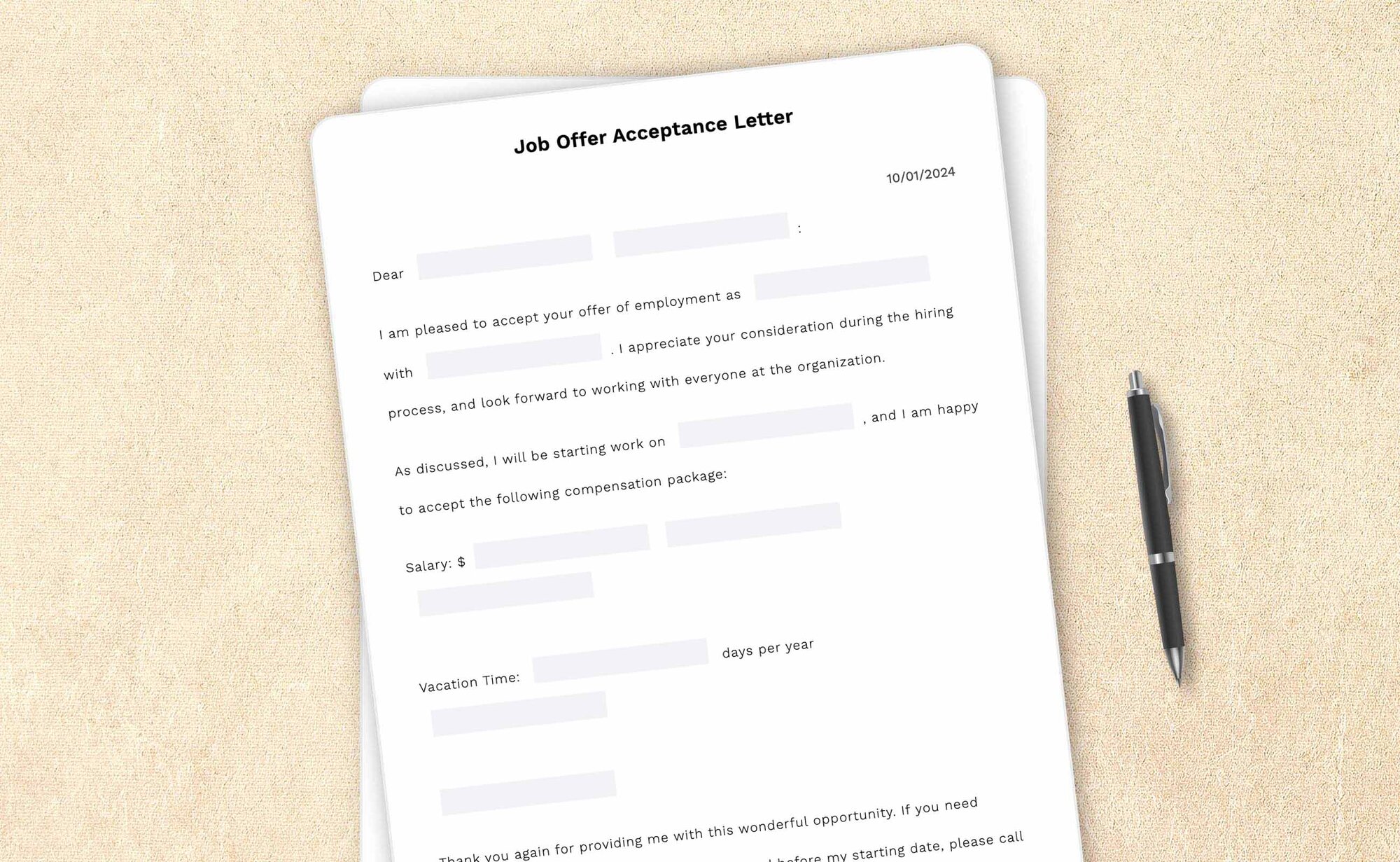
Dear
I am pleased to accept your offer of employment as
As discussed, I will be starting work on
Salary: $
Thank you again for providing me with this wonderful opportunity. If you need additional information or paperwork completed before my starting date, please call me at
| Sincerely, | |||||||||||||||||||||
_______________________________ |
|||||||||||||||||||||
How-to guides, articles, and any other content appearing on this page are for informational purposes only, do not constitute legal advice, and are no substitute for the advice of an attorney.
Job acceptance letter: How-to guide
You spend a lot of time looking for the right employment opportunities. Once you have a job offer in your hands, you should contact the company you’ve chosen by writing a job acceptance letter. You can share the good news with the employer either by sending a job offer acceptance email or posting a physical copy of the same.
A polite and considerate acceptance letter can start your employment relationship on the right foot. While writing the acceptance letter, maintain professionalism and express gratitude for the job opportunity.
From your job acceptance letter, you create a positive impression with your employer. Hence, you should be careful while drafting your letter of acceptance.
This article provides tips and suggestions to help you show consideration for the company that selected you, establishing a tone of mutual respect from the start.
Key points to follow while creating a job acceptance letter
1. Promptly provide your confirmation letter accepting the job
Send an acceptance letter as soon as possible after your decision is made. Give employers the opportunity to prepare for your appointment and to reject other applicants.
If your final decision has been made, try to contact employers within one or two weeks of your interview.
2. Double-check your letter for grammatical errors and spelling mistakes
A letter with spelling mistakes doesn’t look good on you; an error-free letter shows you’re good with your language skills.
Proofread your job acceptance letter. Even though you already have the job, you’ll still want to make a good impression on the company that you’ll be working for in the near future. It’s a good practice to check your job acceptance letter properly before sending it out to your new employer.
3. Send the job acceptance letter even if you verbally accepted the job offer
It’s always a good idea to send an acceptance letter, even if you have already accepted the position over the phone.
You can use the acceptance letter to confirm in writing the details of your employment and clear up misunderstandings before they have a chance to develop.
In the letter, you can clarify and reconfirm your job title, start date, annual salary, health insurance coverage, working hours, annual leave (including paid leave and sick leave), etc.
4. A job acceptance letter can be provided as proof if a dispute arises
Your acceptance letter isn't an employment contract. However, if disputes do arise over the terms of your service, a written record of agreed-on terms may prove useful in and out of court.
Writing a job offer acceptance letter: Key takeaways

The following instructions will provide some information about the terms of your letter:
1. Write key details
Start preparing your letter by providing the date you’re sending this letter, the subject line, and your name.
You also need to add the employer’s company name and company address.
2. Start your letter with a proper salutation
Address the letter to the person who offered you the job. You can address them as “Dear Mr. [Hiring manager name].”
3. Mention key details to be included in your job acceptance letter
The starting paragraph should always begin with your acceptance of the job offer letter. You should also mention the joining date so that the new employer can initiate the onboarding process.
The next paragraph should restate the compensation package. Give your confirmation that you agree to work for the company on the said annual salary. This gives the assurance that both you and the employer are on the same page regarding this.
Conclude your letter by reiterating your interest in the company and providing your contact information. Even though it'll likely already be on file with the company. Including the phone number and contact address as additional information is for convenience.
Say yes to a job offer with LegalZoom’s template | Job acceptance letter sample
With a job offer acceptance letter, you inform an organization you'll be accepting its offer and confirm the general terms of your service.
A well-constructed acceptance letter will ensure that the terms of your employment are verified, and you can focus on preparing yourself for the work to come.
A template can help you create a professional job acceptance letter. It’ll have all the essential information in place and help you not to miss adding important points. LegalZoom provides you with a simple job acceptance letter sample that you can use anytime from anywhere. You can easily fill out our template by answering a few simple questions, customizing it, and downloading the document as a .pdf file.
LegalZoom also provides you with a formal letter form for rejecting a job offer, as well as other professional letter samples that you can use for various business scenarios.
Frequently asked questions
What's a job acceptance letter?
Once you have a job offer you want to formally accept, let the company know your decision with a formal acceptance letter. You can build a healthy employment relationship from the start with a job offer acceptance letter.
A job acceptance letter allows you to agree to the offer and start your relationship with your new company on the right foot.
You can point out specifics that are important to you about your compensation. It also provides a written record of your acceptance, should there ever be a dispute.
What key details do you need to write a job acceptance letter?
Here's the information you'll need to have handy to complete your job acceptance letter:
- Contact information: Add the name and contact address of the new employer providing you with the new job
- Start date: Give the date of joining or when you are supposed to begin this new job
- Compensation: Have the proposed salary information handy and any bonuses and paid vacation days

Job Acceptance Letter Template

Related subcategories
Related templates

Applicant Rejection Letter
Craft courteous rejection with an applicant rejection letter. Ensure respectful communication with candidates who weren't selected.

Business Letter of Recommendation
Craft compelling references for colleagues and partners with a business letter of recommendation. Let the new supervisors know how your colleague would fit the position perfectly.

Employee Termination Letter
Conclude an employee's relationship efficiently with our employee termination letter template. Maintain professionalism while safeguarding rights for both employer and employee. Handle transitions with respect and clarity.

Employment Offer Letter
Streamline your hiring process with an employment offer letter. Provide all the necessary details a new employee needs, including job title, compensation package, joining date, work schedule, and benefits.

Employment Reference Request Letter
Ask someone to provide a recommendation with an employment reference request letter. Boost the chances of being hired.

Employment Verification Letter
Whether for job applications or apartment rentals, simplify the process of confirming someone's work history with an employment verification letter.