Interest in Entrepreneurship Among Un- and Underemployed Americans
Survey insights on why un- and underemployed Americans are considering entrepreneurship, their motivations, and what they need to start a business.


Table of contents
Unstable work and shifting economic conditions are influencing how many adults think about what they want from their careers. For some, the idea of working for themselves is becoming more appealing than returning to or remaining on a traditional career path. To better understand how people experiencing un- or underemployment are weighing that choice, we surveyed more than 1,200 adults navigating job loss, reduced hours, or limited opportunities.
The responses offer a detailed look at how interest in entrepreneurship is taking shape, what motivates people to consider starting a business, and what may be holding them back. This analysis explores three key areas: what drives interest in entrepreneurship, the pressures and barriers shaping that interest, and how potential founders envision their future businesses.
Entrepreneurial Interest and What Fuels It
Interest in entrepreneurship is relatively high among adults facing un- or underemployment. Many are weighing whether working for themselves could offer greater stability, control, or long-term opportunity than continually trying to find something that works on a more traditional career path. Our survey results show how this interest is taking shape and explore what motivates people to consider starting a business of their own.
Growing Interest in Working for Yourself
The appeal of entrepreneurship isn’t abstract for many respondents. It’s immediate and increasingly tangible.
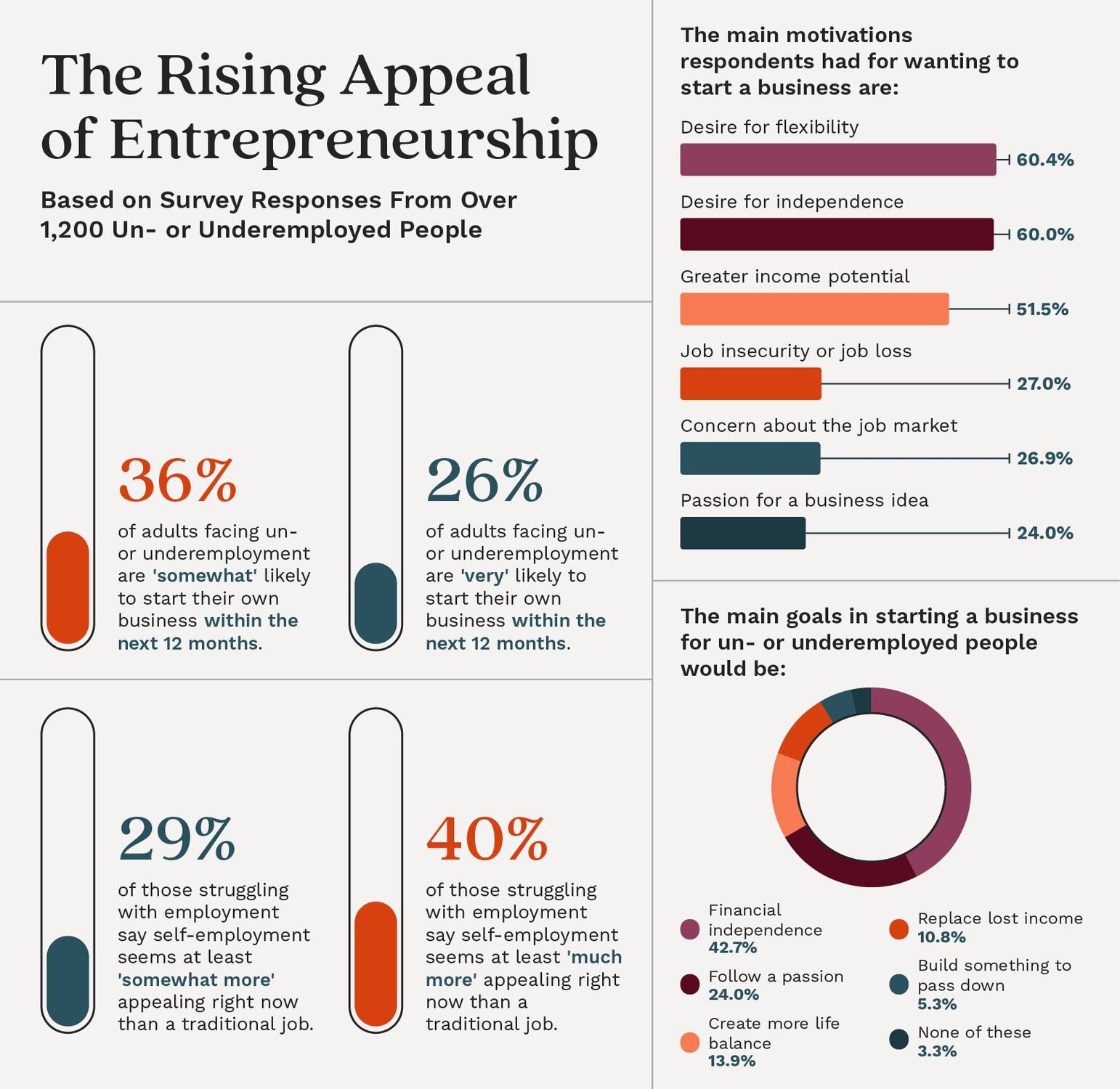
- 62% of un- or underemployed adults say they’re somewhat or very likely to start a business within the next 12 months, with 26% saying they’re very likely.
- 4 in 10 (40%) have seriously considered starting a business before, and another 32% have thought about it casually.
- 69% say self-employment feels at least somewhat more appealing than a traditional job right now, including 40% who say it feels much more appealing.
These indicators reflect how dis- or misplaced workers view their options. Research from the Federal Reserve Bank of St. Louis shows that during periods of economic uncertainty, like the COVID-19 downturn, interest in self-employment often grows as people look for more control over income, schedule, and long-term career direction.
What’s Driving This Interest
Flexibility, financial potential, and independence stand out as the clearest motivators, but the reasons vary a bit depending on employment status.
- 60% cite flexibility and 60% cite independence as key motivations.
- 52% point to greater income potential, though this varies notably between unemployed and underemployed adults (43% vs. 61%).
- Job insecurity (27%) also plays a role, with unemployed respondents more likely to cite it than those who are underemployed (32% vs. 22%).
- 24% say passion for an idea is a primary driver.
The contrast highlights differences in how unemployed and underemployed respondents describe their motivations. Underemployed adults appear more focused on increasing earning potential, while unemployed adults are more likely to say instability in their working lives is influencing their interest in entrepreneurship.
Goals for Starting a Business
When asked about the primary goal of starting a business, respondents provided a mix of financial and personal aspirations.
The top three reasons are:
- 43% say their main goal would be financial independence.
- 24% want to pursue a passion.
- 14% seek better work-life balance.
Age also shapes these priorities. Adults aged 18–28 are more likely to want to pursue a passion (30%) than those aged 45–60 (19%). Older adults, by contrast, are more likely to be motivated by replacing lost or unstable income (14% vs. 8%). These differences point to how life stage and financial obligations influence what entrepreneurship represents for individuals.
Across the un- and underemployed populations we surveyed, interest in entrepreneurship is strong and driven by a blend of autonomy-seeking goals (such as independence and flexibility) and practical needs, including income stability and financial growth. For many, working for themselves represents greater perceived control over both earning potential and day-to-day work than traditional employment.
Next, we’ll look at the reasons behind this interest in more detail and examine the barriers that may stand in the way.
Why More People Are Weighing Business Ownership
The decision to start a business doesn’t happen in isolation. For many adults navigating un- or underemployment, interest in entrepreneurship is shaped by a mix of economic pressure, career disruption, and a desire to regain control over their work lives. Let’s take a closer look at how these forces interact and why some people move toward business ownership while others hesitate.
Forces Shaping Interest in Business Ownership
A combination of pressure and opportunity is shaping interest in entrepreneurship. Instability in recent work experiences is prompting respondents to to consider business ownership, and some see today’s economic conditions as a chance to make a move.
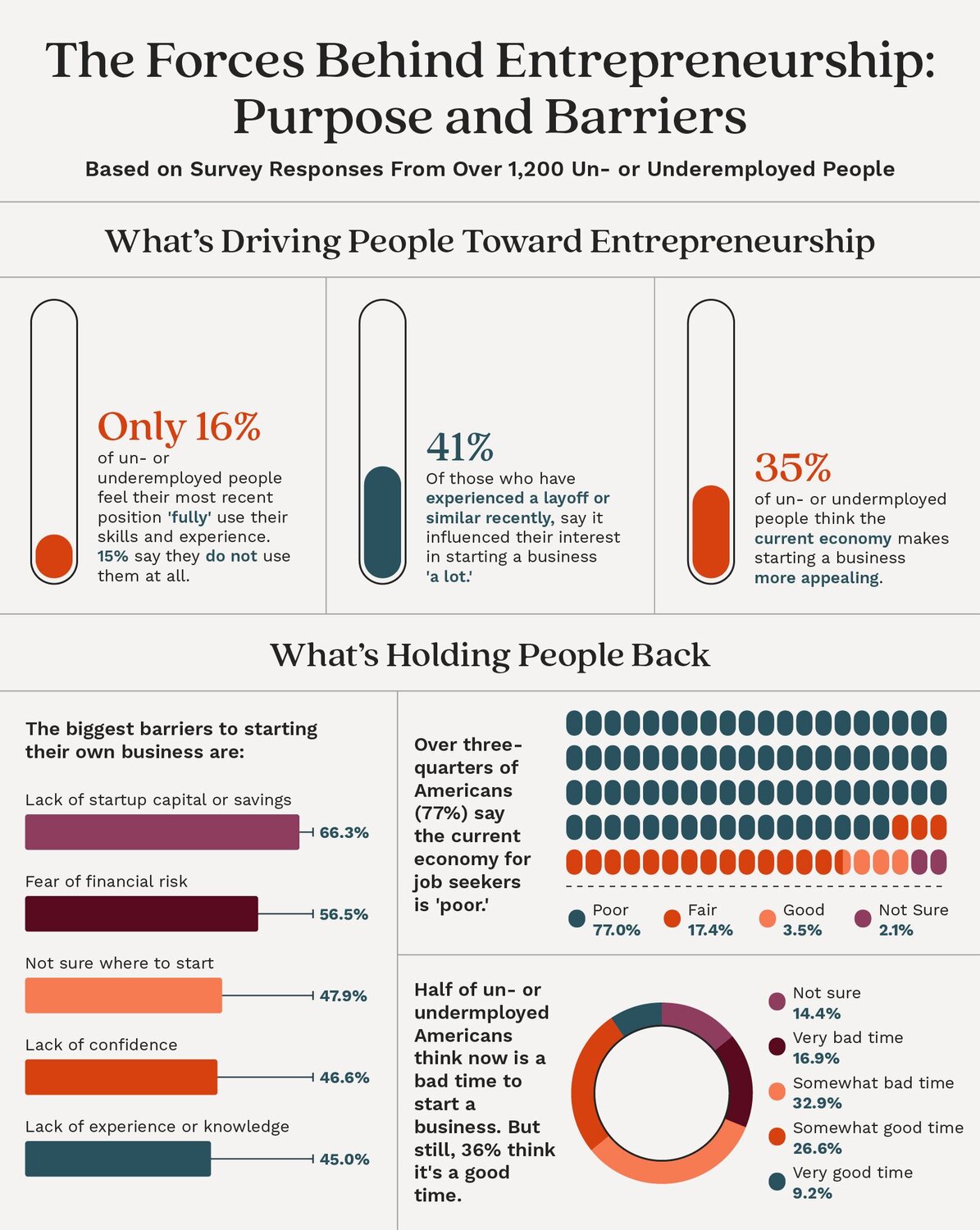
- Only 16% feel their most recent role made full use of their skills and experience, while 15% say it didn’t use them at all.
- 33% experienced a layoff, hours reduction, or pay cut in the past 12 months.
- Among those affected, 41% say it influenced their interest in starting a business “a lot.”
- The influence of layoffs increases with age: 53% of adults 45 and older say it had a big impact compared with 22% of adults 18–28.
- 35% say the economy makes entrepreneurship more appealing right now.
Skill underutilization, employment disruptions, and a challenging job market are influencing many adults to consider alternatives to traditional work, while current economic conditions are playing a role in making entrepreneurship feel more appealing. This pattern echoes the post-COVID period, when new business applications rose sharply above pre-pandemic norms, suggesting that disruption can coincide with elevated interest in launching new ventures. Some respondents may be recognizing similar openings today as consumer needs and industry landscapes continue to shift.
As interest grows, many early-stage founders begin exploring what it would take to formalize a business, like understanding the basics of business formation requirements and choosing the right entity type such as an LLC or sole proprietorship. These steps can help clarify what’s required to get started and what support someone may need to move forward.
Barriers: What’s Stopping Potential Entrepreneurs
Strong interest doesn’t always translate into immediate action. Respondents identified several challenges that limit their ability to move forward.
- 66% cite a lack of start-up capital.
- 56% worry about financial risk.
- 48% are unsure where to start.
- 47% feel a lack of confidence.
- 45% say they don’t have enough experience.
These responses highlight a consistent set of obstacles facing potential entrepreneurs, with access to capital and financial risk weighing most heavily, while uncertainty about the fundamental and practical steps involved in starting a business seem to slow progress.
Economic Perceptions and Their Influence
Respondents’ views of the broader job market also play a role in whether entrepreneurship feels like a viable next step.
- 77% say the current job market is poor for job seekers.
- This perception is highest among adults 18–28 (84%) compared with those 45 and older (64%).
- Half (50%) say now is a bad time to start a business, but 36% think it’s a good time.
- Optimism increases with age: 31% of younger adults see it as a good time to start compared with 45% of adults 45 and older.
While most respondents view the job market as unfavorable, this perception does not translate into uniform optimism about entrepreneurship. Instead, the results suggest that factors beyond labor market sentiment, including self-report confidence and perceived readiness, may be associated with how viable entrepreneurship feels.
The push of unstable employment and the pull of perceived opportunity are contributing to a growing interest in entrepreneurship among un- and underemployed adults. At the same time, financial and confidence-related barriers continue to limit follow-through.
Next, we’ll look at how potential entrepreneurs envision the businesses they want to build and what they say they need to move from interest to action.
Readiness and Expectations for Self-Employment
Interest in entrepreneurship becomes more concrete when people begin imagining what running a business would look like. For many un- or underemployed adults, that vision sits somewhere between optimism and uncertainty. We found out how confident people feel, what support they believe they need, and how they view self-employment in both the short and long term.
Gauging Readiness: Confidence and Support Needs
Confidence varies among potential founders and shapes how prepared they feel to pursue business ownership.
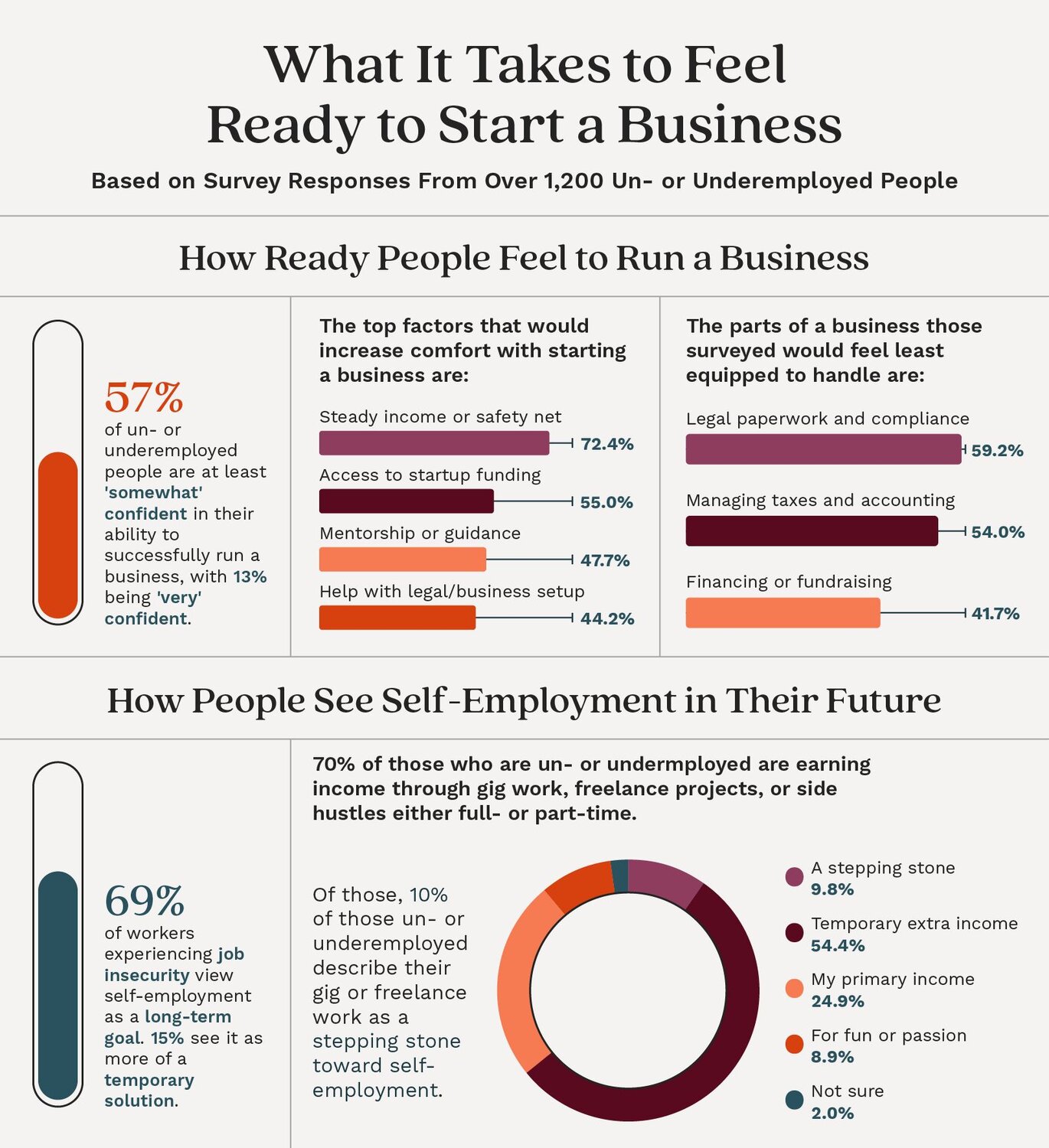
- 57% feel at least somewhat confident in their ability to run a business, including 13% who say they’re “very confident.”
When asked what would make them more comfortable starting a business, respondents point to:
- 72% want a steady income.
- 55% need access to start-up funding.
- 48% want mentorship or guidance.
- 44% want help with legal or business setup.
These priorities reflect areas respondents say they need support in as they consider starting a business. Many look for clear, structured support as they build a foundation, whether through guidance on business formation or understanding ongoing business operations requirements.
Where Potential Founders Feel Least Equipped
Even with interest and baseline confidence, respondents identified areas of business management that feel especially challenging.
- 59% say they feel least prepared for legal paperwork and compliance.
- 54% cite managing taxes and accounting.
- 42% say financing or fundraising.
These results highlight areas where respondents feel least prepared when thinking about starting a business. Tools and services that simplify filings, compliance, accounting, or intellectual property protection can help reduce the uncertainty that keeps some from launching.
How People See Self-Employment in Their Future
For many, self-employment isn’t just a backup plan. It’s a long-term goal shaped by their experience in an unstable job market.
- 69% of workers experiencing job insecurity view self-employment as a long-term path. 15% see it as temporary.
- Younger adults (18–28) are almost twice as likely to view it as a temporary solution (19% vs. 10% of adults 45–60).
These responses suggest that self-employment is more often viewed as a long-term path than a temporary solution among those experiencing job insecurity, though perspectives vary by age.
The Role of Gig and Freelance Work
Gig and freelance work are already part of daily life for many, and for a smaller segment, can serve as an early step toward self-employment. 70% of those surveyed are earning income through gig work, freelance projects, or side hustles.
- 10% view this work as a stepping stone toward self-employment.
- 9% say they do it for passion.
- 54% say it’s a temporary way to earn additional income.
This mix of motivations shows that gig work primarily serves as a short-term income solution, while a smaller share of respondents view it as a potential step toward self-employment.
What Future Entrepreneurs Envision
Respondents also shared how they picture their future businesses taking shape.
- 62% would start a business in a different industry than where they last worked, pointing to a willingness to move beyond prior professional experience.
- Only 14% would stay in the same industry.
- When it comes to structure, 40% prefer to start a business alone, 30% would choose one partner, and 16% like the idea of a small team.
These preferences reflect a flexible view of business ownership. Many respondents are open to moving beyond their prior professional experience and considering different business structures, from solo ventures to small partnerships.
We see a clear pattern here: many un- or underemployed adults are open to entrepreneurship and can picture what their future businesses might look like, but many cite stability, guidance, and manageable entry points as important to moving forward.
“Periods of job instability often are associated with people reevaluating their career paths, and we're seeing that reflected in this data,” said Jeff Stibel, CEO of LegalZoom. “Many adults facing unemployment or underemployment aren’t just looking for the next job — they’re looking for more control, stability, or earning potential. Entrepreneurship becomes a practical consideration when traditional work no longer meets those needs.”
Closing Thoughts
Interest in entrepreneurship is rising among adults facing unstable or insufficient work, and our survey shows how that interest is shaped by both pressure and possibility. Many are drawn to the idea of working for themselves, motivated by flexibility, income potential, and a desire for greater control. At the same time, financial barriers and uncertainty about the steps involved can slow the move from interest to action.
Despite these challenges, many un- and underemployed adults already view self-employment as a long-term path or are experimenting with gig and freelance work that could evolve into something more. Their goals, motivations, and concerns highlight how respondents describe their interest in independent work and alternatives to traditional employment.
As more people explore business ownership, accessible tools and clear guidance can make the process more attainable. LegalZoom supports new entrepreneurs with resources that simplify business formation, compliance, and long-term management, helping them build momentum as they turn their ideas into the next stage of their careers.
Methodology
To explore how economic uncertainty is influencing entrepreneurship, we surveyed over 1,200 U.S. adults ages 18–60. The sample included two groups: 682 unemployed respondents and 595 employed respondents who are considered underemployed (working fewer hours or in a position that doesn’t match their skill level or experience).
Respondents were screened to get representation by age, gender, and income level. Employment status and perceived underemployment were used as key segmentation variables to compare entrepreneurial intent across groups.
The survey asked participants about their likelihood of starting a business in the next 6–12 months, motivations for pursuing self-employment, and the factors holding them back. Additional questions explored how respondents view the economy, their confidence in running a business, and the types of support or resources that would make entrepreneurship more accessible.
The survey was conducted online over two weeks in December 2025.
'%20/%3e%3c/svg%3e)

'%3e%3cpath%20fill-rule='evenodd'%20clip-rule='evenodd'%20d='M9.31239%2025.5316H13.0679V14.1032H9.31239V25.5316ZM11.1913%208.46875C9.93945%208.46875%209%209.25086%209%2010.505C9%2011.5995%209.78211%2012.5389%2011.1913%2012.5389C12.6005%2012.5389%2013.3826%2011.5995%2013.3826%2010.505C13.3826%209.4082%2012.6005%208.46875%2011.1913%208.46875ZM27%2018.9577V25.5316H23.2445V19.4275C23.2445%2017.8609%2022.6174%2016.7664%2021.3679%2016.7664C20.2711%2016.7664%2019.644%2017.5463%2019.3316%2018.1756C19.1743%2018.488%2019.1743%2018.8004%2019.1743%2019.1128V25.5316H15.4165V13.9458H19.1743V15.5123C19.644%2014.7302%2020.5835%2013.6357%2022.6174%2013.6357C25.1234%2013.7908%2027%2015.3573%2027%2018.9577Z'%20fill='white'/%3e%3c/g%3e%3cdefs%3e%3cclipPath%20id='clip0_952_9489'%3e%3crect%20width='18'%20height='18'%20fill='white'%20transform='translate(9%208)'/%3e%3c/clipPath%3e%3c/defs%3e%3c/svg%3e)


Contact us
For media inquiries, call us at (213) 371-6260 or email at press@legalzoom.com.
