




Ready to form a corporation in Oregon but not sure how to get started? This comprehensive guide covers everything you need to know about Oregon's specific requirements, forms, fees, and procedures for incorporating your business in the state.

What is an Oregon corporation?
An Oregon corporation is a legal business entity formed under Oregon Revised Statutes (ORS) Chapter 60 that provides significant advantages for business owners. A corporate business structure offers tax advantages, investor opportunities, and liability protection for your personal assets in the event that your business faces a lawsuit or can’t meet its financial obligations.
Other benefits of forming a corporation in Oregon include the following:
- Limited liability protection for shareholders, directors, and officers
- Enhanced credibility with customers, vendors, and financial institutions
- Potential tax advantages through various deduction opportunities
- Greater appeal to outside investors who prefer corporate structures
- Perpetual existence that continues beyond the involvement of original owners
- Transferable ownership through the sale of stock shares
Under Oregon law, every corporation has the purpose of engaging in any lawful business, unless you specify a more limited purpose in your articles of incorporation.
How do I form an Oregon corporation?
You form an Oregon corporation by filing articles of incorporation with the Oregon Secretary of State and paying the required filing fee. The corporation's existence begins as soon as you file the articles, unless you specify a later effective date. However, there are some steps you need to take before filing the paperwork. Here's the step-by-step process:
Step 1: Choose a business name and check availability
Before incorporating your business, make sure your desired corporate name is available and meets Oregon's specific requirements:
- Must contain the words "corporation," "incorporated," "company," or "limited," or an abbreviation of one of those words
- Cannot contain the word "cooperative"
- Must be distinguishable from other business names registered with the Oregon Secretary of State
- Must be written in the alphabet used to write the English language, but can include Arabic and Roman numerals
Once you decide on a name, conduct an Oregon business search to check its availability. You can do this using the Oregon Secretary of State's business name search tool or using LegalZoom’s free name lookup tool, which offers the exact same information, below.
Free Oregon Business Name Check
Use our free name check tool to search the Oregon Secretary of State database and see if your business name is available.
By clicking "Check Availability," I agree to LegalZoom's Terms of Use. This search is a preliminary check of state databases and does not include variations or trademarks. Results do not guarantee name availability or compliance with legal requirements.
If your desired name is available, you can reserve it for 120 days by filing an Application for Name Reservation with the Oregon Secretary of State. The reservation fee is $100 and can be renewed for additional 120-day periods.
Step 2: Appoint an Oregon registered agent
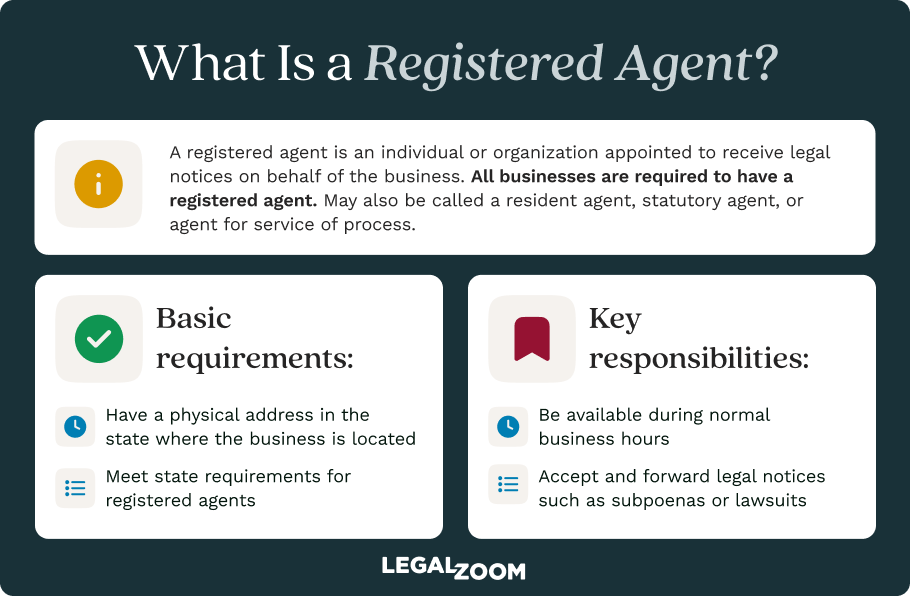
Every Oregon corporation must maintain a registered office in Oregon and designate a registered agent at that office. The registered agent receives lawsuits, notices, and demands on behalf of the corporation and forwards them to the corporation. An Oregon registered agent must:
- Be either an individual who resides in Oregon and is aged 18 or older, or a business entity authorized to do business in Oregon
- Have a business address must be identical to the registered office address
- Be available during normal business hours to receive legal documents
Many businesses choose professional registered agent services for reliability and privacy. LegalZoom’s Portland-based registered agent office is fully staffed and meets all state requirements.
Step 3: Decide share structure
Before filing your articles of incorporation, you must determine your corporation's stock structure and identify initial directors. When deciding your stock structure, keep in mind:
- The articles of incorporation must state the total number of authorized shares of stock.
- If more than one class of shares is authorized, the articles must state the number of authorized shares in each class and prescribe a distinguishing designation for each class.
- Before any shares of a class are issued, the articles must state the preferences, limitations, and relative rights of that class.
Step 4: Choose incorporators and directors
An incorporator signs the articles of incorporation and delivers them to the Secretary of State for filing. If the articles of incorporation do not name initial directors, the incorporators must elect directors. Incorporators may also approve bylaws. Once the directors have been chosen, the incorporators have no further duties. The following requirements apply when specifying incorporators:
- At least one incorporator is required, and you may have more.
- Incorporators may be an individual aged 18 or older, a corporation, a partnership, or an association.
- Incorporators' names and addresses must be listed in the articles of incorporation.
Directors oversee major policies and decisions and appoint officers who manage day-to-day affairs. If you choose to specify a director or directors in your articles of incorporation, the requirements are as follows.
- There is no maximum limit on the number of directors.
- The estate of an incompetent or deceased person cannot serve as a director.
- The number of directors should be stated in either the articles of incorporation or the bylaws.
Step 5: Prepare articles of incorporation
The articles of incorporation must contain specific information required by Oregon law. While the articles may contain additional provisions, they must include the following.
- Corporate name: Must comply with Oregon naming requirements
- Mailing address: Address for notices until the corporation designates an address in its annual report
- Registered agent information: Name and street address of Oregon registered agent
- Stock structure: Total number of authorized shares and class designations if applicable
- Incorporator information: Names and addresses of all incorporators
Your articles of incorporation can include more than just the basic details. Below are some common examples of what you can add.
- Names and addresses of the initial directors: You can list who will serve on your first board of directors.
- Provisions about how your corporation operates: This can cover your business purpose, how the company is managed, and rules that define the powers of the board and shareholders.
- A clause limiting director liability: A rule that protects directors from personal financial liability, except in cases like breaking their duty of loyalty, acting in bad faith, or violating the law.
- A statement of responsibility: You can include language that directs your corporation to operate in an environmentally and socially responsible way.
Step 6: File with the Oregon Secretary of State
You can file your Oregon articles of incorporation with the Secretary of State through several methods. The simplest way is to create an account with Oregon Business Registry online portal to fill out and submit your articles of incorporation online. You can also print the articles and mail them or deliver them in person to:
Oregon Secretary of State
Corporation Division
255 Capitol St. NE, Suite 151
Salem, OR 97310
Whichever option you choose, the filing fee is $100 for all for-profit corporations.
How much does it cost to form an Oregon corporation?
The cost to file your articles of incorporation with the Oregon Secretary of State is $100. You’ll also pay $100 per year to file your annual report. Additional optional fees include the following.
- Business name reservation: $100
- Registered agent service: $100–$300 annually
- Legal assistance: $500–$2,000 depending on complexity
- Articles of correction: $100 for each correction filed
How long does it take to form an Oregon corporation?
The length of time it takes for the Secretary of State to approve your articles of incorporation depends on how you submit the filing.
- Online filing: 1–3 business days
- Mail filing: 7–10 business days
- In-person filing: Same day (if submitted before 4:00 p.m.)
Processing times can also vary depending on how complete your documents are, whether your name is available, payment delays, and busy filing seasons. LegalZoom can help you avoid common errors and delays with our tried-and-true corporation formation service.
Should my Oregon corporation choose C corp or S corp status?
The choice between C corporation and S corporation tax status impacts your Oregon corporation's tax obligations and operational flexibility.
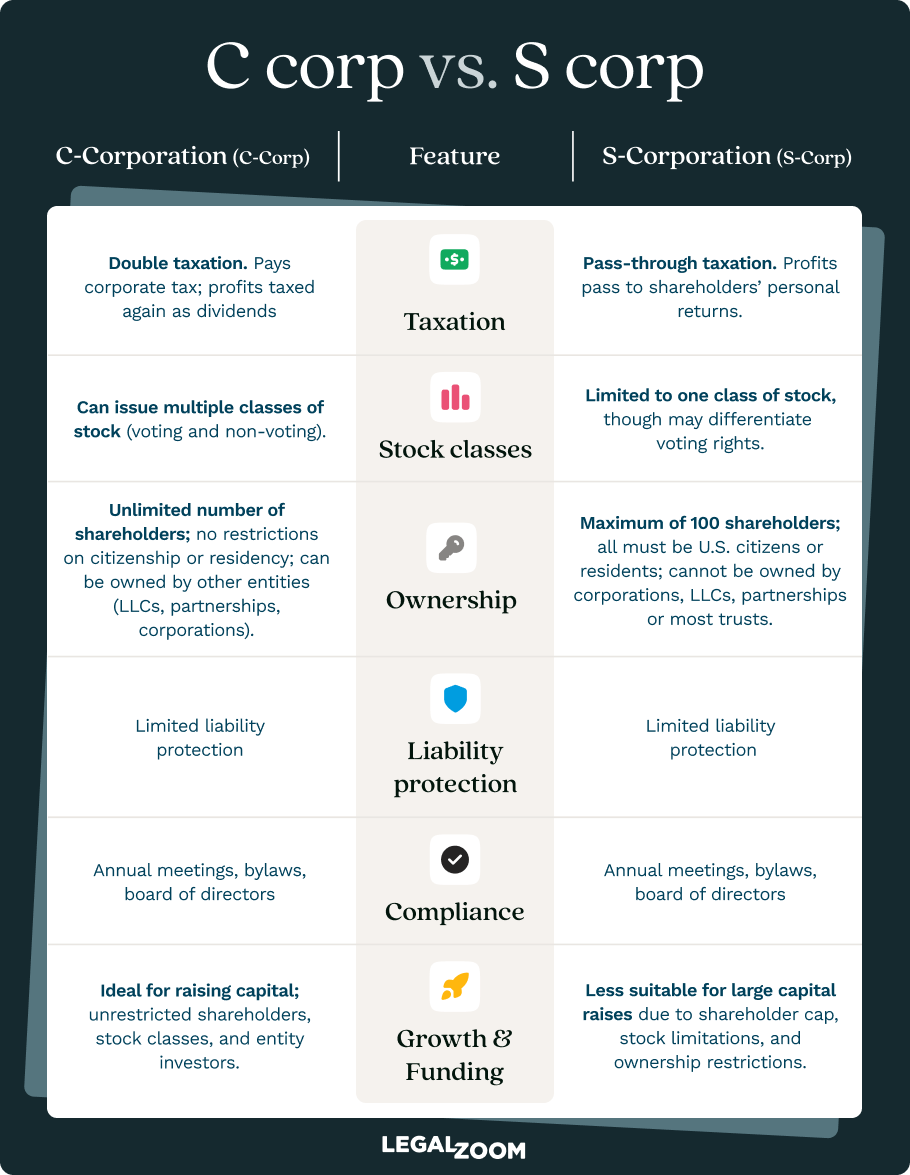
A C corporation is treated as a separate taxable entity, meaning it pays taxes on its profits before any dividends are distributed to shareholders. Those dividends are then taxed again on individual returns, resulting in double taxation. However, C corporations have no limits on the number or type of shareholders, making them ideal for larger or growing businesses.
An S corporation is a federal tax status that allows profits and losses to pass directly to shareholders, avoiding double taxation. To qualify, your business must meet certain federal rules:
- An S corp can have no more than 100 shareholders.
- There can be only one class of stock.
- All shareholders must be U.S. citizens or residents.
- There can be no corporate or partnership shareholders.
- Form 2553 must be filed with the IRS within 75 days of incorporation.
What should I do after I form an Oregon corporation?
Successfully incorporating your Oregon corporation is just the beginning. You must complete several important steps to make sure your corporation is properly established and compliant.
Obtain an EIN and fulfill tax requirements
Once your corporation is formed, your next step is to get a federal employer identification number (EIN) from the IRS. You can apply online at irs.gov or use an EIN service like LegalZoom. You’ll need this number to file federal tax returns based on your corporation’s chosen tax status.
At the state level, you’ll need to register with the Oregon Department of Revenue for state income tax and sales tax if applicable, and set up unemployment insurance if you plan to hire employees.
Draft bylaws and hold the first board meeting
Your corporation must have bylaws—the internal rules that guide how your business operates. They must follow Oregon law and usually explain things like how directors and officers are chosen, how meetings are held, and how voting works.
After drafting your bylaws, your first board meeting should be held to adopt them officially. During this meeting, directors will elect officers, authorize issuing stock, adopt a corporate seal, open business bank accounts, set the fiscal year, and decide whether to elect S corporation tax status.
You can draft your own bylaws or use a template, but it’s wise to draft bylaws with the help of an attorney or professional service. At the very least, you should have your DIY bylaws reviewed by a business attorney for completeness and compliance with Oregon law.
Issuing shares and maintaining a stock ledger
After your first board meeting, your corporation must issue shares to its initial shareholders as stated in the articles of incorporation. You’ll need to keep a stock ledger, which records important shareholder information such as names, addresses, the number of shares owned, issuance dates, and any payments or property exchanged for shares.
The ledger should also track any share transfers and the dates they occur. Whether you provide physical stock certificates or keep digital records, all share activity must comply with federal and state securities laws.
Open a business bank account
To separate your business finances from your personal funds, open a corporate bank account in your company’s name. Banks typically require several documents, including a certified copy of your articles of incorporation, your corporate bylaws, your EIN confirmation letter, a board resolution authorizing the account, and identification for those authorized to sign.
Always keep business funds in this account, record every transaction carefully, and avoid mixing personal and company money. It’s also a good idea to get a business credit card to handle company expenses and build corporate credit.
Register for licenses, permits, and taxes
There is no statewide, general Oregon business license, but many businesses will need industry-specific licenses. For example, certain professions—like law, medicine, and accounting—require professional licenses from the appropriate state licensing board.
Most cities and counties also require local business licenses. You should also check with your city or county government for general license requirements as well as zoning clearances, building permits, or health department requirements.
Maintain ongoing compliance
Oregon corporations must meet several ongoing compliance requirements to maintain good standing and preserve limited liability protection:
- Annual report: Your annual report is due by the anniversary of your business's original filing. The fee is $100 and you can file it online through the Oregon Business Registry portal. If you don’t file within 45 days of the due date, you can lose the ability to conduct business in Oregon.
- Registered agent: You must maintain a registered agent continuously as long as your corporation conducts business in Oregon. If you need to change your registered agent or office, file a Statement of Change with the Secretary of State.
- Recordkeeping: Oregon corporations must keep organized records, including articles, bylaws, meeting minutes, stock records, and financial documents. You must hold annual shareholder meetings, record major decisions, and store records at your main office.
How LegalZoom can help you form an Oregon corporation
LegalZoom makes it easy to start and manage your Oregon corporation. You can search for an available business name, file your incorporation paperwork, and get your EIN—all in one place. We can also provide registered agent services, help you file annual reports, and offer ongoing compliance support so your corporation stays in good standing with the state.
FAQs
Can I file my Oregon articles of incorporation online?
Yes, Oregon offers online filing through the Oregon Business Registry and allows you to pay by credit card. You can track your filing status online so you know when it’s approved.
What if my desired corporate name is already taken?
If your desired corporate name is already taken in Oregon, you still have a few options. You can choose a different name that meets the state’s naming rules, or reach out to the current name holder to ask if they’re willing to release it. Another option is to add unique or distinguishing words to make your name different enough to qualify.
Do I need a lawyer to form an Oregon corporation?
While not legally required, consulting with an Oregon business attorney can be beneficial, especially for complex situations. Consider legal assistance if you have multiple shareholders, complex ownership structures, or specific regulatory requirements.
Can a non-U.S. citizen form an Oregon corporation?
Yes, non-U.S. citizens can form Oregon corporations. However, they must use a registered agent with an Oregon address and may face restrictions if they later elect S corporation tax status, which requires all shareholders to be U.S. citizens or residents.
What's the difference between authorized and issued shares?
Authorized shares are the maximum number of shares your corporation can issue, as stated in the articles of incorporation. Issued shares are the actual number of shares distributed to shareholders. You can issue up to the authorized amount without amending your articles.
Do I need to hold annual meetings for my Oregon corporation?
Yes, Oregon corporations must hold annual shareholder meetings unless the articles of incorporation or bylaws provide otherwise. Board meetings should be held regularly as specified in your bylaws. All meetings should be properly documented with written minutes.
Can my Oregon corporation do business in other states?
Yes, but you'll need to register as a foreign corporation in each state where you conduct business. This typically involves filing an application for authority to transact business and appointing a registered agent in each state.
Jane Haskins, Esq., contributed to this article.
'%20/%3e%3c/svg%3e)

'%3e%3cpath%20fill-rule='evenodd'%20clip-rule='evenodd'%20d='M9.31239%2025.5316H13.0679V14.1032H9.31239V25.5316ZM11.1913%208.46875C9.93945%208.46875%209%209.25086%209%2010.505C9%2011.5995%209.78211%2012.5389%2011.1913%2012.5389C12.6005%2012.5389%2013.3826%2011.5995%2013.3826%2010.505C13.3826%209.4082%2012.6005%208.46875%2011.1913%208.46875ZM27%2018.9577V25.5316H23.2445V19.4275C23.2445%2017.8609%2022.6174%2016.7664%2021.3679%2016.7664C20.2711%2016.7664%2019.644%2017.5463%2019.3316%2018.1756C19.1743%2018.488%2019.1743%2018.8004%2019.1743%2019.1128V25.5316H15.4165V13.9458H19.1743V15.5123C19.644%2014.7302%2020.5835%2013.6357%2022.6174%2013.6357C25.1234%2013.7908%2027%2015.3573%2027%2018.9577Z'%20fill='white'/%3e%3c/g%3e%3cdefs%3e%3cclipPath%20id='clip0_952_9489'%3e%3crect%20width='18'%20height='18'%20fill='white'%20transform='translate(9%208)'/%3e%3c/clipPath%3e%3c/defs%3e%3c/svg%3e)

