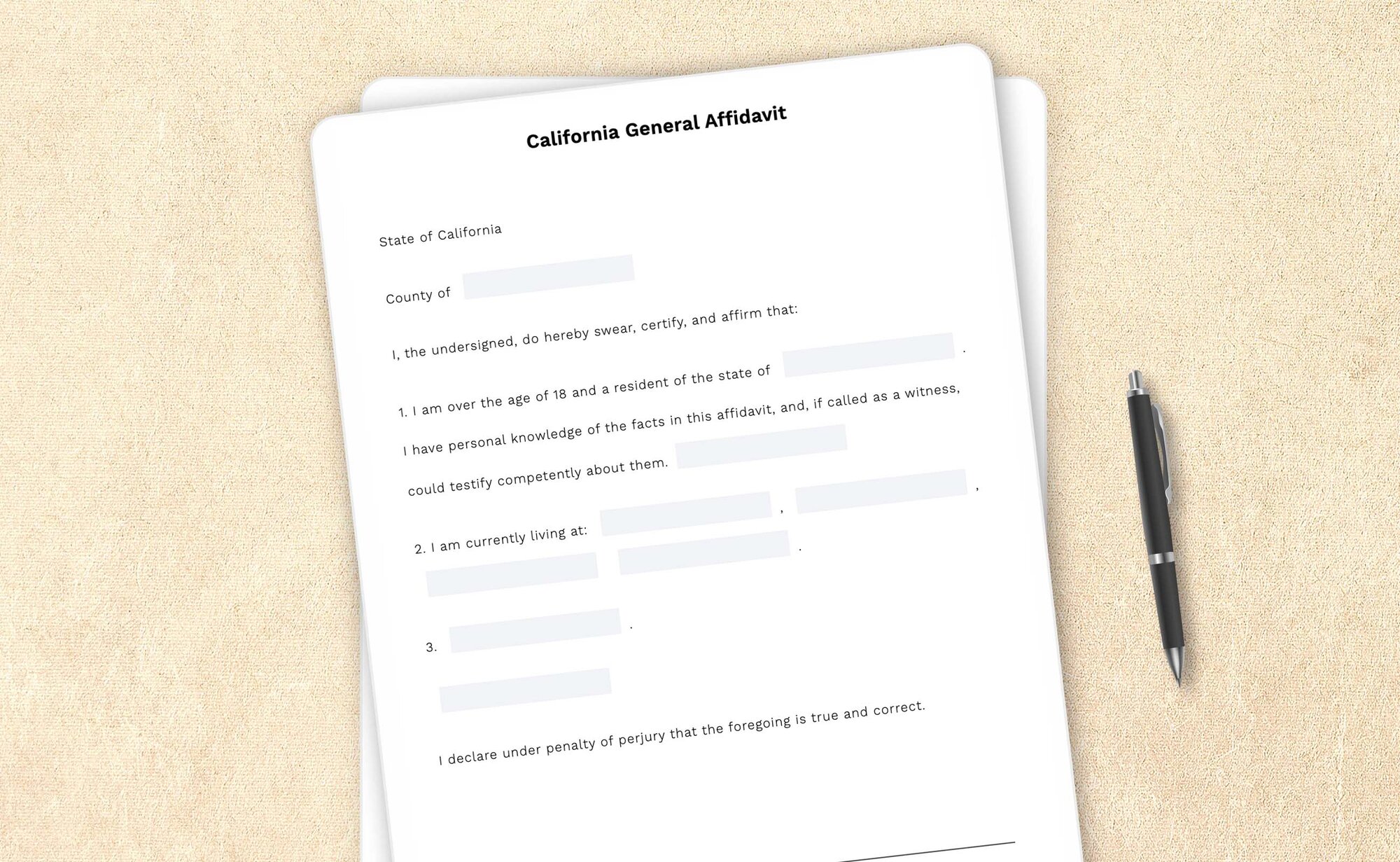
State of California
County of
I, the undersigned, do hereby swear, certify, and affirm that:
1. I am over the age of 18 and a resident of the state of
2. I am currently living at:
3.
I declare under penalty of perjury
| Date:_______________________________ | ____________________________________________ |
| add border |
|---|
| A notary public or other officer completing this certificate verifies only the identity of the individual who signed the document to which this certificate is attached, and not the truthfulness, accuracy, or validity of that document. |
State of California
County of
| ________________________________________(Notary Seal) Signature of Notary Public |
| ________________________________________ Printed Name |
| My Commission expires: ______________ |
How-to guides, articles, and any other content appearing on this page are for informational purposes only, do not constitute legal advice, and are no substitute for the advice of an attorney.
General affidavit: How-to guide
An affidavit is a sworn written statement that can be used in several important ways.
- In connection with filing or responding to a motion in court.
- To give assurances to other parties in non-court transactions (for example, promising a buyer that you're the owner of a particular property). Creditors may require it on loan documents.
A well-drafted affidavit can provide clarity to a court or certainty to a business transaction, strengthening your case and defenses.
What are the key aspects to consider for creating general affidavits?
1. Including relevant information
The content of your affidavit should depend on its intended purpose. If you intend to present the document in court, list all relevant facts that can convince the judge to rule in your favor. On the other hand, if you use the affidavit to assure another party of your deal, include information about your financial condition or creditworthiness.
2. Keeping it concise
While providing a lot of information and detail in your legal case seems like a good idea, it isn't always the best approach. Judges, clerks, commissioners, and other court staff are often short on time to read lengthy documents. Keep the information concise and include only the most critical information to ensure your case is considered fairly.
3. Maintaining accuracy and reliability in written statements
Ensure you only write about things you have witnessed or have direct knowledge of. Avoid including information you may have heard from others or assume is true. When writing an affidavit, using language indicating that you're providing information based on your personal knowledge is vital to ensure that your statement is accurate and reliable. It is crucial to use first-person statements, specifically I-statements, such as "I am the President of XYZ, Inc."
4. Mentioning the truth
It is important to note that misrepresenting facts in your affidavit can lead to severe consequences. Therefore, it is crucial to always be truthful and accurate in your affidavit.
5. Formatting the affidavit
- When you submit your affidavit to the court, copy the "caption" from your other papers and place it at the top. The caption includes the names of the parties, the court, the title of the document, and other case-specific information.
- Enter the correct date on which the affidavit was signed, along with the city and state where the signing occurred.
- Include your full name, address, age, occupation, and other identifying information.
6. Signing the affidavit
It is essential to sign the document only in the presence of a notary public.
7. Reviewing the affidavit
There may be specific rules in your city and county with respect to affidavits. Hence, reviewing those before submitting your document to the court is a good idea.
Frequently asked questions
What's a California general affidavit?
An affidavit is a written statement you're asserting is true. Affidavits can be used for many reasons, such as in court cases as evidence and outside of court to verify facts in a business transaction (for instance, if you need to assure a buyer you own what you're selling them). Whether you're using it in or out of court, you'll want to include different details to help you prove your case or close your deal.
What information is needed to complete the California general affidavit?
Here's the information you'll need to complete your California general affidavit:
- County you're in: Know which California county you're signing this affidavit in
- Where you live: Be ready with your complete street address and county name

California General Affidavit Template

Related subcategories
Related templates

Affidavit of Lost Promissory Note and Indemnity Agreement
Secure your financial arrangements with an affidavit of lost promissory note and indemnity agreement. Simplify the process of recovering lost promissory notes.

Affidavit of Lost Stock Certificate
Report lost/damaged stock certificates quickly and accurately with a lost stock certificate affidavit form. Fill in essential details about the loss, stock information, and the person signing the affidavit to kickstart the replacement process.

Affidavit of Lost Stock Certificate and Indemnity Agreement
Safeguard your investments with an affidavit of lost stock certificate and indemnity agreement. Simplify the process of recovering lost or destroyed stock certificates. Ensure the security of your assets.

Florida General Affidavit
Elevate your credibility in legal matters and business transactions using a Florida general affidavit form. Craft a compelling statement of truth and strengthen the facts of your case.

Illinois General Affidavit
Safeguard yourself in legal matters with an Illinois general affidavit form. Assert the truth in writing, whether verifying facts for court evidence or business transactions.

Texas General Affidavit
Elevate your credibility in legal matters and business transactions using a Texas general affidavit form. Craft a compelling statement of truth and strengthen the facts of your case.