The State of Small Business Compliance
Our survey of 1,000 small business owners reveals what compliance looks like in 2026, from workload and risks to its impact on growth.


Table of contents
Running a small business in 2026 requires more than delivering products or services. It also means navigating a regulatory environment that continues to evolve. From filings and permits to reporting requirements and enforcement, business compliance now plays a visible role in how companies operate and grow.
To better understand what that responsibility looks like today, we surveyed 1,000 small business owners across the U.S. The results offer a detailed view into who is managing compliance, how much time it requires, how workloads are changing, and what consequences arise when obligations are missed. They also reveal how compliance pressures influence confidence, risk exposure, and long-term growth plans.
This analysis explores three key areas: the size and scope of today’s compliance workload, the risks and costs of noncompliance, and the ways regulatory demands can shape business opportunities in the year ahead.
The Expanding Compliance Workload for Small Businesses
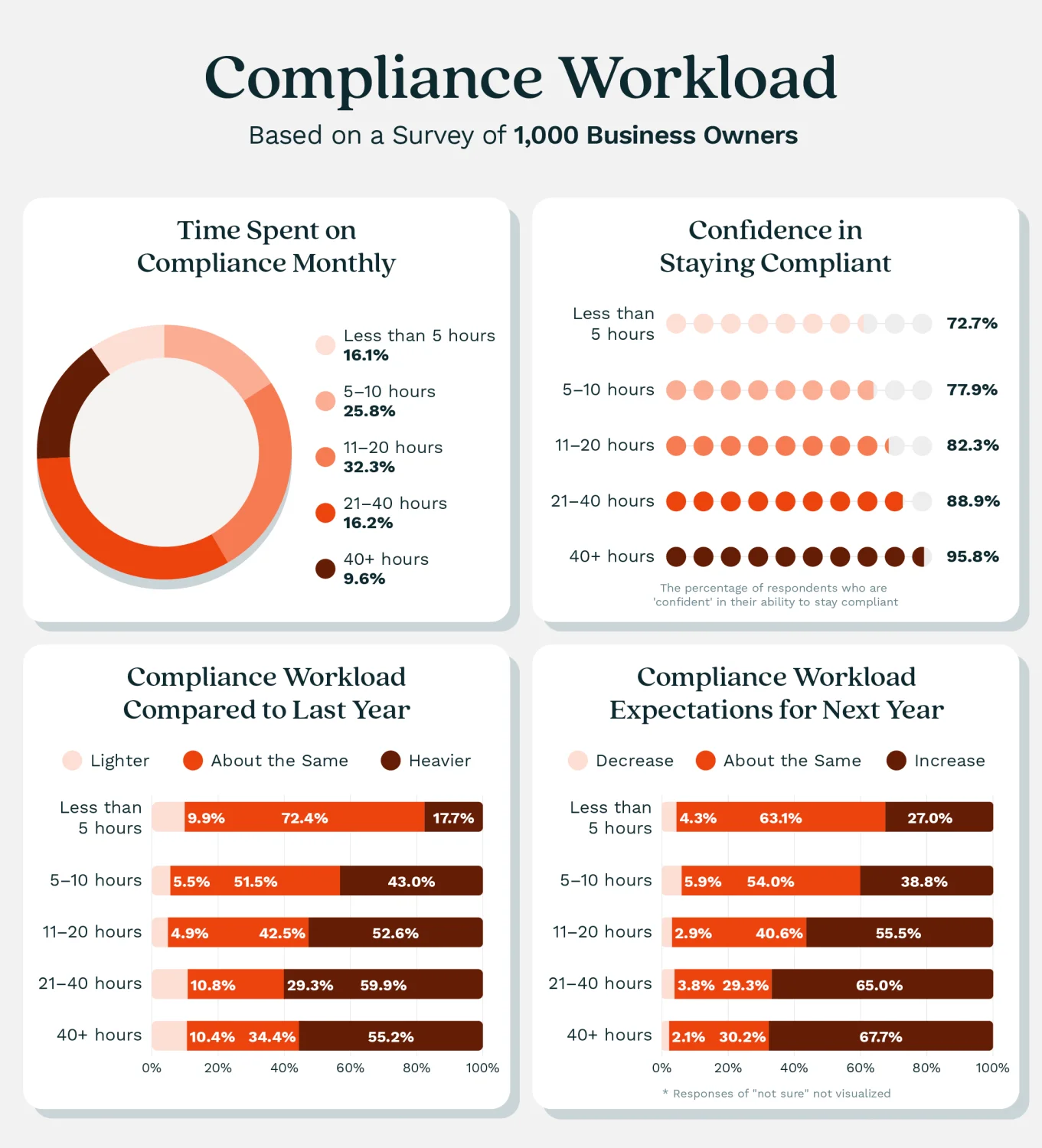
Compliance often operates in the background of daily operations, but the time and attention it requires shape how business owners run their companies. As regulations evolve and businesses grow, compliance is becoming a larger and more visible part of the small business workload.
Our survey of small business owners shows that for many, compliance is not delegated. It is personal.
Who’s handling compliance
For most small business owners, compliance responsibility sits at the top.
- 82% personally handle compliance themselves.
- Even among businesses with 50+ employees, 66% of owners still manage compliance on their own.
This hands-on approach suggests that compliance remains closely tied to ownership and oversight. In many cases, it is not treated as a back-office function but as a core leadership responsibility.
That visibility and direct involvement may reinforce owners’ sense of control, contributing to the high confidence they report in their ability to remain complaint
- 82% of business owners say they feel confident in their ability to stay compliant.
- 43% say they are “very confident.”
However, confidence is not evenly distributed and varies by stage and structure:
- Among businesses operating for less than one year, only 56% feel confident, and just 15% feel “very confident.”
- Solo owners are slightly more likely to feel confident, with 73% reporting confidence overall.
For many new owners, compliance responsibilities begin during the business formation process and continue building and evolving as operations expand.
Industry differences further underscore the role of structure and complexity :
- Cleaning services (95%) and manufacturing (93%) report the highest levels of confidence.
- Arts and entertainment businesses report the lowest, with 71% saying they feel confident.
Experience, operational structure, and regulatory complexity may all influence how prepared owners feel. Newer and solo operators as well as more nuanced regulatory environments may face greater uncertainty.
How much time compliance requires
Confidence does not eliminate workload. For many, compliance consumes a measurable share of each month.
- 32% spend 11 to 20 hours per month on compliance-related tasks.
- 26% spend five to ten hours.
- 16% spend 21 to 40 hours.
For businesses spending more than 20 hours per month, compliance begins to resemble at least a part-time role, rather than an occasional administrative task. At that level, it can feel like directly competing with revenue-generating activities and strategic priorities. The amount of time required underscores the operational complexity involved and the ongoing effort needed to keep up with evolving requirements.
Workloads are trending upward
Compliance workload is compounding — particularly for growing and already time-intensive businesses — rather than plateauing over time.
Nearly half of business owners report that compliance is taking more time than it did last year.
- 46% say their compliance workload is heavier than 1 year ago.
- 13% describe it as “much heavier.”
- Only 7% say it is lighter.
Those already dedicating significant time to compliance are more likely to feel the increase:
- 60% of those spending 21 to 40 hours per month say workloads have grown heavier.
- 55% of those spending 40+ hours report the same.
Among those who say their workload has grown heavier, these are the primary reasons:
- Business growth (66%).
- State or local regulations (45%).
- Increased enforcement (44%).
As businesses expand, compliance obligations often scale with them. New jurisdictions, additional employees, and expanded operations can introduce new reporting and regulatory requirements.
Those who report lighter compliance workloads told us the main reasons are:
- Better internal processes (46%).
- New state or local regulations (41%).
- New federal regulations (36%).
- Business decrease or stagnation (33%).
Together, these responses suggest that operational discipline and process improvements can meaningfully reduce compliance strain, even amid evolving regulatory requirements environments shift.
Looking ahead to 2026
Business owners anticipate that compliance demands will continue to intensify.
- Half (50%) expect their compliance workload to increase next year.
- Among businesses with 50+ employees, 73% anticipate an increase.
- By contrast, 36% of solo owners expect growth in workload.
Time investment today also shapes expectations about future demands:
- About 65% of those already spending more than 20 hours per month on compliance expect workloads to rise further.
Larger teams and growing operations may face more regulatory touchpoints, which can compound over time. Owners who are already deeply engaged in compliance appear to recognize that complexity is unlikely to recede.
For many, compliance isn’t just an occasional box to check; it’s a recurring and expanding responsibility that demands time, attention, and oversight. While most express confidence in their ability to manage it, nearly half report heavier workloads than last year, and half expect additional growth ahead.
As the workload increases, so do the stakes. Next, we’ll examine what happens when compliance falls short and how business owners are weighing the risks and consequences of noncompliance.
The Cost of Falling Out of Compliance
As compliance workloads grow, so does exposure to risk. It’s not only a time commitment, but also a potential financial and operational liability.
Our survey findings show that enforcement is not theoretical. A meaningful share of owners have experienced compliance-related consequences firsthand.
How Common Are Compliance Penalties?
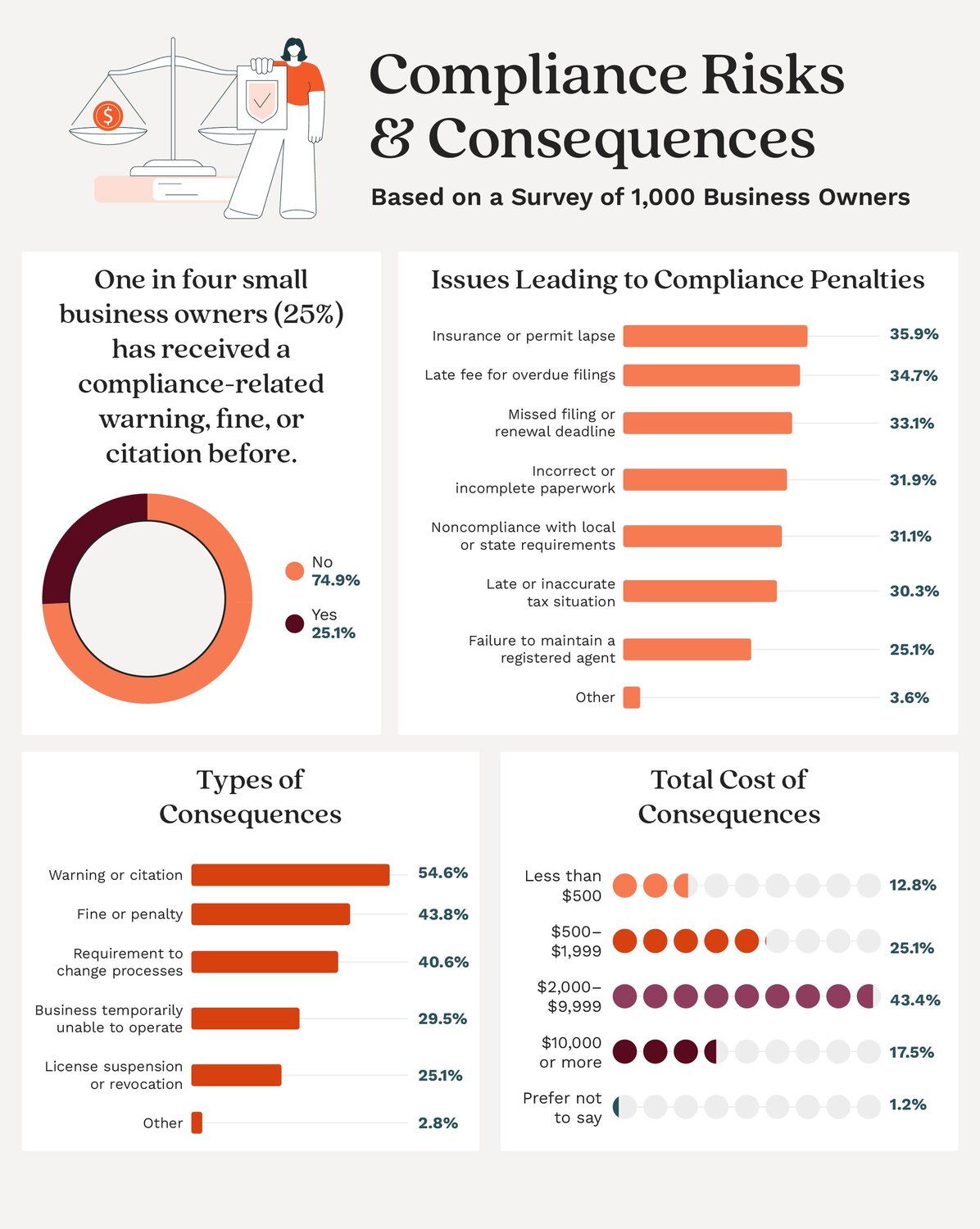
One in four small business owners (25%) report receiving a compliance-related warning, fine, or citation. The likelihood varies by owner demographic and industry:
- 30% of male owners report receiving a warning, fine, or citation.
- 18% of female owners report the same.
Certain industries face even higher exposure:
- Finance and insurance: 61% report receiving a compliance-related consequence.
- Manufacturing: 49% report the same.
These industries often operate within more heavily regulated environments, which may increase the number of reporting requirements, documentation standards, and oversight checkpoints.
What Triggers Compliance Consequences?
The compliance issues that most often lead to penalties are not necessarily complex violations. In many cases, they stem from timing or administrative oversight.
The most common compliance issues cited include:
- Insurance or permit lapses (36%)
- Late fees for overdue filings (35%)
- Missed filing or renewal deadlines (33%)
Compliance risks often arise from routine obligations rather than intentional misconduct. As workloads expand, even small gaps in tracking or follow-up can result in formal consequences.
What Those Consequences Look Like
Among those who experienced a compliance issue, the resulting consequences varied in severity and impact
- Warnings or citations: 55%
- Fines or financial penalties: 44%
- Required process changes: 41%
In many cases, penalties involved both financial and operational adjustments. Beyond paying fines, businesses often had to modify internal processes, update documentation practices, or implement new tracking systems to prevent repeat violations.
The financial impact is also notable. Most penalties totaled between $2,000 and $10,000, including fines, fees, and lost revenue.
For small businesses, that range can represent a significant unplanned expense. When paired with operational disruption and the time required to resolve the issue, the true cost of noncompliance can extend beyond the initial fine.
As compliance obligations expand, the impact is not limited to workload. It can directly affect financial stability and operational continuity. The next section examines how these pressures influence growth and whether compliance is becoming a barrier to expansion for small businesses.
Compliance Pressures and Their Impact on Growth
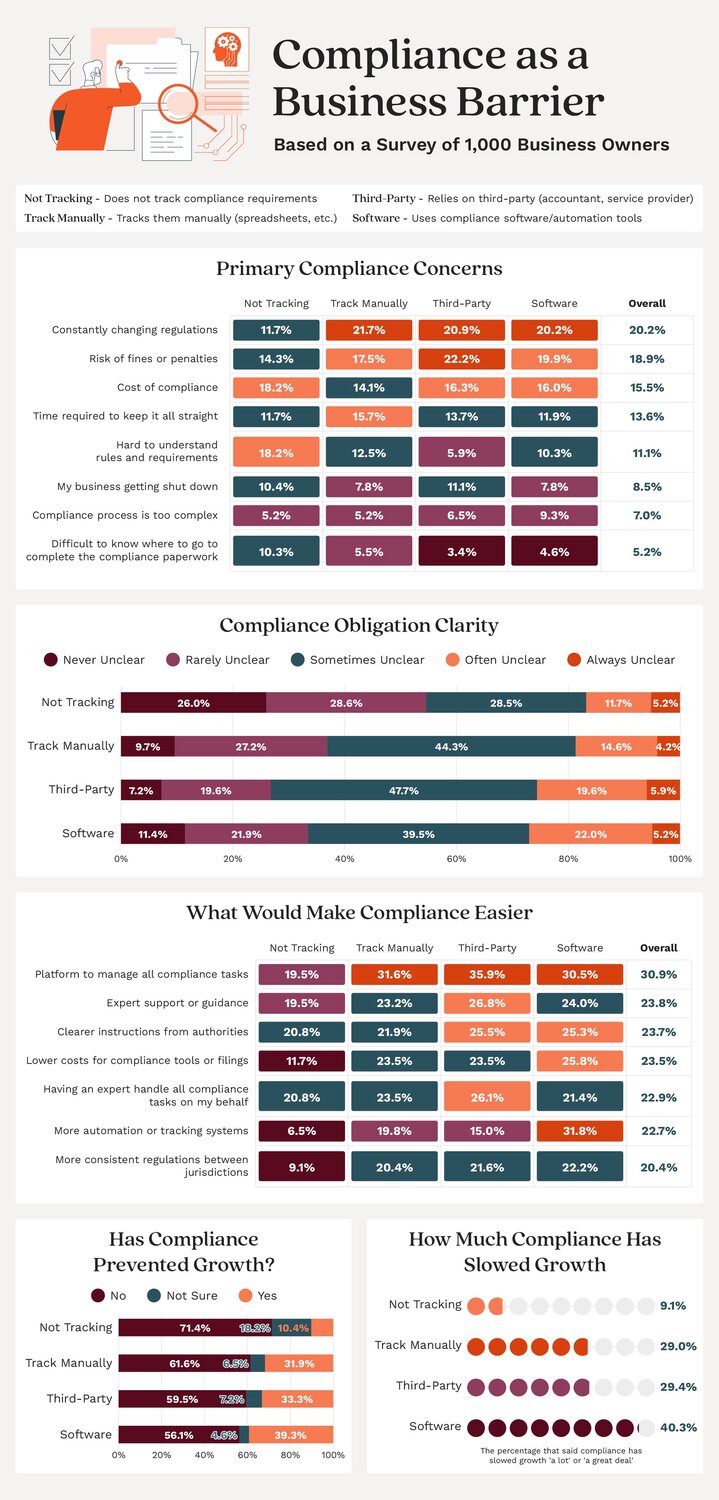
Compliance does not exist in isolation. The time demands, financial cost, and operational complexity tied to regulatory obligations can shape how businesses approach planning, hiring, and growth. For many small business owners, that means compliance isn’t only a requirement. It’s a factor that influences strategic decisions.
What Worries Business Owners Most
The most common compliance concerns reflect both regulatory uncertainty and operational strain:
- Constantly changing regulations (20%)
- Risk of fines or penalties (19%)
- Cost of staying compliant (16%)
- Time required to manage compliance (14%)
Concerns are distributed across regulatory change, financial risk, cost, and time — suggesting compliance strain is multifaceted rather than driven by one core pressure point.
For owners who do not systematically track compliance tasks, concerns shift slightly:
- Cost (18%)
- Difficulty understanding requirements (18%)
Owners without structured tracking systems are more likely to cite cost and confusion, reinforcing that process discipline may directly reduce perceived burden.
Industry differences highlight how context shapes perception:
- Arts and entertainment: 22% say compliance is hard to understand, compared to 11% across all industries.
- Transportation: 28% cite risk of fines or penalties as their primary concern, about 10% more than the overall sentiment.
Perceived compliance burden is closely tied to clarity and predictability. In industries with complex or highly regulated frameworks, uncertainty can amplify concern.
Uncertainty and How Compliance is Managed
Nearly 23% of business owners say they “often” or “always” feel unclear about what their compliance obligations are. Only 11% say they never feel this way. Part of that uncertainty stems from varying definitions and requirements across jurisdictions, which is why many business owners benefit from a clear breakdown of what business compliance is and how it works.
How compliance is managed appears to influence that experience:
- 17% of entrepreneurs who do not track compliance at all say they “often” or “always” feel unclear.
- 28% of those who use compliance software and 26% that rely on third parties report the same.
Owners who rely on structured systems may have greater visibility into the volume and complexity of their obligations. That increased awareness can make regulatory shifts more noticeable, which may elevate perceived uncertainty even as oversight and control are stronger.
When asked what would make compliance easier, owners pointed to practical solutions:
- One platform to manage all compliance tasks (31%)
- Expert support or guidance (24%)
- Clearer instructions from authorities (24%)
- Lower costs for compliance tools or filings (24%)
Among those who do not currently track compliance tasks, priorities center on:
- Clearer instructions from authorities (21%)
- Having an expert handle compliance tasks (21%)
The desire for centralization, clearer guidance, and expert support reflects a broader push toward operational simplification and reduced administrative complexity with small businesses.
Missed Opportunities and Delayed Growth
For some businesses, compliance obligations extend beyond administrative burden and directly influence strategic decisions.
33% say compliance requirements have prevented them from pursuing new business opportunities. This is most common among those who use dedicated software to track their compliance requirements (39%).
Industries also seem to be impacted differently, with those feeling it most being:
- Administrative support: 59%
- Manufacturing: 55%
- Finance and insurance: 55%
The opportunities most often missed include:
- Expanding to new areas (46%)
- Securing new partnerships (44%)
- Securing new investment (44%)
- Hiring (43%)
- Launching new products or services (41%)
The findings suggest that compliance extends beyond routine operations and can act as a constraint on business growth.. Expansion, partnerships, hiring, and product development often require navigating additional regulatory layers, which may delay timeline or deter forward action.
Impact On Focus and Operations
Compliance also affects how owners allocate time and mental bandwidth.
- 32% say compliance obligations impact their ability to focus on growth and operations “a lot” or “a great deal.”
- Only 10% say it does not impact them at all.
The effect is more pronounced among owners with structured oversight.
- 40% of those using compliance software say it impacts them “a lot.”
- 9% of those not tracking compliance report the same.
Industry variation remains consistent:
- Finance and insurance: 57%
- Manufacturing: 49%
- Compared to the overall average of 32%
In highly regulated sectors, compliance appears closely intertwined with daily operations and strategic planning. As regulatory intensity increases, so does the likelihood that compliance will influence, and at times constrain,=growth focus.
Compliance in 2026 extends well beyond routine filings and renewal deadlines. Business owners cite changing regulations, rising cost, and time demand as primary concerns, as nearly one in three say compliance has prevented them from pursuing new opportunities. For many, it also limits the attention away from expansion, operations, and other growth opportunities.
“Compliance is no longer just an administrative task. It’s a strategic consideration for small business owners,” said [Name], [Title] at LegalZoom. “When regulatory obligations begin to influence hiring decisions, expansion plans, or new product launches, it signals that compliance is directly tied to growth. The right structure and support can help business owners manage those requirements more efficiently, so they can focus on building and scaling their companies.”
Closing Thoughts
Compliance in 2026 is both a daily operational responsibility and a strategic consideration for small business owners. Our data shows that most still manage compliance themselves, often dedicating meaningful hours each month to staying current. Nearly half report heavier workloads than last year, and many anticipate that burden to increase further.
As regulations continue to evolve, small businesses need clarity, structure, and reliable support. LegalZoom provides step-by-step tools and attorney guidance designed to help business owners understand their obligations, stay organized, and move forward with confidence. In an environment where compliance shapes both risk and growth, having the right foundation in place can make all the difference.
Methodology
To better understand how small businesses are navigating regulatory compliance in 2026, we surveyed 1,000 U.S. small business owners in December 2025.
The sample included businesses across a range of industries, sizes, and revenue levels. Respondents were asked about the types of compliance requirements they handle, such as annual report filings, business licenses and permits, maintaining a registered agent, tax filings, and employment-related obligations, as well as how the regulatory workload has changed over the past year.
Questions explored confidence in meeting compliance requirements, time spent on compliance tasks, experiences with warnings or fines, the financial impact of non-compliance, and the tools or support systems businesses rely on. Additional items examined pain points, expectations for the year ahead, and interest in professional compliance support.
'%20/%3e%3c/svg%3e)

'%3e%3cpath%20fill-rule='evenodd'%20clip-rule='evenodd'%20d='M9.31239%2025.5316H13.0679V14.1032H9.31239V25.5316ZM11.1913%208.46875C9.93945%208.46875%209%209.25086%209%2010.505C9%2011.5995%209.78211%2012.5389%2011.1913%2012.5389C12.6005%2012.5389%2013.3826%2011.5995%2013.3826%2010.505C13.3826%209.4082%2012.6005%208.46875%2011.1913%208.46875ZM27%2018.9577V25.5316H23.2445V19.4275C23.2445%2017.8609%2022.6174%2016.7664%2021.3679%2016.7664C20.2711%2016.7664%2019.644%2017.5463%2019.3316%2018.1756C19.1743%2018.488%2019.1743%2018.8004%2019.1743%2019.1128V25.5316H15.4165V13.9458H19.1743V15.5123C19.644%2014.7302%2020.5835%2013.6357%2022.6174%2013.6357C25.1234%2013.7908%2027%2015.3573%2027%2018.9577Z'%20fill='white'/%3e%3c/g%3e%3cdefs%3e%3cclipPath%20id='clip0_952_9489'%3e%3crect%20width='18'%20height='18'%20fill='white'%20transform='translate(9%208)'/%3e%3c/clipPath%3e%3c/defs%3e%3c/svg%3e)

Related Content

Simplifying Compliance for Business Owners: Inside LegalZoom’s AI-Powered Business License Research Platform
March 25, 2026


Playing By The Rules: How Compliance Can Power Growth and Unlock New Markets
July 17, 2025
Contact us
For media inquiries, call us at (213) 371-6260 or email at press@legalzoom.com.
