AI and Entrepreneurship in 2026
A survey of 1,000 aspiring and current business owners reveals how entrepreneurs are using AI to start and run businesses, where they draw the line, and what it means for the future.


Table of contents
Artificial intelligence is no longer an emerging trend for entrepreneurs—it's the new baseline. Nearly half of business owners and aspiring founders now use AI tools on a regular basis, and outright resistance to AI has shrunk to a single-digit minority. What was once a curiosity for early adopters has become a daily operating tool for hundreds of thousands of small business owners across the country.
To understand how AI is reshaping entrepreneurship in real time, we surveyed 1,000 aspiring founders and current business owners across the United States about their AI usage, the tools they rely on, how they're substituting AI for professional services, where they still insist on human oversight, and how they see AI shaping their competitive future.
The results paint a picture of a business landscape that has fundamentally shifted—and one that is still negotiating the boundaries of what AI should and shouldn't do.
AI Adoption Has Gone Mainstream
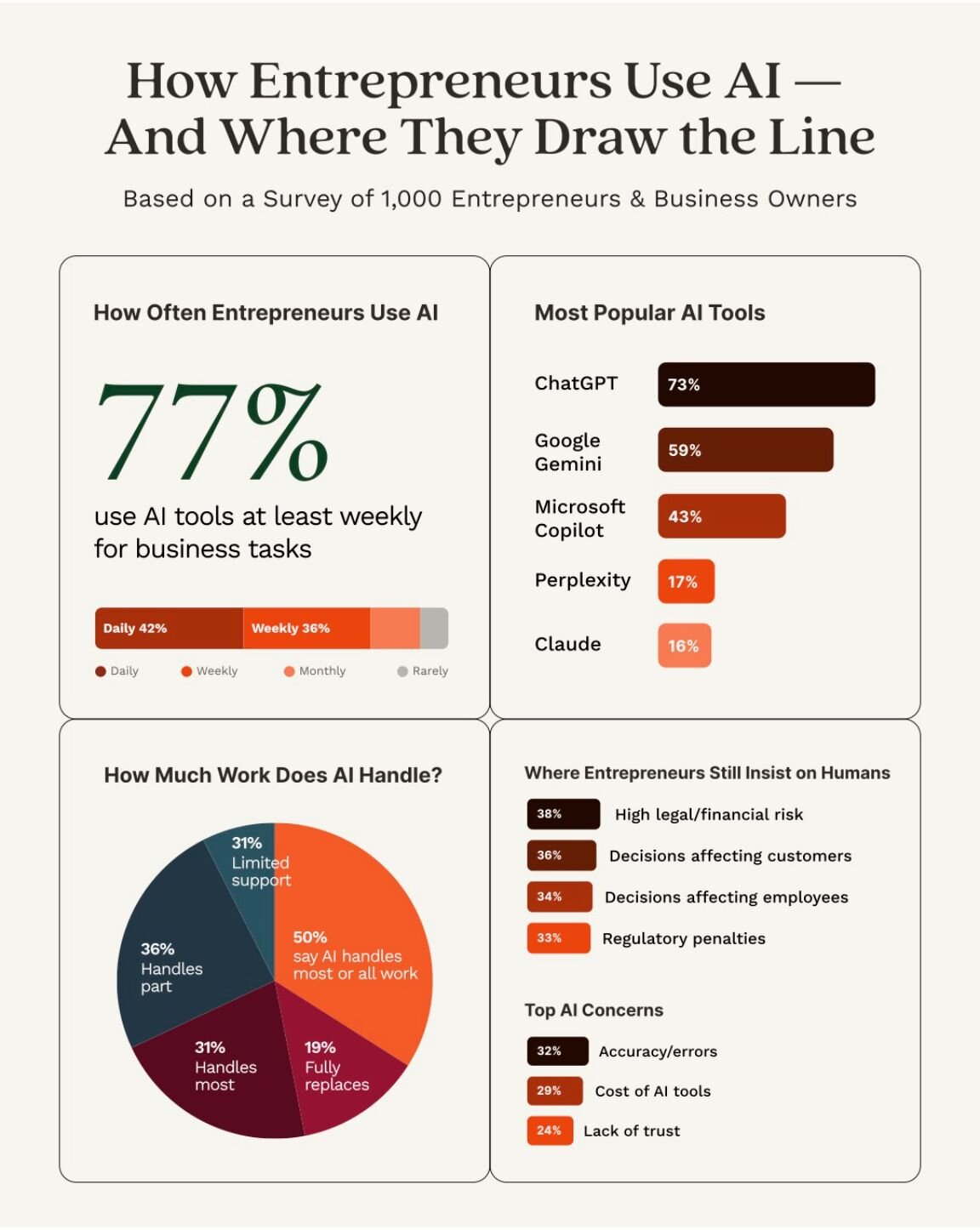
The data is clear: AI is no longer optional for most entrepreneurs. But how deeply it's been adopted (and by whom) reveals important nuances about where the technology is heading.
77% Say AI Is Important to Running a Business
Perhaps the most telling data point:
- 44% say AI tools are "very important" to their ability to start or run a business today.
- 33% say "somewhat important."
- Only 10% say AI is "not very" or "not at all" important.
More than three-quarters of entrepreneurs now view AI as an important part of their business toolkit.
Nearly Half of Entrepreneurs Use AI Regularly
The speed of AI adoption among entrepreneurs has been striking.
- 46% say they are currently using AI tools regularly to help start or run their business.
- Another 29% have experimented with AI tools, even if they haven't made them a regular part of their workflow.
- Only 8.5% say they have no plans to use AI for business at all.
That means more than nine in ten entrepreneurs are either actively using AI or open to it—another signal that resistance to AI in the business world has become a fringe position.
AI Is a Daily Habit for Many
When we asked how often entrepreneurs use AI for business tasks, the frequency was notable.
- 42% use AI tools daily.
- 36% use them weekly.
- Combined, more than three-quarters (77%) use AI at least weekly.
Daily usage was virtually identical between aspiring founders (42%) and established business owners (42%), challenging the assumption that newer entrepreneurs are leading the AI curve. Both groups have woven AI into their regular routines.
ChatGPT Leads, But the Field Is Growing
When it comes to specific tools, one platform dominates, but others are gaining meaningful traction.
- 73% use ChatGPT.
- 59% use Google Gemini.
- 43% use Microsoft Copilot.
- 17% use Perplexity.
- 16% use Claude.
ChatGPT's lead is significant, but the usage patterns suggest the AI tool landscape is more competitive than headlines often suggest. Business owners are increasingly multi-tool users, not locked into a single platform.
The Adoption Gap: Size and Education Matter
AI adoption is widespread, but not evenly distributed. Two factors create the sharpest divides.
By company size:
- 73% of businesses with 50+ employees use AI regularly.
- 42% of businesses with 2-9 employees do the same.
- Only 39% of solo entrepreneurs are regular AI users.
By education:
- 71% of entrepreneurs with a master's degree are regular AI users.
- 61% of those with a doctorate report regular use.
- Just 32% of high school graduates use AI regularly.
These gaps suggest that AI adoption may be tied to the resources, digital fluency, and organizational capacity that come with larger teams and advanced education. Solo founders and those without post-secondary education may need more accessible on-ramps to benefit from AI at the same rate.
Industry Matters, Too
Not every industry is embracing AI at the same pace. Among current business owners:
- In manufacturing, 61% report regular AI use—one of the highest rates of any sector surveyed.
- In healthcare and pharmaceuticals, 57% are regular users, particularly for compliance and administrative tasks.
- In consulting and professional services, 54% report regular use.
- In arts, entertainment, and content creation, adoption is notably lower, with just 29% of business owners reporting regular AI use, likely due to concerns about authenticity and intellectual property.
The finding that manufacturing leads in AI adoption is particularly striking and underreported. These are not tech companies—they're businesses using AI to streamline operations, manage supply chains, and handle administrative workloads.
How Entrepreneurs Are Using AI—and Where They Draw the Line
AI has moved beyond content generation and chatbot novelty. Entrepreneurs are applying it across a wide range of business functions, including some traditionally reserved for professionals. But the data also reveals clear limits to how far they're willing to go.
The Top Business Tasks for AI
The most common business tasks entrepreneurs use or would consider using AI for include:
- Customer support or communications (44%).
- Financial planning, budgeting, or forecasting (42%).
- Marketing content or strategy (42%).
- Administrative or operational tasks (39%).
These results reinforce that AI is being applied to substantive business functions, not just generating social media posts. Nearly a third of entrepreneurs are using or considering AI for legal and formation tasks, areas that carry real regulatory and compliance weight.
AI Is Substituting for Professional Services
One of the most significant findings is the extent to which entrepreneurs are using AI as a partial replacement for professional services.
- 37% have used AI as a substitute for customer support services.
- 35% for marketing or advertising services.
- 33% for business planning or consulting.
- 31% for administrative or virtual assistant services.
- 30% for accounting or bookkeeping.
Only 18% say they haven't used AI for professional services at all.
When asked how complete the substitution is:
- 19% say AI fully replaces the professional service.
- 31% say AI handles most of the work with minimal human involvement.
- 36% say AI handles part of the work, but humans remain essential.
- 11% say AI provides limited support, with humans doing most of the work.
Taken together, half of entrepreneurs believe AI handles most or all of the work that would otherwise require a professional. But the largest group (36%) sees AI as a powerful assistant, not a full replacement. The data suggests a hybrid model is emerging: AI does the heavy lifting, while humans provide oversight, judgment, and accountability.
Where Entrepreneurs Still Insist on Humans
Despite broad adoption, entrepreneurs have clear boundaries.
When asked in which situations they would not rely on AI, regardless of convenience:
- 38% say high legal or financial risk decisions.
- 36% say decisions affecting customers.
- 34% say decisions affecting employees.
- 33% say situations involving regulatory penalties.
- Only 18% say they would consider AI for all situations, with appropriate review.
These limits reflect an important pattern: entrepreneurs are pragmatic about AI, not ideological. They'll use it aggressively for operational efficiency, but pull back when the stakes involve legal liability, human impact, or regulatory exposure. Where errors carry real consequences, human expertise simply can’t be replaced.
Trust Is High—With Guardrails
The confidence numbers among entrepreneurs is notable:
- 67% say AI has increased their confidence in making business decisions. Among them, 24% say "significantly."
- Only 4% say AI has decreased their confidence.
- 62% say AI provides more value than traditional tools or professional services. Nearly a third (33%) call it "much more valuable."
But that trust comes with verification habits. When using AI for business decisions:
- 30% always verify with a trusted source.
- 36% usually verify.
- 18% verify only for important decisions.
- Only 1.3% never verify.
The message is nuanced: entrepreneurs trust AI enough to rely on it daily, but not enough to stop checking its work. Two-thirds verify outputs consistently, a sign of mature, cautious adoption rather than blind faith.
The Concerns That Persist
The top frustrations and limitations entrepreneurs report with AI:
- 32% cite concerns about accuracy or errors.
- 29% cite the cost of AI tools.
- 24% cite lack of trust in AI-generated advice.
- 22% cite time required to learn or set up AI tools.
- 21% cite legal or compliance risks.
- 19% cite difficulty applying AI outputs to real-world situations.
Accuracy remains the leading concern, and it's a legitimate one. As entrepreneurs push AI into higher-stakes applications, including legal, compliance, financial, the tolerance for error shrinks. Notably, cost is the second-most cited frustration, suggesting that the "AI is free" narrative doesn't match the experience of many business owners investing in premium tools and subscriptions.
The Competitive Edge and the Road Ahead
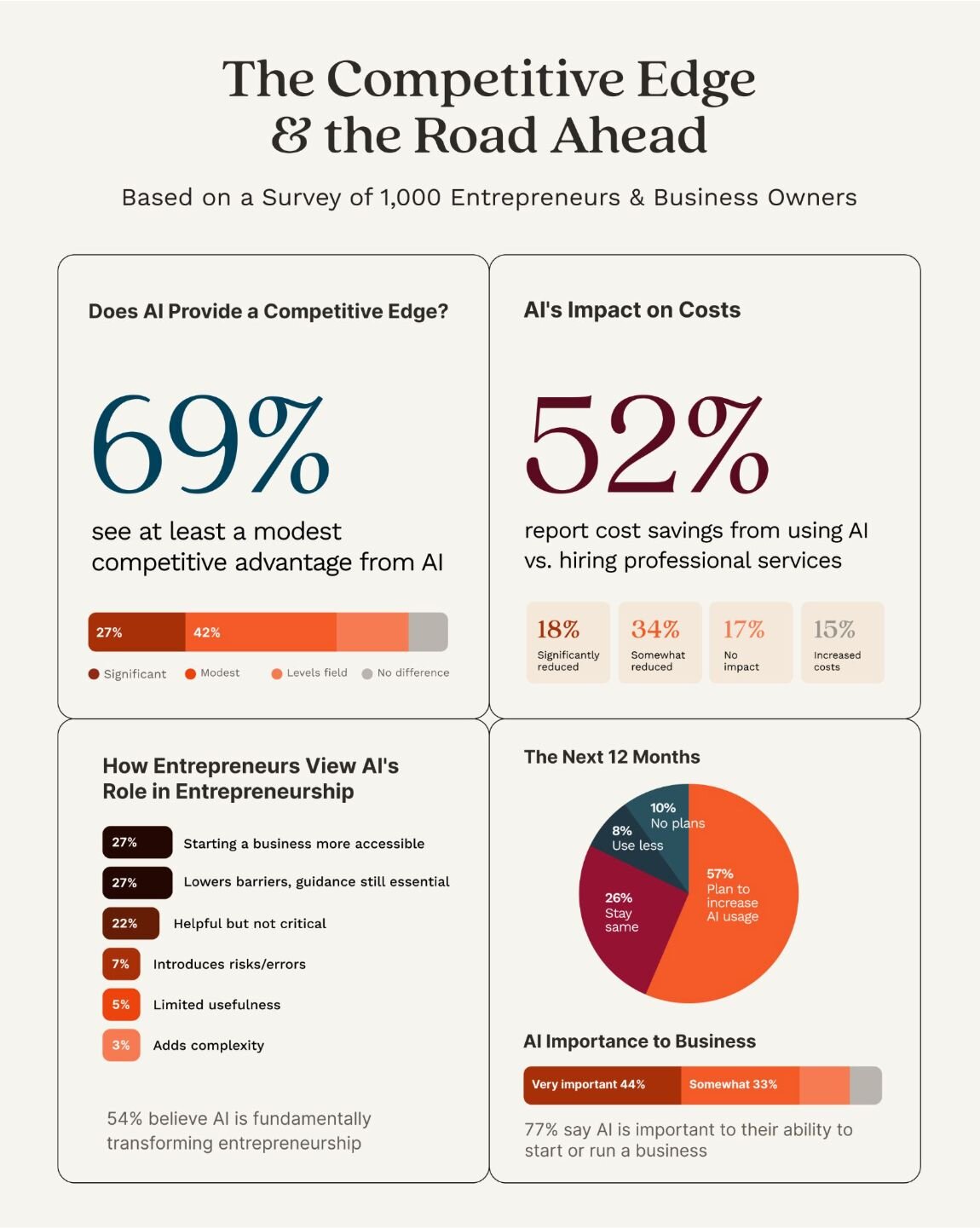
Alt Text: An infographic illustrating survey insights about the competitive advantages of AI for entrepreneurs and their outlook on AI usage over the next 12 months.
AI adoption is accelerating not because entrepreneurs think it's interesting, but because they believe it's giving them a measurable advantage. The data on cost, competition, and future plans makes the direction unmistakable.
Nearly 7 in 10 See a Competitive Advantage
When asked whether AI gives their business a competitive edge:
- 27% say a significant advantage.
- 42% say a modest advantage.
- 14% say it levels the playing field.
- 10% say it makes no difference.
Business owners are more likely than aspiring founders to see at least a modest advantage (44% vs. 40%), suggesting that real-world experience with AI reinforces its perceived value. When you've used AI to cut costs or speed up operations, the competitive benefit becomes tangible, not theoretical.
AI Is Cutting Costs for Most
Compared to hiring professional services:
- 18% say AI has significantly reduced their costs.
- 34% say it has somewhat reduced their costs.
- 17% say it's had no meaningful impact.
- Only 15% say AI has increased their costs.
More than half of entrepreneurs report cost savings from AI, with business owners slightly more likely than aspiring founders to experience reductions. This is significant in an environment where, as LegalZoom’s previous small business owners survey found, 53% of small business owners reported rising operating costs.
AI may be emerging as a counterbalance to cost pressures that have defined the small business experience in recent years.
How Entrepreneurs View AI's Role in Entrepreneurship
We asked respondents which statement best captures their view on AI and entrepreneurship:
- 27% say "AI makes starting a business more accessible than ever."
- 27% say "AI lowers barriers, but guidance is still essential."
- 22% say "AI is helpful but not critical for entrepreneurs."
- 7% say "AI introduces risks or errors that make it difficult to rely on."
- 5% say "AI has limited usefulness for entrepreneurship."
- 3% say "AI adds unnecessary complexity."
- 9% say “not sure.”
More than half (54%) believe AI is fundamentally transforming entrepreneurship, either by making it more accessible or by lowering barriers, with the caveat that guidance remains essential. Business owners are more likely than aspiring founders to say AI makes starting a business more accessible (29% vs. 25%), reflecting the perspective of those who have experienced the operational realities that AI can help solve.
The finding that 27% still emphasize the need for guidance alongside AI is particularly relevant. These entrepreneurs aren't anti-AI. They see its power, but they also recognize that AI output alone doesn't replace the need for expert knowledge, especially when risks are high.
The Next 12 Months: The Acceleration Continues
Looking ahead:
- 57% expect to increase their use of AI over the next 12 months. Among them, 21% plan to rely on AI "much more."
- 26% expect usage to stay about the same.
- Only 8% expect to use AI less.
- 10% don't plan to use AI for business tasks at all.
Business owners are slightly more bullish than aspiring founders (59% vs. 54% plan to increase). The trajectory is clear: the majority of entrepreneurs are planning to go deeper with AI, not pull back.
Closing Thoughts
The data from this survey tells a clear story: AI has moved from novelty to necessity for a large and growing share of American entrepreneurs. Nearly half use it daily. Most see it as a competitive advantage. More than half have used it to substitute for professional services. And close to six in ten plan to use it even more in the year ahead.
But the adoption story is more nuanced than the headlines suggest. Entrepreneurs trust AI for efficiency and cost savings, but draw clear lines around high-stakes decisions. They verify outputs. They worry about accuracy. And they recognize that AI lowers barriers without eliminating the need for expert guidance, especially in areas like legal compliance, financial planning, and business formation.
The gaps in adoption also matter. Solo founders, entrepreneurs without advanced degrees, and those in creative industries are adopting AI at lower rates. As AI becomes a competitive differentiator, those gaps could widen, making accessible tools and education more important than ever.
AI is lowering the barriers to entrepreneurship faster than ever, but it isn't eliminating the need for human judgment, legal expertise, or accountability. LegalZoom supports entrepreneurs at every stage of the business journey, from formation to ongoing compliance. As AI reshapes how businesses operate, having trusted legal and business guidance, whether through our vast independent attorney network or our own law firm, may be the real competitive advantage.
Methodology
To understand how artificial intelligence is shaping entrepreneurship in the United States, we surveyed 1,000 respondents: 500 aspiring founders who plan to start a business and 500 current business owners. Respondents were screened to ensure they represent the entrepreneurial population.
Participants spanned a range of industries, including consulting, healthcare, manufacturing, retail, construction, food services, and more. The sample also reflected diverse business sizes, from solo owners to companies with more than 50 employees, and a range of education levels and geographic regions across the U.S.
The survey explored AI tool usage, frequency, trust levels, professional service substitution, concerns, competitive perceptions, cost impact, and future adoption plans. Additional questions captured attitudes about the relationship between AI and entrepreneurship.
The survey was conducted online in January 2026.
'%20/%3e%3c/svg%3e)

'%3e%3cpath%20fill-rule='evenodd'%20clip-rule='evenodd'%20d='M9.31239%2025.5316H13.0679V14.1032H9.31239V25.5316ZM11.1913%208.46875C9.93945%208.46875%209%209.25086%209%2010.505C9%2011.5995%209.78211%2012.5389%2011.1913%2012.5389C12.6005%2012.5389%2013.3826%2011.5995%2013.3826%2010.505C13.3826%209.4082%2012.6005%208.46875%2011.1913%208.46875ZM27%2018.9577V25.5316H23.2445V19.4275C23.2445%2017.8609%2022.6174%2016.7664%2021.3679%2016.7664C20.2711%2016.7664%2019.644%2017.5463%2019.3316%2018.1756C19.1743%2018.488%2019.1743%2018.8004%2019.1743%2019.1128V25.5316H15.4165V13.9458H19.1743V15.5123C19.644%2014.7302%2020.5835%2013.6357%2022.6174%2013.6357C25.1234%2013.7908%2027%2015.3573%2027%2018.9577Z'%20fill='white'/%3e%3c/g%3e%3cdefs%3e%3cclipPath%20id='clip0_952_9489'%3e%3crect%20width='18'%20height='18'%20fill='white'%20transform='translate(9%208)'/%3e%3c/clipPath%3e%3c/defs%3e%3c/svg%3e)

Related Content



Contact us
For media inquiries, call us at (213) 371-6260 or email at press@legalzoom.com.
