Small Business Outlook in 2026
60% of small business owners describe their outlook for 2026 as optimistic


Table of contents
Small business owners are entering 2026 in a complex environment shaped by fluctuating costs, evolving technology, and economic volatility. Many formed their businesses with a clear sense of purpose and independence, but now, they must balance growth ambitions with operational demands that extend well beyond their core product offerings.
To better understand how founders are navigating this moment, we surveyed small business owners across the U.S. about their motivations at formation, current business health, funding confidence, cost pressures, and plans for the year ahead. We also examined how artificial intelligence is influencing day-to-day business operations and long-term strategy.
The results offer a snapshot of how entrepreneurs are feeling about 2026, where optimism is building, and where uncertainty continues to shape decision-making.
Founders’ Early Mindset and Current Business Health
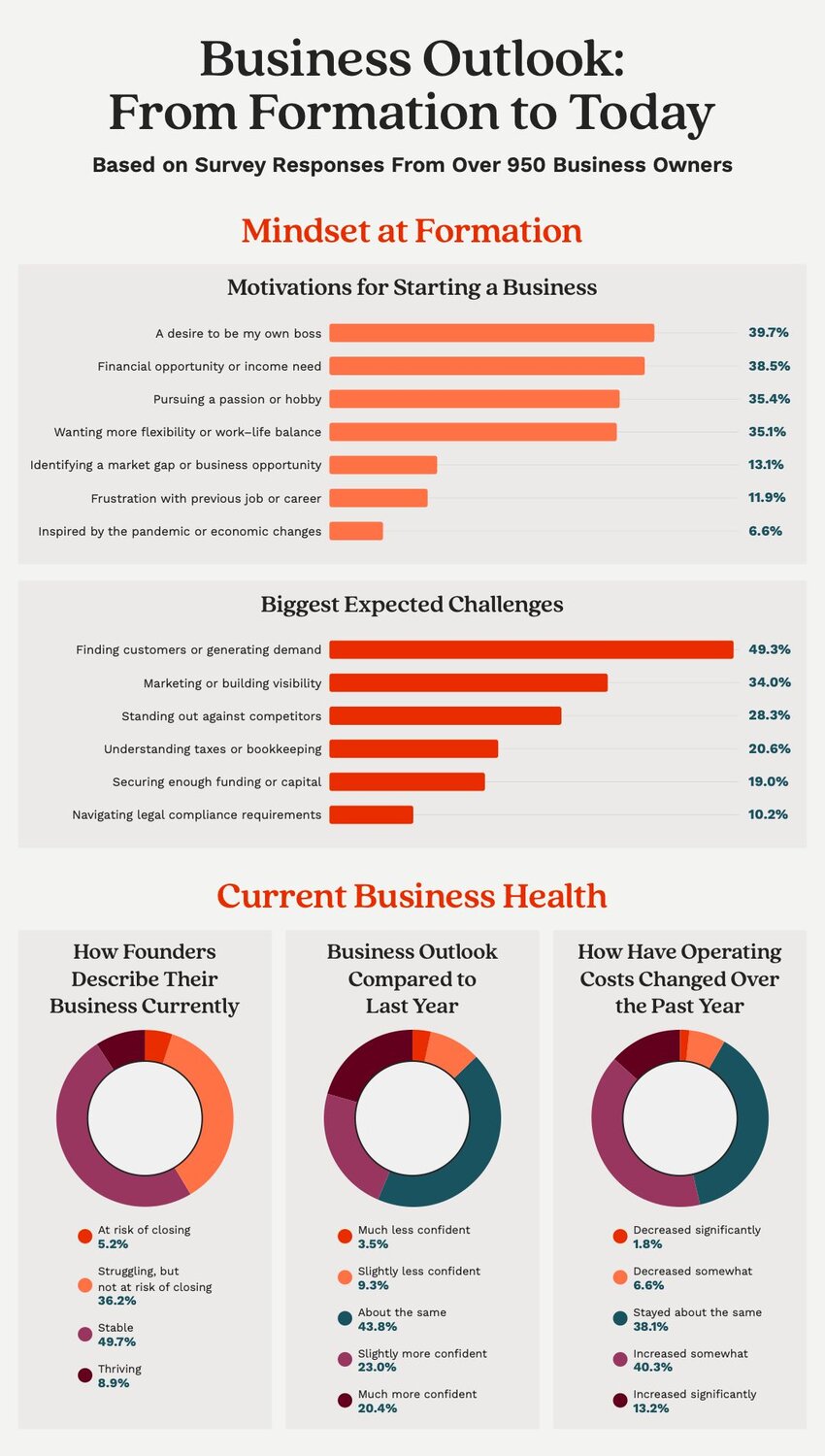
Starting a business often begins with conviction. But over time, that conviction must contend with operational complexity, rising costs, and evolving market conditions. Our survey data reveals how founders’ original motivations compare with their current business health and confidence.
What Motivated Founders To Take the Leap
For many entrepreneurs, independence remains the defining spark.
- 40% say their primary motivation for starting a business was the desire to be their own boss.
- 39% cite financial need.
- 35% point to pursuing a passion.
- 35% wanted greater flexibility.
While financial pressures and personal interests played major roles, autonomy narrowly ranked highest, indicating that people continue to value self-direction and control over the work they do.
That desired independence, however, also requires founders to shoulder full responsibility for the challenges ahead, growth, compliance, and long-term viability.
The Challenges Founders Expected
Before opening their doors, founders anticipated clear hurdles:
- 49% expected difficulty in finding customers.
- 34% anticipated challenges with marketing and building visibility.
- 28% worried about standing out against competitors.
- 21% expected difficulty understanding taxes and bookkeeping.
Revenue generation was the most anticipated challenge, underscoring the importance of customer acquisition to business owners. At the same time, administrative readiness proved to be a meaningful concern, highlighting the dual pressures of growth and compliance that founders expected to face.
27% felt unprepared to handle administrative and legal requirements at launch. Among those who felt least prepared:
- 53% cite handling taxes and bookkeeping.
- 26% cite choosing the right business structure, such as an LLC or operating as a sole proprietorship.
- 23% cite understanding business licensing.
- 15% cite creating legal documents and contracts.
These findings suggest that independence may ignite the decision to start a business, but sustained success ultimately hinges on how effectively founders manage the operational and compliance demands that follow. While founders plan for customer acquisition, many underestimate the time and expertise required to manage compliance and administrative workloads. Access to qualified business attorneys can help founders navigate entity selection, licensing requirements, and contract development with greater clarity.
Nearly half of respondents, 48%, say running a business is harder than they first expected. Only 14% say it’s easier. The gap between expectation and experience appears closely tied to operational demands beyond core business functions.
Business Health Today Is Stable, But Under Pressure
When asked to describe their current business health:
- 50% say their business is “stable.”
- 36% say they are “struggling” but not at risk of closing.
- 9% describe their business as “thriving.”
Stability is the norm, but strong, widespread growth is less common. Industry differences are notable.
In healthcare and pharmaceuticals, 65% describe their business as stable, and only 21% say they are struggling. That relative steadiness may reflect consistent demand and structured regulatory environments within that sector.
Confidence has also shifted over time, both in the short- and long-term:
- 43% are more confident that their business will still be open in a year than they were this time last year.
- 13% are less confident that their business will still be open in a year.
- 43% are confident that their business will still be operating 5 years from now.
- 16% are not confident in their 5 year outlook.
Short-term confidence appears to be improving for many, even as long-term uncertainty remains for a meaningful segment of founders, suggesting that maintaining stability—not acceleration—characterizes the outlook among those surveyed.
Rising Costs and Difficult Decisions
Cost pressures are a defining theme across responses.
- 53% report that operating costs have increased over the past year.
- Just 8% report decreases.
The largest spending increases include:
- 43% cite materials.
- 26% cite technology.
- 23% cite marketing.
In consulting and professional services, 45% say technology and software represent their largest increase in spending. That trend reflects continued investment in digital infrastructure and tools, even amid cost concerns.
To offset higher expenses:
- 44% have raised prices, and an additional 17% have not yet raised prices but plan to.
- 22% say rising costs have made them consider closing their business in the past year.
Taken together, the findings suggest rising costs are compressing margins and forcing many founders to prioritize financial stability over growth investment. While price adjustments are a common response, they carry risk in competitive markets. The fact that more than one in five founders have considered closing underscores how sustained cost inflation can strain even established businesses.
Funding Confidence Heading Into 2026
Access to capital remains uncertain for many entrepreneurs.
- 30% are not confident in their ability to secure funding in 2026 if needed.
- 39% are confident in their ability to secure funding.
With cost increases and competitive pressures shaping the operating environment, access to funding may play a decisive role in which businesses expand, stabilize, or scale back in the coming year.
Many founders often begin their journey motivated by independence and opportunity. But, over time, administrative demands, rising costs, and compliance responsibilities reshape that experience.
Next, we’ll examine how artificial intelligence is influencing these dynamics and shaping entrepreneurs’ outlook for 2026.
Technology, Priorities, and the Business Outlook in 2026
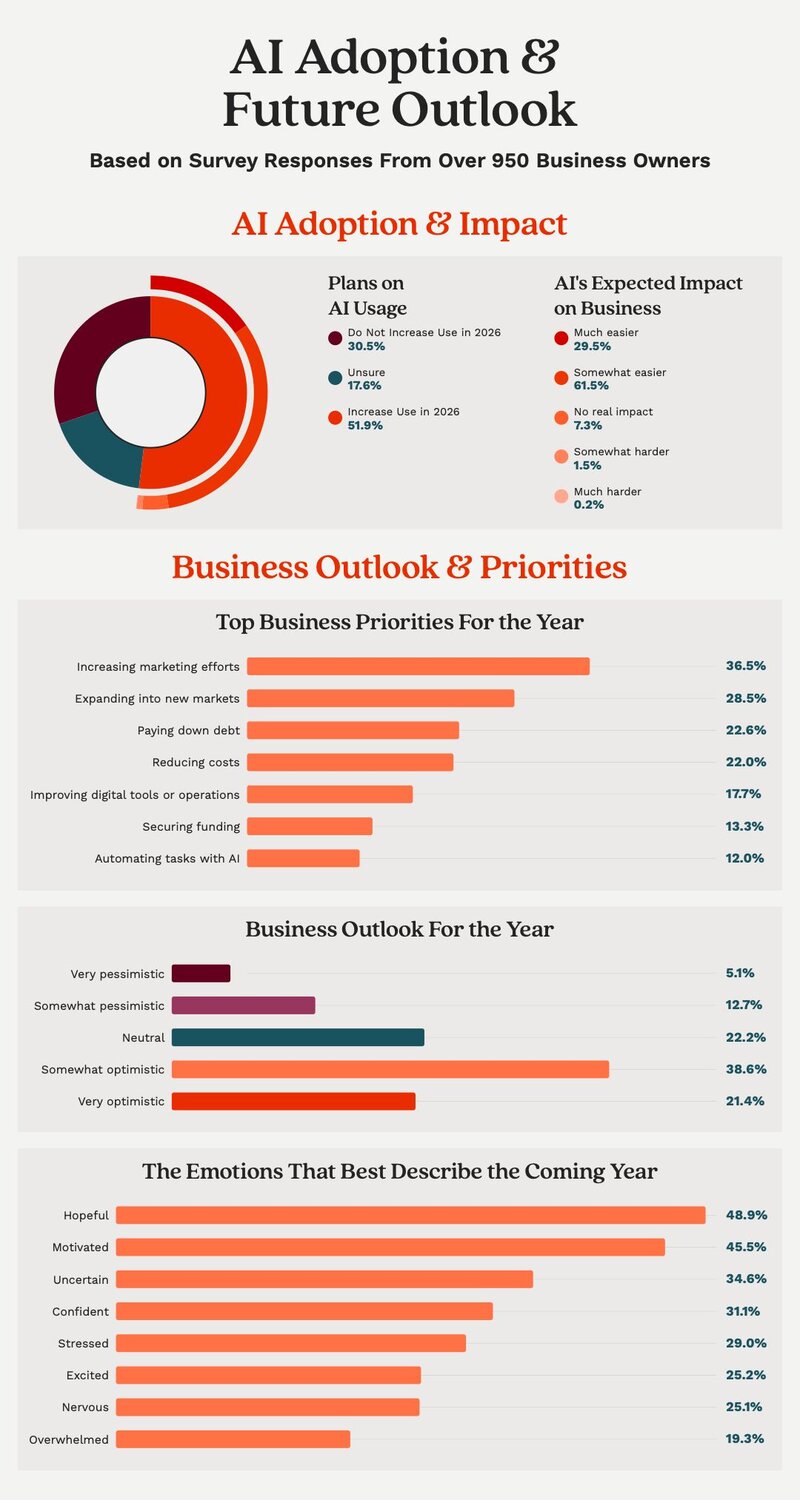
As founders move through 2026, many are balancing cost pressures and compliance demands with a renewed focus on growth, and artificial intelligence sits at the center of that equation. But whether it represents efficiency and scale or just introduces new uncertainty depends on who you ask.
AI Adoption is Accelerating, Especially for Larger Teams
More than half of small business owners are preparing to expand their use of AI tools.
- 52% plan to increase their use of AI in 2026.
- 18% are unsure.
Adoption varies by business size:
- 70% of businesses with more than 5 employees plan to increase AI use.
- 48% of businesses with fewer than 5 employees plan to do the same.
The variation in planned adoption indicates that AI may become a key lever of efficiency and scale, particularly for businesses with greater internal capacity to implement it. Larger teams may see AI as a way to streamline operations, support compliance tracking, or manage marketing and administrative workloads more efficiently. Smaller businesses appear more cautious, potentially reflecting limited resources or a need to prioritize immediate operational demands over learning and adopting a new technology.
Most Expect AI to Make Running a Business Easier
Among those increasing AI use:
- 30% believe it will make running their business “much easier.”
- 62% say it will make it “somewhat easier.”
That means more than nine in ten expect at least some operational benefit. In an environment where founders report rising costs and administrative strain, AI appears to be viewed less as experimentation and more as a practical efficiency tool—one that reduces manual workload and supports day-to-day operation.
Industry differences are notable.
- In healthcare and pharmaceuticals, 72% believe AI will make running their business easier in 2026.
- In arts and entertainment, 23% believe AI will make it harder to run their business.
- 46% of arts and entertainment businesses plan not to increase AI use in 2026, while only 37% plan to increase it.
These differences may reflect how directly AI integrates into daily operations. In regulated or process-driven industries, automation and data tools may support documentation and workflow management. In creative industries, concerns about authenticity, intellectual property, or disruption may shape adoption decisions.
Strategic Priorities Reflect Both Growth and Caution
While AI adoption grows, founders remain focused on core business fundamentals.
Top priorities for 2026 include:
- Increasing marketing efforts (36%)
- Expanding into new markets (28%)
- Wanting to pay down debt (23%)
- Reducing costs (22%)
The mix of expansion initiatives and financial discipline reflects a balanced approach. Many founders are pursuing growth while working to stabilize operations after a period marked by cost increases and economic uncertainty.
When asked what they most need from policymakers to succeed in 2026, respondents point to broader economic conditions:
- 39% want less economic uncertainty.
- 35% want lower inflation.
- 29% want lower taxes.
- 25% want increased consumer spending.
These responses suggest that while individual business strategy matters, macroeconomic stability plays a central role in shaping founder confidence and planning the year ahead.
Outlook for 2026: Realistic Optimism
Despite ongoing challenges, overall sentiment trends positively. 60% describe their outlook for 2026 as “optimistic,” 21% of whom say they are “very optimistic.”
Drilling into those feelings a little deeper, we asked respondents what their emotions are heading into 2026. Results reflect a mix of confidence and caution:
- 49% feel hopeful.
- 46% feel motivated.
- 35% feel uncertain.
- 31% feel confident.
The presence of both optimism and uncertainty reflects an environment where founders are navigating cost pressures, regulatory demands, and technological change simultaneously.
Still, not all founders would make the same decision.
- 12%, about one in eight, say that if they had to start over today, they would not start their business again.
Among that group, the primary reasons include:
- Current economic conditions (48%)
- Too much stress (38%)
- A decline in customer demand (25%)
These responses highlight the personal and operational weight of entrepreneurship. Economic volatility and sustained pressure continue to influence how founders assess long-term sustainability.
“Small business owners are showing resilience in 2026, but resilience doesn’t make today’s operating environment any less complex,” said Allison DeSantis, senior director, product counsel at LegalZoom. “Our findings show that founders remain optimistic about growth, and many are turning to AI to improve efficiency. At the same time, rising costs, funding uncertainty, and compliance demands are shaping how they make decisions. With the right legal foundation and ongoing support in place, business owners are better positioned to adapt, manage risk, and pursue new opportunities with confidence.”
Closing Thoughts
Small business owners enter 2026 balancing ambition with operational pressure. Our data shows a community motivated by independence, navigating rising costs, and increasingly turning to AI to manage workload and drive growth. While many describe their businesses as stable and express optimism for the year ahead, uncertainty around funding, inflation, and compliance remains part of the equation.
Founders aren’t just building products and serving customers. They’re managing taxes, licensing, legal documents, and evolving regulatory requirements. As expectations meet operational reality, the need for reliable guidance becomes clearer.
LegalZoom supports entrepreneurs at every stage of that journey, from formation to ongoing compliance. As small business owners plan for 2026, having structured tools and trusted legal support can help turn optimism into sustained progress.
Methodology
To better understand how small business owners are navigating today’s economy and preparing for 2026, we surveyed 974 small business owners and entrepreneurs across the United States in December 2025. Respondents were screened to ensure they currently own or operate a small business.
Participants represented a wide range of industries and also reflected diverse business sizes, from sole proprietors to companies with more than 50 employees.
The survey explored how small business owners are experiencing current economic conditions, their confidence in funding and growth, and their expectations for the year ahead. Questions covered topics such as operating costs, pricing changes, access to funding, business priorities, and overall optimism for 2026. Additional hypothetical and forward-looking questions captured how entrepreneurs might respond to economic shifts or new funding opportunities.
The survey was conducted online over one week in December 2025.
'%20/%3e%3c/svg%3e)

'%3e%3cpath%20fill-rule='evenodd'%20clip-rule='evenodd'%20d='M9.31239%2025.5316H13.0679V14.1032H9.31239V25.5316ZM11.1913%208.46875C9.93945%208.46875%209%209.25086%209%2010.505C9%2011.5995%209.78211%2012.5389%2011.1913%2012.5389C12.6005%2012.5389%2013.3826%2011.5995%2013.3826%2010.505C13.3826%209.4082%2012.6005%208.46875%2011.1913%208.46875ZM27%2018.9577V25.5316H23.2445V19.4275C23.2445%2017.8609%2022.6174%2016.7664%2021.3679%2016.7664C20.2711%2016.7664%2019.644%2017.5463%2019.3316%2018.1756C19.1743%2018.488%2019.1743%2018.8004%2019.1743%2019.1128V25.5316H15.4165V13.9458H19.1743V15.5123C19.644%2014.7302%2020.5835%2013.6357%2022.6174%2013.6357C25.1234%2013.7908%2027%2015.3573%2027%2018.9577Z'%20fill='white'/%3e%3c/g%3e%3cdefs%3e%3cclipPath%20id='clip0_952_9489'%3e%3crect%20width='18'%20height='18'%20fill='white'%20transform='translate(9%208)'/%3e%3c/clipPath%3e%3c/defs%3e%3c/svg%3e)

Related Content

LegalZoom Launches Free AI-Powered Grant Finder to Help Small Businesses Discover Critical Funding
March 19, 2026


Contact us
For media inquiries, call us at (213) 371-6260 or email at press@legalzoom.com.
