.
.





Forming an LLC in Illinois requires filing articles of organization with the Secretary of State and paying a $150 base filing fee. This guide walks through choosing a compliant name, appointing a registered agent, choosing a management structure, and handling post-approval tasks such as annual reports, tax and employer registrations, banking, and licensing. Which follow-up registrations you need depends on what your business does, whether you hire employees, and where you operate.
Key takeaways
- Illinois LLC formation starts with articles of organization (Form LLC-5.5) and a $150 state filing fee.
- Your filing needs accurate name, registered agent, management authority, purpose, organizer, duration, and member information.
- After approval, handle the tax, employer, banking, licensing, and recordkeeping steps that fit your business.
- An annual report costs $75 and may be filed during the 60 days before the first day of the anniversary month.
Step 1: Choose a name for your Illinois LLC
Your LLC's name must be distinguishable from the names the Secretary of State has on file and include an approved designator. A name conflict can lead the Secretary of State to return your articles of organization for correction, so search carefully before you file.
What are the Illinois LLC naming requirements?
Under the Illinois Limited Liability Company Act, your LLC name must:
- Be distinguishable from all other business entity names on file with the Illinois Secretary of State. Differences in punctuation, spacing, or capitalization alone aren't enough.
- Contain an approved designator: "Limited Liability Company," "L.L.C.," or "LLC" (with or without periods).
- Avoid implying a different entity type ("corporation," "incorporated," "inc.," "corp.," "limited partnership," "L.P.") or government affiliation.
- Comply with industry-specific naming rules and required approvals around words associated with banking, insurance, fiduciary services, or another regulated activity.
If the Secretary of State returns a filing because of a naming problem, correct the issue and follow the current resubmission instructions. A name search is helpful, but it does not guarantee approval.
Search the Illinois Secretary of State's database with LegalZoom’s free business name search tool. This will show you if your preferred name is available or if another business is already using it.
Free Illinois LLC Lookup
Starting a business? Use our free name check tool to check your business name against the Illinois Secretary of State records.
By clicking "Check Availability," I agree to LegalZoom's Terms of Use. This search is a preliminary check of state databases and does not include variations or trademarks. Results do not guarantee name availability or compliance with legal requirements.
Additionally, just because a business name isn’t registered in Illinois does not mean that it’s completely available. Run a federal trademark search to ensure your preferred LLC name is not already protected.
Do I need to reserve a name before forming an LLC in Illinois?
It isn't required, but it can be useful if you've chosen a name and aren't ready to file. File Form LLC-1.15 (Application to Reserve a Name) for $25 to hold the name for 90 days, either online or by mail to the Department of Business Services in Springfield. After 90 days, the reservation expires and the name may become available to someone else.
Should I file an Illinois assumed name (DBA) for my LLC?
If you want to operate under a name that's different from the one on your articles of organization, register an assumed name (DBA) with the Illinois Secretary of State. The fee depends on the year of registration. The registration is renewed on a five-year cycle, so check the current instructions before filing.
Should I register my Illinois LLC name as a state trademark?
Registering a name or logo as an Illinois state trademark is optional and separate from forming an LLC. The Secretary of State's forms page lists a $10 trademark or servicemark application fee, but it does not state a per-class fee. State registration is not the same as federal registration, so if you plan to operate beyond Illinois, review the USPTO's trademark guidance too.
Should I check domain availability before filing my Illinois LLC name?
Illinois doesn't require a matching domain, but check anyway before you commit. You don't want your legal name and your brand pulling in different directions.
Step 2: Appoint an Illinois registered agent
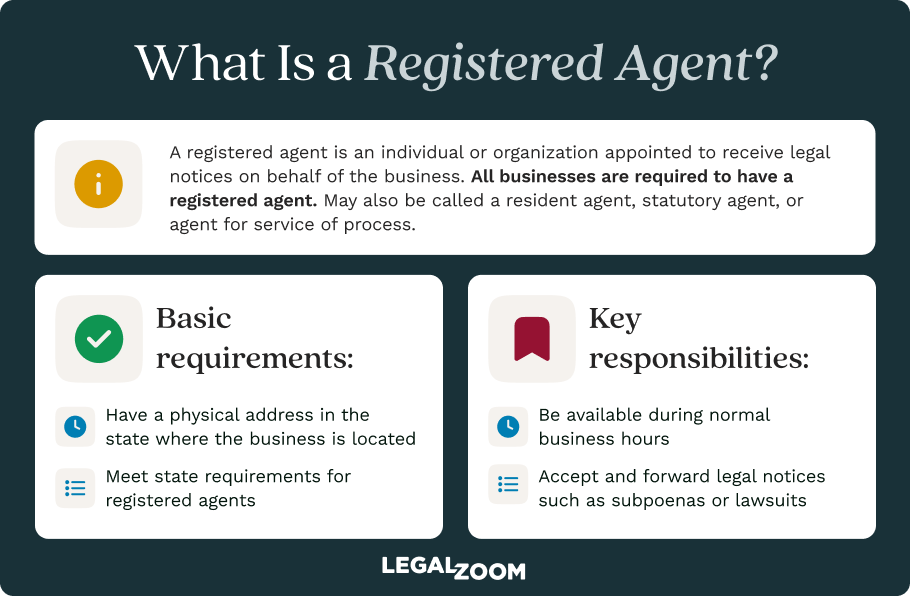
Illinois law requires every LLC to keep a registered agent and registered office on file. The agent must be an Illinois resident individual or an entity authorized to transact business in Illinois, and the registered office must have an Illinois street or rural-route address that is identical to the registered agent's business-office address; a P.O. box alone is not enough. Keep the information current so you do not miss legal notices or state correspondence.
Can I be my own registered agent in Illinois?
Yes, if you are an Illinois resident and can use an Illinois registered office that meets the state's address requirements. Your name and address will generally be public, and you need a reliable way to receive service of process and state correspondence. Really consider the privacy and availability requirements when deciding whether to serve as your own registered agent.
How do I choose a registered agent for an Illinois LLC?
If you travel often or you want to keep your home office off public record, consider a commercial registered agent. This can be an individual or entity authorized to transact business in Illinois that has an Illinois street address and is reliably
What happens if my Illinois LLC doesn't maintain a registered agent?
Illinois law gives the LLC 60 days after the resignation notice to name a replacement. If the record is not updated, the LLC may miss legal notices and can face compliance problems, including possible administrative dissolution.
Step 3: Decide whether your Illinois LLC will be member-managed or manager-managed
Your articles of organization and operating agreement should make the management authority clear. Form LLC-5.5 asks for the names and business addresses of managers and any member with manager authority, which helps banks and other parties understand who may act for the company.
What is the default management structure for an Illinois LLC if I don't specify one?
Illinois defaults to a member-managed structure unless the operating agreement expressly provides for manager management. In a manager-managed LLC, designated managers handle the company's operations while members may take a more hands-off role.
What's the difference between member-managed and manager-managed for an Illinois LLC?
In a member-managed LLC, members generally have management authority, subject to the operating agreement and applicable law. That works well for small LLCs where everyone wants a hand in things. In a manager-managed LLC, members appoint one or more managers (who may or may not be owners) to run operations while members act more like passive investors. That fits larger LLCs or setups where some owners would rather stay hands-off. Either way, list the names and business addresses of everyone with management authority on your articles of organization.
Step 4: File your Illinois articles of organization with the Illinois Secretary of State
Filing articles of organization legally creates your LLC. Submit Form LLC-5.5 to the Secretary of State's Department of Business Services. Once it's approved, the details become public record. Get your name, registered agent, and management structure locked in first, since this filing brings all three together.
What information do I need to include on the Illinois articles of organization?
- LLC name: Needs an approved designator and has to be distinguishable from every name on file
- Principal place of business address: May be outside Illinois, but use an address permitted by the form
- Registered agent name and Illinois registered-office address: The office address must match the agent's business-office address, so a P.O. box alone is not sufficient
- Management authority: Names and business addresses of managers and members with manager authority
- Duration: Perpetual existence or a fixed end date
- Purpose: State the purpose of the LLC. A general statement, such as "any lawful purpose" may be used
- Organizer name, address, and signature: The organizer must be a natural person age 18 or older and does not need to be a member or manager
How do I file an LLC online in Illinois?
Use the Secretary of State's online LLC instructions and filing portal. Online organization is limited to a domestic LLC that does not require a specific purpose or custom provisions. The current instructions list $150 for standard online service with 10 business days of processing and $250 for 24-hour service. If you need custom provisions, review the paper-filing option and current instructions.
Can I file Illinois LLC articles of organization other ways?
- By mail: Send two copies of the completed Form LLC-5.5 and payment to the Department of Business Services, Limited Liability Division, 501 S. Second Street, Room 350, Springfield, IL 62726. Confirm the current mailing instructions before sending a paper filing.
- In person: Same Springfield office, Monday through Friday, 8:00 a.m. to 4:30 p.m. Central time
The articles have a $150 base filing fee, but payment processing charges or expedited service fees may be separate.
Is my Illinois LLC's formation information public record?
Yes. Information filed with the Secretary of State may appear in the public entity record, and the business entity search tool supports searches by business name, registered agent, manager, and other fields. Any changes down the road require updated filings.
What is the effective date and duration of an Illinois LLC?
Your articles of organization become effective the day the Secretary of State file-stamps the document, which is your LLC's legal formation date. Illinois lets you set a delayed effective date, up to 60 days after filing. You can choose perpetual duration or a fixed term, though most owners choose perpetual to avoid refiling later.
Does Illinois require two identical copies of the articles of organization?
If you file by mail or in person, follow the current Secretary of State instructions for copies, payment, and signatures. Online filers receive electronic confirmation. Keep the file-marked articles of organization and approval records with your business records.
How do I amend my Illinois articles of organization, and what does it cost?
To fix errors on your articles, file articles of amendment (Form LLC-5.25) for $50, online or by mail. If you need to change the registered agent or registered office, file a statement of change of registered agent and/or registered office (Form LLC-1.36/1.37) for $25. If you only need to correct a clerical error or typo, file a statement of correction (Form LLC-5.47) instead for $25.
Does Illinois allow series LLCs?
Illinois permits a series LLC, but it is not a routine add-on to a standard filing. The Secretary of State forms page lists Form LLC-5.5(S) at $400, and the online instructions say each series requires a separate LLC-37.40 certificate of designation, which costs $50. A series structure can be useful when you need to separate assets or activities, but compare its legal, tax, and recordkeeping requirements with separate LLCs before choosing it.
Step 5: Get an EIN for your Illinois LLC
An employer identification number (EIN) is a federal tax ID issued by the IRS. You can apply for an EIN directly from the IRS or let LegalZoom prepare and file the application for you. If you use the Pro or Premium LLC formation packages, EIN applications are included at no extra cost.
Who needs an EIN?
Multi-member LLCs generally need an EIN because the IRS treats them as partnerships by default. An LLC with employees also needs one, as does an LLC that elects to be taxed as a corporation or has certain federal tax filing obligations. A single-member LLC may not need an EIN if it has no employees and no excise-tax filing requirement, but if you think this is your situation, confirm your situation with the IRS or a tax professional.
When should I apply for an EIN?
Apply after your articles of organization are approved and before you hire employees, open a business bank account, or file federal tax returns that require an EIN. The IRS issues EINs at no charge through its online EIN application; you can also apply using Form SS-4. Keep the IRS confirmation with your company's formation and tax records.
Starting a business takes courage. LegalZoom makes sure the legal details don’t stand in your way, from the day you register until the day you retire.

Illinois LLC required and optional filing fees
Budget for the $150 filing fee, then add optional costs based on how quickly you need approval and how much help you want along the way.
| Fee or service | Cost and details |
|---|---|
| Articles of organization filing fee | $150 (Form LLC-5.5) |
| Name reservation (optional) | $25 (Form LLC-1.15), holds the name for 90 days |
| Expedited processing (optional) | An extra $100 state fee for roughly 24-hour turnaround |
| Business licenses and permits (situational) | Costs vary by industry, municipality, and county |
These are the minimum required fees. Most founders also budget for a registered agent service, attorney and accountant fees, and other standard operating costs.
Annual reports, taxes, licenses, and ongoing Illinois compliance
Illinois LLCs generally must file an annual report each year. Depending on the business' activities, customers, purchases, and payroll, the LLC may also need Illinois Department of Revenue (IDOR) registration, Department of Employment Security (IDES) registration, tax filings, and state or local licenses. Missed reports and fees can lead to delinquency and administrative dissolution, so set up a compliance calendar.
When is the Illinois LLC annual report due?
An annual report may be filed during the 60 days immediately before the first day of the LLC's anniversary month. For example, if the articles of organization were approved on March 15, the anniversary month is March, and the report is due before March 1 each year. The fee is $75. Check the Secretary of State's annual report instructions for filing options, and keep the anniversary month on your calendar.
What happens if I miss the Illinois annual report deadline?
Failure to file or pay can create a delinquency and eventually lead to administrative dissolution. Illinois imposes a $100 penalty when the default is not corrected before the first day of the second month after the anniversary month, plus additional penalties beginning with the second year of delinquency.
How are Illinois LLCs taxed by default?
For federal tax purposes, a single-member LLC is generally treated as a disregarded entity, and a multi-member LLC is generally treated as a partnership unless the LLC elects another classification. Tax filing duties depend on the LLC's classification and activities.
Illinois replacement tax can apply to partnerships and S corporations, including LLCs taxed as partnerships. Register with IDOR when your activities create an Illinois tax registration requirement, and confirm the correct forms and elections with the IRS, IDOR, or a tax professional.
What business licenses does my Illinois LLC need?
Illinois business license requirements are activity- and location-specific rather than one universal license for every business.
- State professional licenses: Professions regulated by the Illinois Department of Financial and Professional Regulation (IDFPR), like cosmetology, real estate brokerage, specific healthcare professions, and architecture, require licensure.
- Illinois business registrations: Some activities require registration or licensing through a specific state agency.
- Local licenses and permits: Many cities and counties tack on their own requirements, like a county health permit, municipal zoning approval, or a general business license.
Check the Illinois business portal, the relevant state agency, and the city or county where the LLC operates.
Illinois LLC DIY risks
Forming an Illinois LLC yourself can be straightforward, but small state-specific mistakes can create delay, extra cost, or missed compliance duties. Before choosing a DIY filing, consider these Illinois-specific risks:
- Treating a name search as approval or trademark clearance. The Illinois Secretary of State’s search tool can help you evaluate name distinguishability, but it does not guarantee approval or establish trademark rights.
- Using an ineligible filing method or outdated instructions. Illinois online organization is limited to eligible domestic LLCs that do not require a specific purpose or custom provisions. Confirm the form, filing method, fee, and processing information before submitting.
- Underestimating public-record and registered-agent obligations. Your registered agent’s name and address, principal office location, and certain manager or authorized member information may be searchable. Keep the information accurate and appoint a replacement within the required timeframe if your agent resigns.
- Submitting incomplete articles or overlooking special-structure requirements. Illinois articles of organization must address required details such as purpose, member status, management authority, duration, and organizer information. If you choose a series LLC, each series also requires a separate certificate of designation.
- Treating approval as the end of compliance. Illinois LLCs must track annual-report deadlines tied to the anniversary month and may need IDOR or IDES registration, tax filings, payroll registrations, or state and local licenses based on the business’ activities and location.
How to start your Illinois LLC with LegalZoom
Filing yourself is entirely doable, but plenty of founders would rather hand off the paperwork and get back to running their business. LegalZoom's LLC formation service, backed by a 4.6-4.7 star rating from more than 32,000 customer reviews, handles the Illinois-specific details covered in this guide.
- LLC formation filing: LegalZoom prepares and files your Illinois articles of organization (Form LLC-5.5) with the Secretary of State for you
- Illinois registered agent service: get a registered agent with a physical Illinois street address, so your home address stays off the public record
- Operating agreement templates: put your LLC's management structure, member rights, and profit-sharing terms in writing, even though the state doesn't require it
- EIN acquisition support: get your federal EIN handled alongside your formation paperwork
- Compliance filing reminders: stay on top of your Illinois annual report deadline so you don't risk late penalties or administrative dissolution
Ready to get started? [Start your LLC online with LegalZoom] and let the paperwork side of forming your Illinois LLC take care of itself.
Find the right state to form an LLC
Find the right state to form an LLC
Every state has different rules, costs, and considerations for LLC formation.


Illinois LLC FAQs
What records should an Illinois LLC keep after formation?
Keep the filed articles of organization and amendments, operating agreement, member and manager information, financial records, tax filings, annual reports, major contracts, and records showing who was authorized to act for the LLC. Good records make it easier to answer bank, tax, licensing, and ownership questions; see the Illinois recordkeeping provisions.
When should an Illinois LLC consider foreign qualification in another state?
If you regularly conduct business or maintain a meaningful presence in another state, you’ll need to file for a foreign qualification in that state. The other state's rules control, so check those filing instructions.
Why doesn't an Illinois LLC filing protect the business' brand name?
An LLC filing establishes a legal entity name in Illinois; it does not automatically create trademark rights or nationwide exclusivity. Search the United States Patent and Trademark Office (USPTO) database and review the Illinois trademark process separately before investing in a name or logo.
What happens if an Illinois LLC member wants to transfer an ownership interest?
A transfer may involve the member's economic interest, voting rights, and admission of a new member, which are not always the same thing. Review the operating agreement before promising that a transfer is effective, and document required approvals and update the company's records once the change has been made.
What happens if the Illinois Secretary of State rejects my LLC filing?
A returned filing usually identifies an issue such as an unavailable name, an invalid registered-office address, a missing signature, or an incomplete field. Read the Secretary of State's notice, correct the filing, and follow the resubmission and fee instructions. Do not assume that every filing follows the same correction path.
How much does expedited LLC processing cost in Illinois?
The online instructions list 24-hour service for $250.
How much money should you have before starting an LLC in Illinois?
The minimum state filing cost is the $150 articles of organization fee. Illinois formation provisions require at least one member and do not list a minimum contribution amount. Your actual startup budget may also include a name reservation, registered agent service, licenses, insurance, tax setup, or professional help.
'%20/%3e%3c/svg%3e)

'%3e%3cpath%20fill-rule='evenodd'%20clip-rule='evenodd'%20d='M9.31239%2025.5316H13.0679V14.1032H9.31239V25.5316ZM11.1913%208.46875C9.93945%208.46875%209%209.25086%209%2010.505C9%2011.5995%209.78211%2012.5389%2011.1913%2012.5389C12.6005%2012.5389%2013.3826%2011.5995%2013.3826%2010.505C13.3826%209.4082%2012.6005%208.46875%2011.1913%208.46875ZM27%2018.9577V25.5316H23.2445V19.4275C23.2445%2017.8609%2022.6174%2016.7664%2021.3679%2016.7664C20.2711%2016.7664%2019.644%2017.5463%2019.3316%2018.1756C19.1743%2018.488%2019.1743%2018.8004%2019.1743%2019.1128V25.5316H15.4165V13.9458H19.1743V15.5123C19.644%2014.7302%2020.5835%2013.6357%2022.6174%2013.6357C25.1234%2013.7908%2027%2015.3573%2027%2018.9577Z'%20fill='white'/%3e%3c/g%3e%3cdefs%3e%3cclipPath%20id='clip0_952_9489'%3e%3crect%20width='18'%20height='18'%20fill='white'%20transform='translate(9%208)'/%3e%3c/clipPath%3e%3c/defs%3e%3c/svg%3e)