



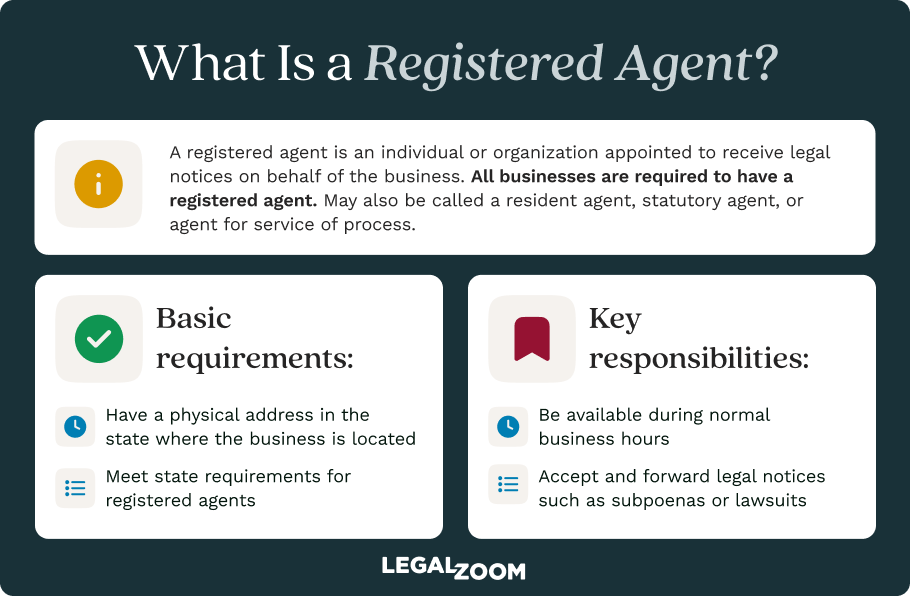
Every Utah LLC and corporation must designate a registered agent, a person or entity that receives lawsuits, tax notices, and official state correspondence on the business's behalf. The state requires that agent to maintain a physical Utah street address and be available during normal business hours.
You appoint your registered agent when you form your business, and that appointment stays in place for as long as your entity remains registered with the state. Choosing the wrong person, missing the requirement, or letting the designation lapse can cost your business its good standing or trigger administrative dissolution, a state-initiated process that can end your LLC's legal right to operate.
“The mistake founders make most often is choosing a registered agent without agreeing on what happens after a legal document arrives. A trusted friend may accept the papers and leave them on a desk, assuming you’ll pick them up. Before naming anyone, agree on how they’ll notify you, who receives the documents, and how you’ll confirm receipt. Your agent needs a reliable handoff process, because receiving a lawsuit means little if you never learn about it.”


Utah registered agent at a glance
- Every Utah LLC, corporation, and other registered business entity must maintain a registered agent with a physical Utah street address at all times.
- A registered agent must be available during normal business hours to accept service of process, tax notices, and official state correspondence.
- You can serve as your own registered agent if you are a Utah resident with a physical in-state address, but doing so puts your personal address on the public record.
- You appoint or change a registered agent through the Utah Division of Corporations & Commercial Code, typically via the state's online filing system.
- Professional registered agent services typically cost $100–$300 per year and keep your personal address off public filings while making sure no legal documents are missed.
- Failing to maintain a registered agent can result in your business losing good standing and potentially being administratively dissolved.
What is a Utah registered agent?
A Utah registered agent is a person or entity your business officially designates to receive legal documents and government notices on its behalf. When someone files a lawsuit against your business or the Utah Division of Corporations & Commercial Code needs to reach you, your registered agent receives that notice first.
The most critical document a registered agent handles is service of process, the formal court papers that notify your business it is being sued. Missing service of process can mean missing a court deadline you never knew existed.
Beyond litigation, a Utah registered agent typically receives:
- Service of process. Court documents notifying your business of a lawsuit or legal proceeding
- State tax notices. Official correspondence related to your business's tax obligations
- Government correspondence. Documents from the Utah Division of Corporations & Commercial Code, including compliance notices and filing reminders
- Administrative notices. Communications about your business's registration status or good standing
Utah law requires every registered agent to maintain a physical street address in Utah, not a P.O. box, and to be present and available at that address during normal business hours. If a process server shows up with a lawsuit and no one is there, your business could miss a filing deadline without ever knowing a case was brought against it.
Do you need a registered agent for a Utah LLC or corporation?
Yes, with no exceptions. Utah law requires every business entity registered with the Utah Division of Corporations & Commercial Code to designate and maintain a registered agent at all times, starting the moment you file your formation documents.
The requirement applies to:
- Domestic LLCs: Any limited liability company formed under Utah law (Utah Code Title 48, Chapter 3a)
- Domestic corporations: For-profit corporations formed under Utah law (Utah Code Title 16, Chapter 10a)
- Nonprofit corporations: Charitable, religious, educational, and other nonprofit entities registered with the state
- Limited partnerships (LPs) and limited liability partnerships (LLPs): Partnership entities formed under Utah law
- Foreign entities: Out-of-state LLCs, corporations, and other business entities that register to do business in Utah
If you don't list a registered agent, the Division will reject your filing.
Sole proprietors and general partnerships that operate without registering as a formal entity are not subject to this rule. But as soon as you form a registered entity, the obligation attaches immediately.
A few additional rules apply once you've named an agent. You can designate only one registered agent; the role cannot be split across multiple people. You also cannot leave the position temporarily vacant. If your current agent resigns or becomes unavailable, file a replacement with the Division right away to avoid a compliance gap.
“If you’re the sole owner and registered agent of your LLC, include a short business continuity plan with your estate planning records. Identify who will arrange for a replacement agent if you become incapacitated or die, and have your attorney confirm that person has the authority to act. Give them access to the company records and filing information they’ll need. Naming someone in a private plan doesn’t change the state’s record, so the plan should explicitly assign responsibility for completing that filing.”
Utah registered agent requirements: Who can serve
Not everyone qualifies. The state sets specific eligibility rules, and a filing that names a noncompliant agent will be rejected. A registered agent must be one of the following:
- An individual who maintains a physical street address in Utah
- A domestic or foreign business entity authorized to transact business in the state with a physical Utah address
- A commercial registered agent that has filed a listing statement with the Utah Division of Corporations & Commercial Code
Both individuals and companies must have a physical Utah address where service of process can be delivered. A P.O. box does not qualify.
Residency and address rules
The registered agent must have a physical street address in Utah and be available during normal business hours. That address appears in Utah's publicly searchable business registry the moment you file.
A home address satisfies the requirement, but listing your personal residence means anyone searching the state's business database can find it. That privacy tradeoff is worth thinking through before you decide who fills the role.
Commercial vs. noncommercial registered agents in Utah
Utah draws a legal distinction between two agent categories that most small business owners have never encountered. The practical difference is simpler than the terminology suggests.
A noncommercial registered agent is an individual or entity that serves as an agent for a specific business only. No separate state registration is required; the filing simply states the agent's name and address (Utah Code § 16-17-203). Most business owners who name themselves, a trusted friend, or an attorney fall into this category.
A commercial registered agent is a company or individual that serves multiple businesses professionally and must submit a Commercial Registered Agent Application with the Division (Utah Code § 16-17-204). Professional registered agent services operate as commercial agents and carry broader, ongoing compliance obligations, including keeping their listing information current with the Division at all times (Utah Code § 16-17-302).
If you name yourself as agent for your own LLC, you're acting as a noncommercial agent. If you hire a professional service, that company operates as a commercial agent. Both are legally valid.
Can I be my own registered agent in Utah?
Yes. Utah law allows you to serve as your own registered agent, but you must meet every eligibility requirement: a physical Utah street address and consistent, in-person availability at that address during normal business hours on every business day.
“Before choosing to be your own registered agent, look at your calendar for a typical month. Client visits, school pickups, and work at other locations can make a home address a poor fit, even if you consider yourself home-based. Being reachable by phone doesn’t help someone trying to deliver papers at your door. I recommend making the decision around where you actually spend your working day, rather than where you receive your mail.”
That last condition is where most business owners hit friction. Being your own agent means committing to consistent availability, not occasional remote days, not business travel, not a long weekend where a process server happens to show up.
Consider serving as your own registered agent if:
- You operate from a fixed Utah office during regular business hours
- You are comfortable with your address appearing on Utah's publicly searchable business registry
- Your operations are straightforward and the risk of missing an official document is low
- Keeping annual costs down is a priority
Consider hiring a professional registered agent service if:
- You work remotely, travel frequently, or keep unpredictable hours
- You want to keep your home address off Utah's publicly searchable business registry
- Your business operates across multiple states and needs consistent coverage in each
- You want a dedicated point of contact who won't miss a lawsuit filing or compliance deadline
LegalZoom's Registered Agent Services send alerts when important mail arrives, scan and upload documents for digital access, and send email reminders about annual report deadlines through the Compliance Calendar.
When you list your home address as your registered agent address, it appears in the Division's business database, visible to anyone who searches your entity name. For home-based and single-member LLC owners, that privacy tradeoff often tips the decision more than anything else.
How to appoint a registered agent when forming a Utah LLC
Appointing your registered agent is not a separate step; it happens as part of the formation filing itself. The Utah Division of Corporations & Commercial Code will not approve your filing without that information.
“A common formation mistake is listing a registered agent service before actually opening an account with that provider. Putting the company’s name on your filing doesn’t establish a service agreement or tell the provider who should receive your documents. Complete the signup first, then use the exact agent information the provider gives you. Keep the confirmation with your formation records so you have a clear record of when service began and which business the account covers.”
- Decide who will serve as your registered agent. Confirm your chosen agent meets Utah's eligibility requirements: a physical Utah street address, availability during normal business hours, and consent to serve. Get the agent's consent before listing them. Keep that consent document in your own records; you do not submit it to the state.
- Log in to the Utah Division of Corporations online filing system. The system requires a UtahID account. Once logged in, click "Formations & Registrations" in the left-hand menu, then "Domestic Formations," and select "Domestic Limited Liability Company" from the Business Entity Type menu.
- Complete your Certificate of Organization. The form asks for your business name, LLC address, and registered agent information.
- Enter your registered agent's name and Utah street address. For commercial registered agents, enter the agent's name only; the Division already has their address on file. For noncommercial agents, enter both the name and the physical Utah street address. P.O. boxes may only be listed after the street address, not in place of one.
- Pay the filing fee and submit. The non-refundable filing fee is $59.00. Most online filings are processed immediately; others may take 2–4 business days.
- Confirm your agent appears in Utah's public business registry. Search your entity name in the Division's online database to verify the information appears correctly.
How to change a registered agent in Utah
Changing your registered agent is a straightforward state filing. You don't need a lawyer; just follow the right steps and file with the Utah Division of Corporations & Commercial Code before the change takes effect.
- Choose your new registered agent and confirm consent. Confirm your new agent meets Utah's eligibility rules and has consented to serve. Skipping this step can result in the Division rejecting your filing.
- Log in to the Utah Division of Corporations online system. Select "File On An Existing Business" from the left-side menu, search for your entity by name or entity number, select the correct entity, and select the filing type from the drop-down list.
- Complete the Registration Information Change form. LLCs use the Limited Liability Company Registration Information Change form; corporations use the Corporation Registration Information Change form. The form requires your business entity number, the name of your current registered agent, and details of your new registered agent.
- Enter your new agent's name and Utah street address. For a commercial registered agent, enter the agent's name only; the Division already has their address on file.
- Pay the state filing fee and submit. A registered agent change costs $13 per record. Online filings are processed by the end of the next business day. Mail, in-person, and faxed filings take five to seven business days.
- Confirm the update in Utah's public business registry. Search your entity in the Division's online database to verify the new agent's information appears correctly.
One cost-saving note: if you file the Registration Information Change form in conjunction with your annual renewal, there is no fee for the change form.
LegalZoom's Registered Agent Services handle all the paperwork needed to switch registered agents and cover state fees on your behalf.
How to resign as a registered agent in Utah
A registered agent can resign at any time by filing a statement of resignation with the Division, signed by or on behalf of the agent (Utah Code § 16-17-209). The resignation takes effect on the earlier of the 31st day after filing or the appointment of a new registered agent. The resigning agent must promptly notify the business of the date the statement was filed.
That 31-day window gives the business time to appoint a replacement. Act quickly to avoid any gap in coverage.
How to find a company's registered agent in Utah
You can find any Utah-registered company's registered agent for free using the Utah Division of Corporations & Commercial Code's public business entity search database. The database includes the registered agent's name and address, the entity's current status, its formation date, and its filing history.
- Go to the Utah Division of Corporations business entity search. Navigate to corporations.utah.gov/searches/.
- Choose your search method. You can search by business name, entity number, or registered agent name. Utah's system supports partial matches, but using the complete legal name ensures precise results.
- Review the results list. The system displays entity name, ID number, entity type, status, and formation date. Review results carefully, as similar names or slight variations may appear.
- Click on the entity name to open the full record. The registered agent's name and Utah street address appear in a dedicated section of the entity profile.
- Confirm the agent's information. If the business appointed a commercial registered agent, the address displayed is the commercial agent's office address, not the business owner's personal address.
A few things worth knowing.
- The registered agent field is always public. There is no way to redact it.
- You can also search by registered agent name, which lets you identify all entities a particular person or commercial agent represents.
- Some personal information stays protected — Social Security numbers, bank account numbers, and driver's license numbers are not part of the public record.
The most common reason business owners look up their own registered agent record is to confirm the Division has the correct agent on file after a change. It takes less than a minute and catches data entry errors before they become a compliance problem.
Utah registered agent costs: DIY vs. professional service
Serving as your own registered agent costs nothing beyond your time. Professional services in Utah typically charge $100–$300 annually. Whether you pay that depends on your situation, not on which option sounds cheaper on paper.
| Serving as Your Own Agent | Hiring a Professional Service | |
|---|---|---|
| Annual cost | $0 | Typically $100–$300/year |
| State filing fee to change agents | $13 per record | $13 per record (often handled by the service) |
| Privacy protection | None — your Utah street address appears in the public registry | Yes — the service's address appears in the public record |
| Business-hours availability required | Yes — you must be present at a physical Utah address | No — the service maintains availability on your behalf |
| Document scanning and forwarding | No | Yes — most services scan and upload documents to an online account |
| Compliance reminders | No | Yes — most services send reminders before annual renewal deadlines |
| Filing assistance | No | Varies — some services include it; others charge separately |
One cost detail worth knowing: Utah's annual renewal fee is only $18, but missing the deadline triggers a $50 late fee. A professional service that sends renewal reminders can easily pay for itself by preventing a single missed filing.
A service priced at $100 per year may cover document receipt and forwarding only. A service at the higher end may include document scanning, an online dashboard, compliance monitoring, and filing support. Before selecting a provider based solely on price, look closely at the complete service package.
What happens if your Utah LLC doesn't have a registered agent?
Losing your registered agent, or never properly appointing one, sets off a compliance chain that can end with your business losing its legal right to operate. The consequences are concrete and time-sensitive.
- Your filing gets rejected at formation. The Division will not approve a Certificate of Organization without a registered agent listed. Your LLC does not legally exist until the filing is accepted.
- You miss critical legal documents. Without a registered agent available at a Utah address during business hours, service of process has no reliable delivery point. You risk missing legal notices that could result in default judgments, a court ruling against your business without you ever knowing a case was filed.
- Your LLC loses good standing. Operating without a registered agent puts your entity out of compliance, which can result in rejected filings, administrative dissolution proceedings, and loss of liability protection.
- The Division initiates administrative dissolution. Under Utah Code § 48-3a-708, the Division may begin dissolution proceedings if the LLC goes without a registered agent for 60 consecutive days. The clock starts the moment the gap begins, not when the Division notices it.
- You receive a notice and a deadline to cure. If the Division determines grounds for administrative dissolution exist, it serves the LLC with notice. If the LLC does not cure the deficiency within 60 days, the Division administratively dissolves the company (Utah Code § 48-3a-708).
- Dissolved status severely limits what your business can do. An administratively dissolved LLC may not carry on any activities except as necessary to wind up its affairs and liquidate its assets, or to apply for reinstatement (Utah Code Title 48, Chapter 3a, Part 7). No new contracts. No new revenue.
- Administrative dissolution may not be easily reversed. Reinstatement requires a separate application and payment of all outstanding fees, and your original business name may no longer be available.
The 60-day threshold matters in practice. If your registered agent resigns, moves out of state, or becomes unreachable, you have a narrow window to file a replacement before dissolution proceedings begin. Act immediately.
Utah registered agent FAQs
Does a registered agent's address have to be in Utah?
Yes. The address must be a physical Utah street address, not a P.O. box, mail forwarding service, or virtual office without genuine physical presence. Someone must be consistently available there during normal business hours.
Can a Utah LLC be its own registered agent?
No. The LLC entity itself cannot fill the role. A member or manager can serve in their personal capacity, provided they have a physical Utah street address and are available during business hours, but the business entity as a whole cannot serve as its own agent.
How often do I need to update my registered agent information in Utah?
There is no periodic renewal tied specifically to the registered agent designation. However, any change to your agent or their address must be filed with the Division right away. Outdated information creates a real gap in coverage, since the Division and process servers use whatever address is on record.
Is a registered agent the same as a statutory agent in Utah?
Yes. Utah uses "registered agent"; other states use "statutory agent," "resident agent," or "service of process agent." All describe the same role: a designated point of contact with a physical address who receives official documents on your business's behalf.
What documents does a Utah registered agent receive?
A Utah registered agent receives service of process, state tax notices from the Utah State Tax Commission, official correspondence from the Division of Corporations & Commercial Code, annual report reminders, and administrative notices about your entity's registration status. The role does not cover general business mail or vendor invoices.
What counts as a valid physical address for a Utah registered agent?
A physical Utah street address where the agent is actually present during normal business hours and where service of process can be physically delivered. A P.O. box, mail forwarding service, or virtual office without genuine physical presence does not qualify. A home address, business office, or commercial registered agent's office all satisfy the requirement.
Who can legally serve as a registered agent in Utah?
Any individual who is a Utah resident with a physical in-state street address; any domestic or foreign business entity authorized to transact business in Utah with a physical Utah address; or any commercial registered agent that has filed a listing statement with the Division. The agent must be available at that address during normal business hours.
What is the difference between a commercial and noncommercial registered agent in Utah?
A noncommercial registered agent serves as agent for a single specific business and requires no separate state registration. A commercial registered agent serves multiple businesses professionally, must file a Commercial Registered Agent Application with the Division, and carries ongoing compliance obligations to keep their listing current. Most business owners who name themselves or a trusted individual are noncommercial agents; professional registered agent services operate as commercial agents.
What are the risks of using a home address as a registered agent address in Utah?
Your home address becomes part of Utah's publicly searchable business registry the moment you file, visible to anyone who searches your entity name. There is no mechanism to redact it. For home-based and single-member LLC owners, this is often the primary reason to hire a professional service, whose address appears in the public record instead.
What is the Utah Division of Corporations & Commercial Code and how does it relate to registered agents?
The Utah Division of Corporations & Commercial Code is the state agency that administers business entity registrations in Utah. It maintains the public business registry, processes formation and change filings, and enforces the registered agent requirement. All registered agent appointments, changes, and resignations are filed with the Division, which uses the registered agent's address on file to deliver official notices and initiate administrative proceedings when a business falls out of compliance.
'%20/%3e%3c/svg%3e)

'%3e%3cpath%20fill-rule='evenodd'%20clip-rule='evenodd'%20d='M9.31239%2025.5316H13.0679V14.1032H9.31239V25.5316ZM11.1913%208.46875C9.93945%208.46875%209%209.25086%209%2010.505C9%2011.5995%209.78211%2012.5389%2011.1913%2012.5389C12.6005%2012.5389%2013.3826%2011.5995%2013.3826%2010.505C13.3826%209.4082%2012.6005%208.46875%2011.1913%208.46875ZM27%2018.9577V25.5316H23.2445V19.4275C23.2445%2017.8609%2022.6174%2016.7664%2021.3679%2016.7664C20.2711%2016.7664%2019.644%2017.5463%2019.3316%2018.1756C19.1743%2018.488%2019.1743%2018.8004%2019.1743%2019.1128V25.5316H15.4165V13.9458H19.1743V15.5123C19.644%2014.7302%2020.5835%2013.6357%2022.6174%2013.6357C25.1234%2013.7908%2027%2015.3573%2027%2018.9577Z'%20fill='white'/%3e%3c/g%3e%3cdefs%3e%3cclipPath%20id='clip0_952_9489'%3e%3crect%20width='18'%20height='18'%20fill='white'%20transform='translate(9%208)'/%3e%3c/clipPath%3e%3c/defs%3e%3c/svg%3e)

