




A living will is a legal document that outlines your preferences for medical care if you become incapacitated. Though part of your estate plan, it is different from a last will and testament, which details how you want to distribute your assets.
People often think writing a living will can wait until sickness, terminal illness, or old age. But unexpected injury or disease can strike at any time, not just to older adults or those in the last stages of an illness. Read on to learn more about what living wills are, how to create one, and what to consider including in yours.

How does a living will work?
A living will is a type of advance directive used to instruct care providers in the event that you can no longer make decisions for yourself. It speaks for you if you become incapacitated and unable to communicate your medical preferences directly. Having one can also shield your loved ones from making difficult choices about your care and reduce the chances of confusion or arguments over what's in your best interest.
As a legal document, your living will must comply with state laws and often requires signatures from a notary public or witnesses. That said, this document exists to ensure you have control over your medical preferences, and therefore you can revoke or update it at any time to meet your current wishes.

How to make a living will
Each state usually offers free health care directive forms with suggestions about what one should include. You can use these as a starting point to discuss with healthcare providers and an experienced attorney.
The following steps are a general guide to writing living wills. If you spend a lot of time in other states, you may want to make sure your living will is enforceable in those states as well.
1. Speak with your doctor
If you have a primary care physician or other healthcare provider that you regularly see, have a conversation with them about your future care. Doctors can walk you through procedures and treatment options, helping you make an informed choice about the care you wish to receive.
2. Choose what kind of care you want
Whether for a serious illness or end-of-life care, your medical care is a personal decision. Certain treatments can be tough on the body, and you should consider how long you would be willing to go through specific regimens. If comfort is a priority for you, make sure that's made known in your living will. Specify where you prefer to be treated if you have a choice. For example, would you prefer to receive treatment in your home or at a health care facility, such as a hospital or nursing home?
3. Talk with family members and close friends
A living will can remove the burden of making difficult decisions from your friends and family. Communicate with them so they're aware of your health care and end-of-life wishes.
4. Get legal assistance
Writing a living will takes lots of foresight and consideration. Living wills are legal documents that need to align with state laws. This typically includes signing before a notary or witnesses who affirm you are sound of mind and not under duress.
Note that you can revise your living will at any time by creating a new document, but it's important to make sure all previous versions are destroyed to prevent conflict or confusion.
Speaking with an experienced attorney can ensure the living will complies with your state's requirements and is written in a clear and instructional way that leaves little or nothing open to interpretation regarding your wishes.
5. File copies of your will with important parties
While it may be tempting to keep your living will private, it's important to remember that many people may need access to this document for advance care planning. If they can't find it, your health care wishes may go unrecognized. Consider keeping an original copy of your living will at home and sharing additional copies with relevant parties:
- Your doctor
- Your hospital
- Your nursing home
- Your healthcare proxy or representative with durable power of attorney
- Your immediate family
You will likely be asked to provide a copy of your living will before any procedure at a hospital or surgery center, even if minor, and especially if involving anesthesia. It’s a good idea to keep copies of your living will in multiple places to ensure that relevant parties have access to your care preferences and wishes.
What to include in a living will
Living wills are only for medical treatment and end-of-life care, and any possible health care or treatment outcome should be considered. Use the following scenarios as a starting point, and make sure to talk to a lawyer and doctor to discuss the most common types of scenarios, outcomes, treatment options before finalizing your living will.
Breathing assistance
A ventilator helps you breathe when your body is no longer able to do so on its own. This can sustain you for long periods of time, so it's important to consider in your health care plans if you wish to be placed on a ventilator at all and if so, how long you would want to use one before being taken off.
Supplemental feeding
Assisted oral feeding provides artificial nutrition when you're unable to feed yourself. If you wish to be fed intravenously or with a stomach tube, you should note in your living will when and how long you would like this treatment to continue.
Cardiopulmonary resuscitation (CPR)
CPR is an emergency procedure that can save your life if your heart stops beating. It consists of chest compressions, often combined with rescue breaths provided mouth-to-mouth, via a valve mask, or with the assistance of a manual bag ventilator. Specify whether or not you would want to be resuscitated, whether through CPR or electrical stimulation to the heart. If you decide you don’t want to be resuscitated if necessary, this is called a Do Not Resuscitate (DNR) order. These can only be issued by a doctor, but can be a supplement to your living will.
Blood transfusions
A blood transfusion is indicated in emergency situations when there is a shortage of red blood cells in the body, either because of blood loss, blood disease, organ damage or dysfunction, or certain types of cancer. Blood transfusions are part of standard care practices, but some people do not wish to have them for personal or religious reasons.
Medications and treatment
Antibiotics and a life sustaining treatment like dialysis can fight infections and remove bodily waste. These can be life-saving, but you might not wish to receive a particular life-sustaining treatment for an extended period of time. Talk to your doctor about various options and their side effects so you can make an informed decision on your care and treatment.
Palliative care
Palliative care is often called comfort care because it's meant to reduce pain and focus care decisions on improving comfort and quality of life. You might wish to receive pain medication (like morphine) or to avoid aggressive treatments and invasive tests to prioritize your comfort. You may also have opinions about what type of palliative care you’d like to receive. For instance, you may refuse to receive opioid medications or wish to be visited by a specific clergy member.
Bodily donations
In a living will, you can declare whether you'd like to donate any or all of the following:
- Your organs
- Your bodily tissues
- Your entire body
A living will can help timely organ donation for viable transplants. While you can register for organ donation through a state registry or with your local bureau of motor vehicles, a living will is considered the best way to convey your wishes. You can also declare whether you would like your body to be donated to specific institutions or for specific purposes (such as scientific research or medical training).
Posthumous decisions
In addition to organ and other bodily donations, a living will may grant consent to other posthumous matters:
- An autopsy to determine the cause of death
- A cremation, burial, or another manner of handling your remains
These are decisions that you should make for yourself, but can be made with guidance from medical, legal, and religious professionals.
Who needs a living will?
Living wills should be considered by every adult and can provide you and your loved ones with peace of mind.
Creating a living will when you're healthy allows you to consider all of your options carefully and makes it so your loved ones aren't left with difficult choices without knowing your wishes. If you're undergoing surgery or are critically or terminally ill, a living will is especially important.
If you don't have a current living will and become incapacitated or are unable to make your own decisions, your physicians will turn to your closest family members (typically spouse first, then children, but the order depends on your state) to make medical decisions.
Living wills are particularly important because many states require them to dictate that your representatives have full authority to make medical decisions for you. In some instances, without a living will, a court order is required to end life support, which can be expensive and heart-wrenching. Doctors may also be allowed to decide which family member's viewpoint is the one to follow.
Can a living will be broken?
There are a few instances in which a living will will not be followed:
By authority of a health care proxy
Your appointed representative (or health care proxy) has the authority to make medical decisions for you, including those that may go against the wishes you've stated in your living will. It's important to appoint a representative whom you trust. You typically appoint a healthcare proxy in your living will.
If your living will is deemed invalid
Your state might consider a living will invalid for a number of reasons. If you don't have the proper witnesses, have previous wills that haven't been destroyed, your mental state is questionable, or a court finds that fraud influenced your will, the decisions you made in your living will may not be followed.
Living will vs. last will and testament
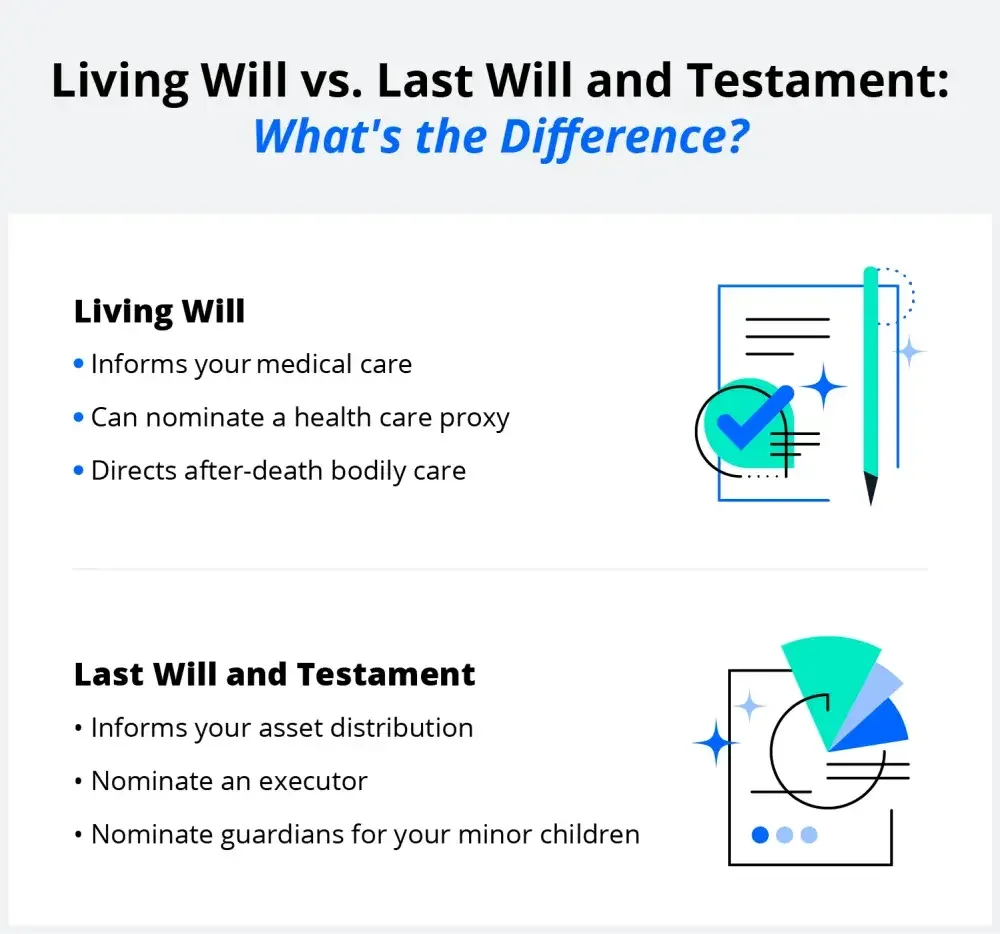
The essential difference between a living will and last will and testament is that the former comes into effect during your lifetime to direct your end-of-life care in alignment with your preferences, while the latter comes into effect after you're deceased to direct the distribution of assets and other property in your estate according to your wishes.
Living will vs. advance directive
Essentially, a living will is a part of an advance directive—but an advance directive isn’t always a living will, and while these terms are often used interchangeably, they are not the same. An advance directive—also called a health care directive—can include a living will but might also include a medical power of attorney for health care. Be sure to consult with a lawyer to determine what should be included in advance directives.
Living will vs. medical power of attorney
A living will directly states your health care wishes in the event of a serious illness, namely whether or not you wish to receive or forgo life-sustaining medical treatments. It's a document that you create to anticipate an incurable or an irreversible condition and outline your wishes as to health care and treatment in the event that you're unable to express those wishes yourself.
A medical power of attorney appoints a representative with your best interests in mind—called a health care proxy or health care power of attorney—whom you appoint to make health care decisions on your behalf. A health care power of attorney can be included as part of your living will, or it can be its own separate document, depending on your state.
State laws vary regarding appointing a health care agent. A common restriction is the health care agent can't be your attending physician. Check state laws to determine who can be your health care agent.
What to consider before creating a living will
Before creating your own living will, you should consider how you feel about the possibility of a range of medical treatment options. It might also benefit you to have conversations with those closest to you to decide if any loved ones have the capabilities to be your health care proxy. Ask yourself these questions before creating a living will:
- Would I like to receive any and all treatments available in the interest of prolonging my life?
- Would I rather prioritize my comfort and convenience?
- Do I prefer to stay at home over being hospitalized?
- Which family members, friends, and loved ones can I trust to act in my best interests regarding health care?
- How much money do I have to cover medical expenses where insurance falls short?
- Does my state require witnesses, a notary, or both when signing my will?
This is not a complete list of questions but rather a starting point for conversations between you and your doctor or lawyer to create a living will.
It can be difficult to think about a potential end-of-life situation and the type of medical care you'd like to receive during it. Preparing a living will is a significant undertaking, but it's ultimately worth it to reduce the stress and burden of the unknown on yourself and your family.

FAQs
What are the benefits of a living will?
A living will has many benefits. It offers you peace of mind knowing that your wishes for your end-of-life care are already clearly stated and protects your family from making those tough calls for themselves, which could potentially lead to bitter disputes or unwanted outcomes. If you have specific religious-based preferences, a living will can also ensure that your doctors are aware of and respect those beliefs.
What is the main drawback of a living will?
Living wills can have oversights—it's impossible to foresee everything that could happen to you. These legal documents must be broad in what they cover while mentioning as much specific information as possible to mitigate gaps.
How old do you need to be to create a living will?
You need to be 18 years old and of sound mind. Parents of minor children or the legal guardian make health care decisions for them until minor children turn 18.
Are living wills the same as living trusts?
No, living wills pertain to health care decisions in the event of illness or end of life. Living trusts allow you to avoid probate court and distribute assets according to your wishes.
Does a living will need to be notarized?
It depends on your state law. Some states require witnesses to sign the document and some require a notarization. Neither you nor your healthcare providers can act as the witness.
Anne Brennan contributed to this article.
'%20/%3e%3c/svg%3e)

'%3e%3cpath%20fill-rule='evenodd'%20clip-rule='evenodd'%20d='M9.31239%2025.5316H13.0679V14.1032H9.31239V25.5316ZM11.1913%208.46875C9.93945%208.46875%209%209.25086%209%2010.505C9%2011.5995%209.78211%2012.5389%2011.1913%2012.5389C12.6005%2012.5389%2013.3826%2011.5995%2013.3826%2010.505C13.3826%209.4082%2012.6005%208.46875%2011.1913%208.46875ZM27%2018.9577V25.5316H23.2445V19.4275C23.2445%2017.8609%2022.6174%2016.7664%2021.3679%2016.7664C20.2711%2016.7664%2019.644%2017.5463%2019.3316%2018.1756C19.1743%2018.488%2019.1743%2018.8004%2019.1743%2019.1128V25.5316H15.4165V13.9458H19.1743V15.5123C19.644%2014.7302%2020.5835%2013.6357%2022.6174%2013.6357C25.1234%2013.7908%2027%2015.3573%2027%2018.9577Z'%20fill='white'/%3e%3c/g%3e%3cdefs%3e%3cclipPath%20id='clip0_952_9489'%3e%3crect%20width='18'%20height='18'%20fill='white'%20transform='translate(9%208)'/%3e%3c/clipPath%3e%3c/defs%3e%3c/svg%3e)

