



Every Ohio LLC and corporation must designate an Ohio registered agent, officially called a "statutory agent" under Ohio law, before the Secretary of State will accept your formation documents. This guide covers who qualifies to serve, how to appoint an agent during formation, how to change your agent later, what happens if you let the requirement lapse, and what you'll pay for professional help versus handling it yourself.

What is an Ohio registered agent?
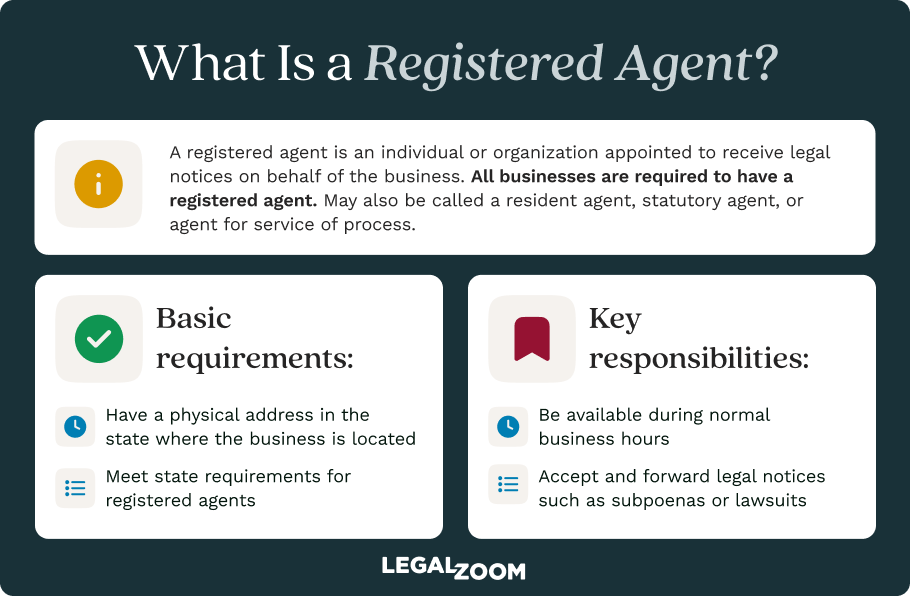
An Ohio statutory agent is a person or entity you designate to receive legal documents on your business's behalf, including service of process, state correspondence, and other government notices. Your agent must maintain a physical Ohio street address and be available during normal business hours.
Without a registered agent, courts, government agencies, and opposing parties have no official way to deliver documents to your business. The requirement makes sure you receive time-sensitive documents before deadlines pass or default judgments are entered.
Ohio registered agent vs. statutory agent: Is there a difference?
No. Both terms describe the same role. Ohio law uses "statutory agent," found in Ohio Revised Code § 1701.07 for corporations and § 1706.09 for LLCs. Most other states use "registered agent," and that term carries over into everyday conversation and many online resources.
One additional term worth distinguishing: registered office. The registered office is the physical Ohio street address where your statutory agent is available, a location, not a person. When Ohio forms ask for your statutory agent's address, they're asking for your registered office.
What does an Ohio statutory agent actually do?
Your statutory agent serves as your business's official point of contact for legal and government communications. Specifically, they.
- Accept service of process on your business's behalf
- Receive official correspondence from the Ohio Secretary of State
- Forward legal notices and state documents to you promptly
- Maintain a physical Ohio street address on the public record, available during normal business hours
Does Ohio require a registered agent for an LLC?
Yes. Under Ohio Revised Code § 1706.09, every domestic LLC must maintain a statutory agent at all times, from formation through the life of the business. There are no exemptions for single-member LLCs, part-time operations, or businesses with no employees. The requirement also applies to foreign LLCs registering to do business in Ohio.
Which Ohio business entities must have a statutory agent?
The requirement to maintain a statutory agent applies to the following Ohio business entities:
- Domestic LLCs. Must name a statutory agent in their Articles of Organization.
- Domestic corporations. Must designate a statutory agent in their Articles of Incorporation.
- Nonprofit corporations. Must designate a statutory agent.
- Foreign LLCs. Must appoint an Ohio statutory agent as part of the foreign qualification process.
- Foreign corporations. Must appoint an Ohio statutory agent.
Who can be a registered agent in Ohio?
Ohio law sets three eligibility requirements. The agent must be either an authorized service provider or an individual who meets the following criteria.
- Lives in Ohio or is an authorized entity. The agent must be an individual who lives in Ohio, or a business entity authorized to do business in Ohio.
- Has a physical Ohio street address. A P.O. box alone does not satisfy this requirement.
- Is available during business hours. The agent must be present at that address during normal business hours on every business day.
A friend, family member, or employee can legally serve, as long as they meet all three conditions.
Can I be my own registered agent in Ohio?
Yes, as long as you have a physical Ohio street address and remain available there during normal business hours. That address becomes part of the public record, searchable by anyone, including process servers and opposing parties. If your Ohio address is your home, it's publicly accessible through the Ohio Secretary of State's business search tool.
“The problem I see most often is an owner naming themselves as statutory agent without realistically accounting for how often they are away from the listed address. The role only works if someone is reliably available to receive time-sensitive legal documents during business hours. A missed service can become much more serious than a routine compliance issue, especially if a lawsuit moves forward without the owner knowing about it. I tell clients to treat availability as the deciding factor, not just whether self-appointment is legally allowed.”

Availability creates a second constraint. If you travel frequently, work remotely from outside Ohio, or can't guarantee you'll be at your listed address every business day, you risk missing service of process. Missing those documents doesn't make a lawsuit go away. It can result in a default judgment entered against your business without you ever having a chance to respond. For a deeper look at the tradeoffs, see Should I Be My Own Registered Agent? 6 Reasons Why Not.
How to get a registered agent in Ohio
Getting a registered agent in Ohio comes down to four steps, regardless of entity type.
- Decide who will serve. Choose between self-appointment, a trusted individual, or a professional registered agent service. Each option carries different tradeoffs around privacy, availability, and compliance support.
- Confirm eligibility. Whoever you choose must meet the eligibility requirements above.
- Get their consent. Ohio requires the agent's agreement before you file. Professional services handle this during onboarding; for individuals, confirm they understand the role before you file.
- Include the agent's name and Ohio address on your formation documents. Those details become part of the public record.
How to appoint a statutory agent when forming an Ohio LLC
When you file your Articles of Organization, you'll designate your statutory agent directly in the form. For a complete formation walkthrough, see forming an Ohio LLC.
- Complete your Articles of Organization through the Ohio Secretary of State's online filing portal or by mail.
- Enter the agent's full legal name and Ohio street address, not a P.O. box.
- Pay the filing fee (currently $99 for standard online filing).
- Submit your documents. Once accepted, your agent's name and address are publicly searchable.
How to appoint a statutory agent when forming an Ohio corporation
The process mirrors the LLC workflow, but you'll file Articles of Incorporation instead. For a full walkthrough, see forming an Ohio corporation.
- Complete your Articles of Incorporation using the Ohio Secretary of State's online portal or paper form.
- Include your statutory agent's name and Ohio street address in the designated field.
- Pay the applicable filing fee and submit.
Confirm your agent agrees before you file. No separate consent form is required by the state.
How to change your registered agent in Ohio
Changing your statutory agent requires a formal filing with the Ohio Secretary of State. The update takes legal effect only after the state processes your filing.
“The biggest transition mistake is assuming the agent change becomes effective as soon as the paperwork is submitted. In Ohio, the update does not take legal effect until the state processes the filing. I tell clients to retain the outgoing agent until the new designation is active in the public record, especially if litigation is pending. A gap during that handoff can create exactly the problem the statutory agent requirement is meant to prevent: important service arriving when no one is prepared to receive it.”
- Choose your new agent and confirm their consent. Your replacement must meet the same eligibility requirements as your original agent.
- Complete the statutory agent update form. The Secretary of State accepts these filings online or by mail. The form asks for your entity name, file number, and the new agent's name and Ohio street address.
- Pay the $25 filing fee. This is a flat fee regardless of entity type.
- Confirm the update appears in the public record. Search your business name on the Secretary of State's website to verify the new agent information is active.
If your business is involved in active litigation, make sure your new agent is ready to accept service of process the moment the old one steps down.
Ohio registered agent costs: DIY vs. professional service
Self-appointment makes sense if you have a dedicated Ohio office address you're comfortable making public and a schedule that keeps you there consistently. Appointing a friend or employee shifts the availability burden onto someone else, which creates problems if they travel, change jobs, or become unavailable. A professional service removes both constraints: your home address stays off the public record, and you don't have to be anywhere specific on any given business day.
What does a professional Ohio registered agent service include?
- A physical Ohio street address that replaces your personal address on the public record
- Scanning and forwarding of legal or state documents received on your behalf
- Compliance reminders for annual filings and state deadlines
- An online account to access received documents
LegalZoom's registered agent service covers Ohio and all 50 states, with document forwarding and compliance alerts included, at $249 per year. Other providers range from $49 to $300 annually depending on features.
If you own multiple Ohio entities, each requires its own statutory agent designation. Most professional services can cover several entities under a single account, simplifying management without multiplying administrative overhead.
What happens if you don't maintain an Ohio registered agent?
Letting your statutory agent lapse creates real legal exposure. Ohio can revoke your business's good standing, which blocks you from bringing or defending lawsuits in state courts. If you miss service of process because no agent is on file, a court may enter a default judgment against your business with no opportunity for you to respond. Continued noncompliance can lead the state to administratively dissolve your entity, a status that is difficult and costly to reverse.
Lapses most commonly occur when an individual agent moves, becomes unavailable, or resigns without the business owner filing a timely replacement. Acting quickly when circumstances change is the simplest way to avoid this outcome. For a broader overview of what's at stake, see Why Do I Need a Registered Agent?
“For a single-member LLC, naming the owner as statutory agent can create a continuity problem because the business is relying on one person to remain available and able to serve. If that owner becomes incapacitated or dies, the company may suddenly be left without a functioning agent unless someone promptly files a replacement. I tell solo owners to think about the statutory agent role as part of continuity planning, not just formation paperwork, because an unexpected lapse can expose the business to missed notices and compliance consequences.”
How to find an Ohio company's registered agent
Ohio statutory agent information is part of the public business record. You can look up any Ohio company's agent through the Ohio Secretary of State's business search tool at ohiosos.gov, free, with no account required.
Enter the company's legal name or Ohio file number. Results display the entity's current statutory agent name, the agent's Ohio street address, and the entity's standing with the state. The record updates once the state processes any agent change filing. If you're verifying your own agent information, this is the fastest way to confirm an update went through correctly.
Ohio registered agent FAQ
Can I be my own registered agent in Ohio?
Yes, provided you have a physical Ohio street address and can be present there during normal business hours every business day. Two tradeoffs apply: your address enters the public record permanently, and any day you're unavailable is a day you could miss service of process with no fallback.
Does Ohio require a registered agent for an LLC?
Yes. Under Ohio Revised Code § 1706.09, every Ohio LLC must maintain a statutory agent from formation through the life of the business, with no exceptions for single-member LLCs, part-time operations, or businesses with no employees.
Can I use a friend as a registered agent?
Yes, as long as they have a physical Ohio street address, live in Ohio, and can reliably be present during normal business hours every business day. Their address will appear on the public record. The primary risk is availability. If they move, travel frequently, or become unreachable, your business could miss service of process.
Can a registered agent resign in Ohio?
Yes, but resignation requires a formal filing with the Ohio Secretary of State. The agent can't simply stop performing the role. Ohio law also requires the resigning agent to notify the business entity. Once the state accepts the resignation, the business must appoint a replacement promptly or risk losing good standing.
Can an Ohio LLC member or manager serve as the statutory agent?
Yes. Ohio law imposes no requirement that the statutory agent be an outside party. A member or manager qualifies as long as they have a physical Ohio street address and are reliably available there during normal business hours. The privacy and availability tradeoffs are identical to self-appointment.
Do I need a separate registered agent for each Ohio business entity I own?
Yes. Each entity requires its own statutory agent designation filed separately with the Ohio Secretary of State. A professional service can typically cover multiple entities under one account, but the state treats each entity's agent designation as a distinct filing.
'%20/%3e%3c/svg%3e)

'%3e%3cpath%20fill-rule='evenodd'%20clip-rule='evenodd'%20d='M9.31239%2025.5316H13.0679V14.1032H9.31239V25.5316ZM11.1913%208.46875C9.93945%208.46875%209%209.25086%209%2010.505C9%2011.5995%209.78211%2012.5389%2011.1913%2012.5389C12.6005%2012.5389%2013.3826%2011.5995%2013.3826%2010.505C13.3826%209.4082%2012.6005%208.46875%2011.1913%208.46875ZM27%2018.9577V25.5316H23.2445V19.4275C23.2445%2017.8609%2022.6174%2016.7664%2021.3679%2016.7664C20.2711%2016.7664%2019.644%2017.5463%2019.3316%2018.1756C19.1743%2018.488%2019.1743%2018.8004%2019.1743%2019.1128V25.5316H15.4165V13.9458H19.1743V15.5123C19.644%2014.7302%2020.5835%2013.6357%2022.6174%2013.6357C25.1234%2013.7908%2027%2015.3573%2027%2018.9577Z'%20fill='white'/%3e%3c/g%3e%3cdefs%3e%3cclipPath%20id='clip0_952_9489'%3e%3crect%20width='18'%20height='18'%20fill='white'%20transform='translate(9%208)'/%3e%3c/clipPath%3e%3c/defs%3e%3c/svg%3e)

