



While there are several good reasons to consider a revocable living trust for your estate plan—avoiding probate, for example—keeping your assets safe from creditors is not one of them.
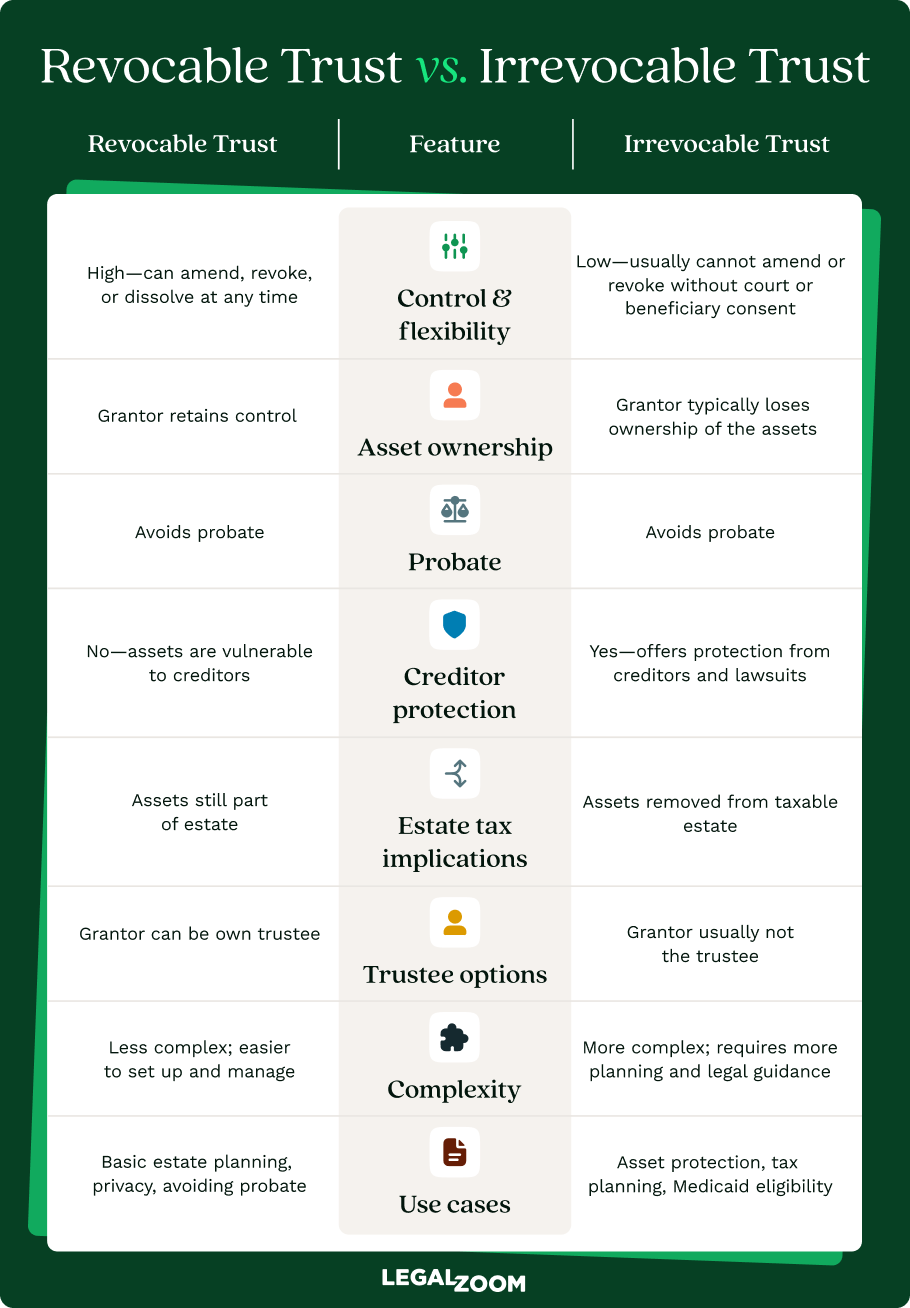
To understand why, it's helpful to discuss what a revocable trust is and what it does, as well as how it differs from an irrevocable living trust—a legal instrument that actually may help you protect assets from creditors.
Aside from an irrevocable trust, there are other ways to keep creditors away from your stuff, so if you're concerned with asset protection, read on.

What is a revocable trust?
A revocable trust, sometimes called a living trust, holds the assets of a trust creator (called a “grantor," “settlor," or “trustor") during his or her lifetime. The trustor is named as the trustee.
Upon the grantor's death, the “successor trustee," who had been chosen by the trustor, facilitates the distribution of assets to the trustor's chosen beneficiaries according to the provisions of the trust documents. All of this happens outside the probate process.
Indeed, many people turn to trusts to avoid probate, the court-supervised process of distributing a decedent's estate, which can become costly and time-consuming.
Generally, trust documents do not become part of the public record, which means your affairs stay private, as opposed to what happens with a last will and testament, which goes on file for anyone to search.
Two characteristics of revocable trusts make assets susceptible to creditor claims:
- Providing continued ownership. The trustor is still legally considered the owner of the assets within the trust.
- Giving full control. The terms can be changed or the trust canceled at any time.
Because the trustor still owns and controls the assets, a creditor could go after the trust, seek its termination, and gain access to assets within it.
So, to be absolutely clear: A revocable living trust does not protect assets from creditors.

What is an irrevocable trust?
An irrevocable trust, on the other hand, may protect assets from creditors. In fact, you may see the term “asset protection trust" used to describe such a trust.
What's the difference? With an irrevocable trust, the assets that fund the trust become the property of the trust, and the terms of the trust direct that the trustor no longer controls the assets. Also, an irrevocable trust's terms cannot be changed, and the trust cannot be canceled without the approval of the grantor and the beneficiaries or a court order.
Since the assets within the trust are no longer the property of the trustor, a creditor can’t come after them to satisfy debts of the trustor.
How state law affects trust creditor protection
Trust creditor protection is primarily governed by state law, which means the level of protection you receive can vary significantly depending on where you live. Some states—including Alaska, Delaware, South Dakota and Nevada—have enacted domestic asset protection trust (DAPT) statutes that allow grantors to create self-settled trusts (trusts where the grantor is also a beneficiary) while still receiving creditor protection.
Other states, such as California, don’t recognize self-settled asset protection trusts. In these states, if you're a beneficiary of a trust you created, your creditors can typically reach those trust assets. The trust document usually specifies which state's law governs the trust, but creditors may attempt to challenge this in their home state's courts.
Because of these variations, understanding your specific state's laws is essential before relying on a trust for asset protection. What works in one state may offer little or no protection in another.
Can creditors reach beneficiary distributions?
When discussing creditor protection, it's important to distinguish between creditors of the grantor and creditors of the beneficiaries. While an irrevocable trust may shield assets from the grantor's creditors, beneficiaries face a different set of rules regarding their own creditors.
Generally, once a distribution is made from a trust to a beneficiary, that money becomes the beneficiary's personal property. At that point, the beneficiary's creditors can pursue those funds just like any other asset the beneficiary owns. However, creditors typically have limited ability to access trust assets that remain undistributed and held within the trust.
To address this vulnerability, many trusts include spendthrift provisions, such as in Montana. A spendthrift clause prevents beneficiaries from pledging their trust interest as collateral and bars creditors from attaching trust assets before distribution. This can be particularly valuable for beneficiaries who face financial difficulties or lawsuits. However, spendthrift protections have exceptions—courts in most states allow creditors to reach trust assets for child support, alimony, and certain tax obligations, regardless of spendthrift language.
Fraudulent transfer warning
It's crucial to know your state law regarding irrevocable trusts to understand exactly how well your assets are protected. A court can find a transfer of assets to a trust to be fraudulent if done with the intent to defraud creditors. Such a finding could expose trust assets to liability and mean heavy legal penalties for the trustor.
Asset protection strategies
State law and fraudulent transfer limitations are especially relevant when it comes to transferring real estate. Many people wonder whether putting their home in an irrevocable trust will protect it from creditors. The answer depends largely on timing. If you transfer your home to an irrevocable trust before any creditor issues arise—and outside the fraudulent transfer lookback period, which typically ranges from 4 to 10 years depending on your state—the transfer may provide protection. However, if you transfer your home after a lawsuit has been filed, a debt has been incurred, or you're aware of a potential claim, a court will likely reverse the transfer.
Before transferring your primary residence to a trust, consider that homestead exemptions may offer simpler protection without requiring you to give up control of your property. Additionally, transferring a home to an irrevocable trust can trigger tax implications and may activate a due-on-sale clause in your mortgage, potentially requiring immediate repayment of the loan. It is strongly advised to consult with an attorney before making such a transfer.
Can creditors go after a trust after death?
A common misconception is that creditors lose their ability to collect debts once the grantor dies. In reality, creditors can still pursue claims against trust assets after the grantor's death, though the rules differ from those that apply during the grantor's lifetime.
When a grantor dies, a revocable trust automatically becomes irrevocable—the grantor is no longer alive to make changes. However, this doesn't mean the trust assets are suddenly protected from creditors. The grantor's existing creditors at the time of death retain the right to file claims against the trust during a statutory claim period. During this window, the successor trustee must typically notify known creditors of the death and may need to publish notice in a local newspaper for unknown creditors.
Beneficiaries should understand that their distributions are generally subject to the payment of valid creditor claims. This means the successor trustee must ensure legitimate debts are satisfied before distributing assets to beneficiaries. If a trustee distributes assets to beneficiaries before properly addressing creditor claims, both the trustee and beneficiaries could face personal liability.
Irrevocable trusts created during the grantor's lifetime operate differently. Because the grantor already relinquished ownership of the assets, creditors of the deceased grantor typically cannot reach those assets—unless the transfer was fraudulent or the trust was self-settled in a state that doesn't protect such arrangements.
Time limits for creditor claims against trusts
Creditors don't have unlimited time to pursue trust assets. Most states impose statutory deadlines—often called non-claim statutes—that bar creditor claims after a specified period. These timeframes vary by state but typically range from 120 days to 3 years after proper notice is given to known creditors.
The clock usually starts running when creditors receive actual notice of the grantor's death or when notice is published for unknown creditors. For known creditors (those the trustee is aware of), the claim period is often shorter—commonly 60 to 120 days from the date notice is sent. For unknown creditors, the period may extend longer, sometimes up to one year from the date of publication or the grantor's death.
Several types of claims may have different or extended timeframes:
- Fraudulent transfer claims. Creditors challenging a transfer as fraudulent may have 4 to 10 years to bring a claim, depending on state law.
- Federal tax liens. The IRS has up to 10 years to collect unpaid taxes, and this can extend beyond typical creditor claim periods.
- Secured debts claims. Mortgages and other secured loans remain attached to the property regardless of claim periods.
Because properly notifying creditors is essential to starting the claim period, trustees should work with an attorney to ensure compliance with their state's notice requirements. Failing to provide proper notice can leave the trust—and its beneficiaries—exposed to claims for years longer than necessary.
What are other ways to protect assets from creditors besides trusts?
Besides trusts, there are several asset protection strategies:
- Homestead exemptions. Many states protect your primary residence in bankruptcy.
- Retirement accounts. Pension plans and retirement accounts are typically protected from creditors.
- Liability insurance. One of the most common protective measures against lawsuits.
- Business entities. LLCs or corporations can shield personal assets from business liability.
The effectiveness of these strategies varies by state law, so consulting with an experienced professional is recommended.
Michelle Kaminsky, Esq., contributed to this article.
'%20/%3e%3c/svg%3e)

'%3e%3cpath%20fill-rule='evenodd'%20clip-rule='evenodd'%20d='M9.31239%2025.5316H13.0679V14.1032H9.31239V25.5316ZM11.1913%208.46875C9.93945%208.46875%209%209.25086%209%2010.505C9%2011.5995%209.78211%2012.5389%2011.1913%2012.5389C12.6005%2012.5389%2013.3826%2011.5995%2013.3826%2010.505C13.3826%209.4082%2012.6005%208.46875%2011.1913%208.46875ZM27%2018.9577V25.5316H23.2445V19.4275C23.2445%2017.8609%2022.6174%2016.7664%2021.3679%2016.7664C20.2711%2016.7664%2019.644%2017.5463%2019.3316%2018.1756C19.1743%2018.488%2019.1743%2018.8004%2019.1743%2019.1128V25.5316H15.4165V13.9458H19.1743V15.5123C19.644%2014.7302%2020.5835%2013.6357%2022.6174%2013.6357C25.1234%2013.7908%2027%2015.3573%2027%2018.9577Z'%20fill='white'/%3e%3c/g%3e%3cdefs%3e%3cclipPath%20id='clip0_952_9489'%3e%3crect%20width='18'%20height='18'%20fill='white'%20transform='translate(9%208)'/%3e%3c/clipPath%3e%3c/defs%3e%3c/svg%3e)

