



Starting a nonprofit doesn’t automatically make your organization tax-exempt. To form a nonprofit corporation in Nevada, register your organization with the Nevada Secretary of State (SOS). Then, apply with the IRS to gain federal tax-exempt status.
Here’s everything you’ll need to know to properly form your nonprofit and bring your mission to life, from choosing your nonprofit structure and filing articles of incorporation to applying for 501(c)(3) status and registering to legally seek charitable donations.
What is a Nevada nonprofit?
Before you start the formation process, decide which structure is right for your organization. There are three types of nonprofit entities in Nevada:
- A nonprofit corporation is a legal business entity that exists to further a purpose other than to make a profit. Nonprofit corporations can’t issue stock or distribute surplus revenue to members. One or more individual(s) can form a nonprofit corporation in Nevada.
- A nonprofit cooperative association is a member-organized and operated entity that can exist to meet the shared needs of its members or the broader community. In Nevada, members of a cooperative association have equal rights and interests. Five or more adult individuals can form a nonprofit cooperative association in Nevada.
- A nonprofit cooperative corporation is a nonprofit entity that exists for the mutual benefit of its members. Nevada nonprofit cooperative corporations may issue stock, but distributions can’t exceed 8% per year. Three or more individuals can form a nonprofit cooperative corporation in Nevada.
Tax exemption is an important consideration when choosing between these structures. Cooperative associations and corporations that operate as mutual benefit organizations don’t qualify for federal tax exemption under Section 501(c)(3) of the Internal Revenue Code.
How to start a nonprofit in Nevada: 9 steps
Nevada Revised Statutes and the IRS set the rules for how to formally start a nonprofit. The process involves a series of intertwined steps that satisfy both state and federal requirements.
Step 1: Name your Nevada nonprofit
Before you can file articles of incorporation to form a nonprofit, you must choose a name that meets Nevada's nonprofit naming rules:
- Names of corporations must be distinguishable from the names of all other entities registered or reserved with the Secretary of State.
- Names of corporations that could be interpreted as the name of an individual must use a corporate designator, such as Corporation, Incorporated, Company, or an abbreviation of those words.
- Names of cooperatives can’t include words such as “common-interest community,” “community association,” “master association,” “unit-owners’ association” or “homeowners’ association” without approval from the relevant agency.
- Names of nonprofit Cooperative Corporations must contain the word “Cooperative,” “Co-op,” or the abbreviation “N.C.C.”
You can check Nevada business names through Orion, Nevada’s Business Portal, by using the business entity search tool, or use LegalZoom’s free business search tool below. For a deeper dive, check out our comprehensive guide to Nevada business names.
Free Nevada Business Name Check
Starting a business? Use our free name check tool to search the Nevada Secretary of State database and see if your business name is available.
By clicking "Check Availability," I agree to LegalZoom's Terms of Use. This search is a preliminary check of state databases and does not include variations or trademarks. Results do not guarantee name availability or compliance with legal requirements.
If you found an available name but aren’t ready to file, Nevada lets you reserve it for up to 90 days. To do so, file a name reservation for a $25 fee either online through Orion or by filling out a paper form and mailing it to the SOS.
Availability in the Secretary of State's database doesn't translate to federal trademarks. Check for trademarks with the United States Patent and Trademark Office and confirm a matching web domain is available if you plan to fundraise online.
Step 2: Recruit your governing body
No matter which structure you choose, you need your governing board in place before you file articles of incorporation. Nevada nonprofit formation documents require you to name your initial directors, incorporator(s)/members, and officers.
- An incorporator is the person who forms the nonprofit entity by signing and submitting the articles of incorporation to the SOS. In Nevada, a nonprofit corporation must have at least one incorporator, while a nonprofit cooperative corporation must have at least three and the majority must be Nevada residents.
- The board of directors govern the organization, guiding its mission and strategic direction. Nevada requires nonprofit corporations to have at least one director, while nonprofit cooperative corporations must have at least three. Directors must be adult individuals.
- A member is someone with the power to vote to elect directors to the board. In Nevada, a nonprofit cooperative corporation must have at least three members and a nonprofit cooperative association must have at least five.
- The officers handle the day-to-day work of running the organization. Nevada requires nonprofit corporations and cooperatives to appoint a president, secretary, and a treasurer in an “initial list” that accompanies their formation documents.
Although Nevada law only requires nonprofit corporations to have one director, the IRS cautions against having a board that is too small, because it could limit the board’s ability to represent board public interests and effectively govern the organization.
Step 3: Appoint a Nevada registered agent
Every Nevada nonprofit needs to appoint a registered agent with an office address in the state. The main role of a registered agent is to receive legal and official documents on behalf of your organization and to make sure you’re promptly made aware of any documents it receives.
A Nevada registered agent must be one of the following:
- An adult individual who lives in Nevada.
- A position in the business, such as an office or other position that is officially named to perform the role of a registered agent.
- A commercial registered agent authorized to do business in Nevada.
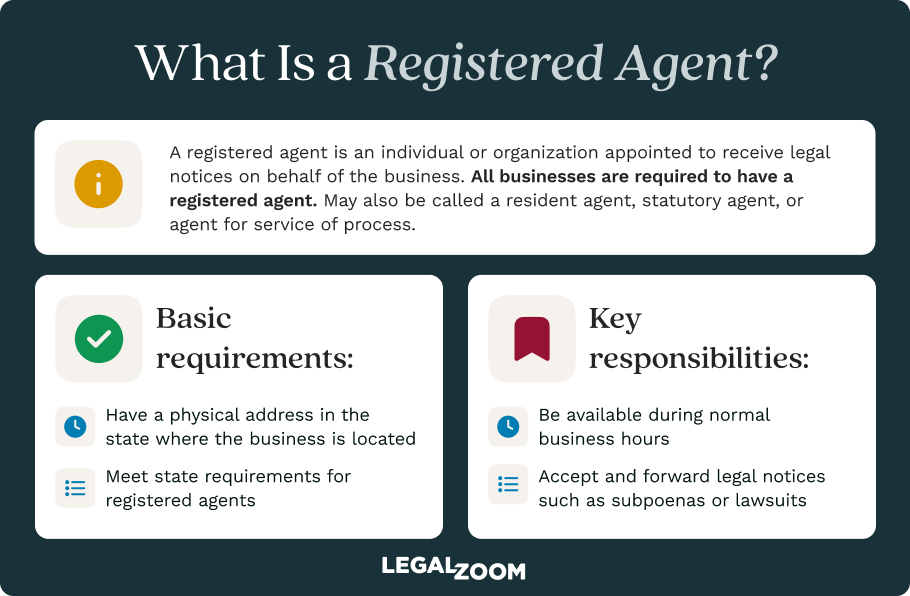
The registered agent must sign the articles of incorporation and agree to be available during regular business hours to receive important mail on behalf of the organization. For this reason, many organizations choose to hire a registered agent service for the convenience and peace of mind.
Step 4: Register for charitable solicitation
If your nonprofit plans to seek donations in Nevada, it may need to fill out and submit a charitable solicitation registration statement along with its formation documents. Nevada law requires all charitable organizations to register with the Secretary of State before soliciting (seeking) donations, unless exempt.
Your organization is exempt if it meets one of the following criteria:
- It solicits fewer than 15 people a year for contributions.
- It only solicits from close relatives of its officers or directors.
- It’s a church that qualifies for tax exemption under IRS section 501(c)(3).
- It’s raising money for a specific person or family, and all funds go directly to them.
- It’s an alumni group from an accredited school and only contacts people connected to the school, such as students, staff, or close relatives of alumni.
All other Nevada nonprofit entities that will register with the SOS must complete a charitable solicitation registration once a year along with the annual list.
Step 5: File your Nevada articles of incorporation and initial list
Now you’re ready to file articles of incorporation, which are the formation documents that officially create your nonprofit, with the Secretary of State. The information you’ll need to include in your articles is generally the same, but there are some differences depending on the structure of your organization.
- Organization name. Provide the legal name of your nonprofit, which must meet Nevada requirements.
- Registered agent information. Give the name (or title), Nevada street address, and signature of your registered agent. If they’re a commercial agent, you only need to provide the name.
- Term of business existence. State the duration of your organization (write “perpetual” if there is no set ending date).
- Membership fee. Provide the cost of membership (for cooperative associations).
- Membership rights. Determine whether or not membership rights will be equal or unequal (for cooperative corporations).
- Benefit corporation type. Indicate whether or not the organization is a benefit corporation (a benefit corporation exists for the benefit of the general public).
- Purpose statement. A nonprofit that seeks to qualify for tax-exempt status under Section 501(c)(3) must convey that it exists exclusively for an exempt purpose, such as a charitable, educational, religious, or scientific endeavor.
- Directors. Provide the names and addresses of your initial directors. Cooperative corporations must include at least three directors, who are majority Nevada residents.
- Authorized shares. Give a breakdown of the corporation's number of shares and par value.
- Incorporators/members. Include the name, address, and signature of each incorporator/member. Cooperative associations must provide at least five members, while cooperative corporations must give at least three, who are mostly Nevada residents.
- An exempt purpose clause limiting your purposes to IRC 501(c)(3) categories.
- A dissolution clause directing that leftover assets go to another 501(c)(3) organization or government entity if your nonprofit winds down.
Along with your articles of incorporation, Nevada nonprofit entities must submit an initial list of officers. Include the name of your organization and the name and address of the president, secretary, treasurer, and one director of your nonprofit. A member of the management team or authorized individual must sign the form.
Additionally, Nevada business entities generally need to apply for a state business license. However, these nonprofit entities are exempt:
- A nonprofit corporation
- A nonprofit cooperative corporation or association that is a unit-owners association
- A nonprofit cooperative corporation or association that qualifies for tax exemption under Section 501(c) of the Internal Revenue Code
If your nonprofit is a cooperative association or nonstock corporation that doesn’t meet the above criteria, it will need to pay a $200 state business license fee. If it is a cooperative stock corporation, it will need to pay a $500 state business license fee.
Lastly, charitable nonprofits that will solicit donations must indicate that they have filled out the charitable solicitation registration statement and file it with the articles.
When you're ready, file online through Orion or deliver a paper form, either by mail or in person, to the Nevada Secretary of State’s Carson City or Las Vegas address. Include payment for $50 for nonprofit articles of incorporation filing fee and $50 for the initial list filing fee ($100 in total). Nonprofit cooperatives that need to apply for a state business license will also need to include the relative business license fee.
Step 6: Draft bylaws and a conflict of interest policy
Nevada law requires nonprofit cooperative corporations and associations to draft bylaws within a month of filing articles. Bylaws are your organization's internal operating rules. They cover how often your board meets, how it makes decisions, elects officers, and handles conflicts. The IRS may also review your bylaws when applying for tax-exemption.
At minimum, your bylaws should include the following provisions.
- Board composition and terms: Director count, election method, and term length.
- Meeting requirements: Frequency, notice, location, and quorum requirements. (Quorum is the minimum number of directors/members who must be present for a meeting to take place or for its actions to be binding.)
- Officer roles: Appointment and removal procedures, authority, and duties.
- Voting procedures: Routine votes versus major actions like amending articles or dissolving the corporation.
- Conflict of interest policy: A policy to ensure directors, officers, and key persons address any conflicts of interest, including procedures for how to navigate the conflict. The IRS scrutinizes whether or not a nonprofit has a conflict of interest policy when applying for tax exemption under Section 501(c)(3).
- Amendment process: Who is needed to vote on an amendment, methods for adding to or adjusting bylaws.
- Recordkeeping standards: A complete written record of director/member meeting minutes, accounting records, and a copy of the articles, amended bylaws, and resolutions.
You can write your bylaws on your own, but due to the extra scrutiny on nonprofits, it might be wise to work with a business attorney or use a legal service to help ensure your bylaws cover all the important points. Your bylaws will often act as a supporting document when registering with state and federal agencies, so it's important to create a comprehensive document that adds credibility to your mission.
Note: While Nevada nonprofit law does not explicitly require nonprofits to keep minutes and make them accessible, the Nevada Attorney General recommends keeping minutes to prevent legal disputes. The IRS also suggests keeping thorough records to help achieve and maintain tax-exempt status.
Step 7: Get an employer identification number
A federal employer identification number (FEIN or EIN) is a nine-digit ID that the IRS assigns businesses to identify them for tax purposes. You’ll need an EIN to file for tax-exempt status, hire employees, and apply for grants. Some banks may also require an EIN to open a bank account.
It’s completely free to obtain an EIN through the IRS website. You can also use LegalZoom’s EIN filing service if you want this task off your plate.
Keep in mind, an EIN doesn’t make your organization tax-exempt. It's an identification number that the IRS, banks, and other agencies use to identify your organization.
Step 8: Apply for federal 501(c)(3) tax-exempt status
While there are several types of classifications for tax-exempt organizations, tax exemption under Section 501(c)(3) is a common qualification for nonprofits. It can make donations tax-deductible and exempts your organization from federal income tax.
The IRS grants 501(c)(3) status through one of two main forms.
Form 1023 is the more complex application.
- Who qualifies: Larger exempt organizations that don’t qualify for the simpler 1023-EZ form.
- Filling fee: $600.
- How to file: Submit the completed form online through www.pay.gov.
- Processing time: Processing times vary. The IRS publishes current processing information, so applicants can check the IRS website for more precise estimates. It generally takes at least four to six months.
- Other requirements: You will need to attach your bylaws and articles of incorporation for a nonprofit corporation.
Form 1023-EZ is a simplified version of the 1023 for smaller organizations.
- Who qualifies: Organizations that meet the IRS eligibility requirements, which include projected annual gross receipts of $50,000 or less and total assets of $250,000 or less.
- Filling fee: $275.
- How to file: Submit the completed form online through www.pay.gov.
- Processing time: Processing times vary. The IRS publishes current processing information, so applicants may check the IRS website for estimates. It generally takes about a month.
- Other requirements: You will need to attach your articles of incorporation for a nonprofit corporation.
After the IRS reviews your application, you’ll receive a determination letter approving your status, a request for additional information, or a rejection letter. If you’d like help filing Form 1023-EZ, LegalZoom’s 501(c)(3) application service can guide you through the process.
Step 9: Register your Nevada nonprofit for state exemptions
Federal tax exemption approval doesn't exempt you from all Nevada taxes. You will need to apply for state exemptions separately with the Nevada Department of Taxation.
Nevada has no state corporate income tax, but there are a few other taxes that a nonprofit organization may have to register for, unless exempt.
- Sales and use tax applies to businesses that sell or lease tangible goods or services. Qualified nonprofits can apply for an exemption letter online through My Nevada Tax or by filing a paper form with the Department.
- Commerce tax applies to Nevada businesses whose gross revenue is above $4 million a year. Nonprofit organizations that qualify for federal tax exemption are automatically exempt from this tax.
- Unemployment tax applies to Nevada businesses that pay $225 or more of wages in a calendar quarter. Register for unemployment tax with the Nevada Department of Employment, Training and Rehabilitation (DETR)
For a more curated look at your organization’s unique tax obligations, it’s best to consult a tax professional.
How much does it cost to start a nonprofit in Nevada?
While the full cost of starting a nonprofit in Nevada will vary based on the needs, location, and size of your organization, these are some of the basic costs that you should be aware of.
- Articles of incorporation: $50
- Initial list of officers: $50
- Business license: $200–$500, depending on your nonprofit structure (nonprofit corporations are exempt)
- Charitable solicitation registration: Free
- Name reservation (optional): $25
- EIN: Free or for a fee using a service like LegalZoom
- Form 1023: $600
- Form 1023-EZ: $275
Therefore, the total basic initial cost to start a nonprofit in Nevada ranges from around $375 to $1,225. Professional assistance would increase these numbers, but is often worth it for the peace of mind and accuracy.
Ongoing compliance for Nevada nonprofits after formation
Once your nonprofit is off the ground, it's important to stay compliant with federal and state laws so that you can keep making a difference.
- Annual list of officers. Nevada nonprofit corporations must file an annual/amended list of officers with the SOS. The list is due each year within 90 days of the nonprofit’s date of formation. The fee is $50. A nonprofit that skips this step risks administrative dissolution.
- Charitable solicitation renewal. Nonprofits that are required to file charitable solicitation registrations with the SOS must file an annual registration statement along with their annual list.
- Registered agent maintenance. Maintain a registered agent with a Nevada address at all times. Failure to maintain a registered agent can also trigger administrative dissolution.
- IRS annual filing. Nonprofits that are tax exempt under Section 501(c)(3) of the Internal Revenue Code must file Form 990, 990-EZ, or 990-N depending on the size of the organization. The deadline for all three is the 15th day of the 5th month after your fiscal year ends (May 15 for a December 31 year-end).
- Sales/use tax exemption renewal. A letter of exemption expires five years after the date it was initially granted. Renew your letter of exemption for another 5 years by filing an application for renewal with the Department of Taxation.
How to find grants for Nevada nonprofit organizations
Grant funding for Nevada nonprofits can come from state agencies, community foundations, private foundations, and federal agencies.
- State agency grants. Several Nevada state agencies fund nonprofits in arts, education, health, and social services. The Nevada Arts Council is a major funder for arts organizations and artists statewide.
- Community foundations. Nevada's community foundations, including those in Las Vegas and Reno, run donor-advised funds and competitive grants for local nonprofits, usually favoring groups with community roots, active tax-exempt status, and one to two years of operating history.
- Private foundations. National and regional private foundations fund Nevada nonprofits that match their goals. Candid's Foundation Directory is a good starting point to find a private foundation that aligns with your nonprofit.
- Federal grants. Agencies like HHS, the National Endowment for the Arts, and the Corporation for National and Community Service fund Nevada nonprofits through Grants.gov. Federal grants often require active federal tax-exempt status under Section 501(c)(3).
Build your grant calendar around your IRS determination letter date. Many foundations and agencies run fixed annual or biannual cycles, so missing a deadline usually means waiting for the next round.
Before you apply for any grant, make sure you have the following:
- An IRS determination letter
- Current charitable solicitation registration with the Nevada Secretary of State
- An up-to-date annual list of officers filing
- A current Form 990 on file (or a plan for your first one)
- A board-approved budget
- Financial statements matching your grant application narrative
If you're not in good standing with the Secretary of State, your organization may be disqualified.
How to start your Nevada nonprofit with LegalZoom
LegalZoom makes it easy for mission-driven founders to establish their charitable organization and secure tax-exempt status. We are a one-stop shop for nonprofit formation and compliance, from filing articles of incorporation with the Nevada Secretary of State, to handling your Form 1023-EZ 501(c)(3) tax-exempt status application with the IRS and managing your ongoing compliance requirements.
We stand behind our work with a 100% accurate filing guarantee. Our technology, combined with our decades of experience, ensures your nonprofit is formed accurately and in compliance with Nevada state and federal regulations.
Nevada nonprofit FAQs
Should you start a new Nevada nonprofit or use a fiscal sponsor?
Incorporation has many benefits for nonprofit organizations, including greater credibility and limited liability status. However, corporations also come with stricter regulations. Fiscal sponsorship is an alternative to incorporation.
A fiscal sponsor is an existing nonprofit that lets you operate under its tax-exempt status without incorporating. It suits early-stage projects needing donor-deductible funding fast. But, it may not be right for long-term organizations.
Here are three questions that could help you decide:
- Do you need your own legal entity now, or can your mission move forward under another organization's umbrella?
- Can you handle ongoing compliance (an annual list of officers, charitable solicitation renewal, IRS Form 990)?
- Do you have the board and governance structure to support a standalone entity?
Is it better to form an LLC or a nonprofit in Nevada?
An LLC and a nonprofit corporation do fundamentally different jobs. An LLC exists to generate returns for its owners, while a nonprofit corporation exists for public benefit and can't distribute profits to members or directors. If you want tax-deductible donations and grant eligibility, you need a nonprofit corporation, not an LLC.
What is the 33% rule for nonprofits?
The 33% rule is an IRS public support test that determines whether you’re treated as a public charity or a private foundation. It requires a public charity, for the most part, to receive at least one-third (33.3%) of its total support from public sources, rather than from a small number of private donors. The difference can have tax and other consequences, so speak to an attorney if you have concerns. Public sources include government grants and individual donations.
Do Nevada nonprofits need local or county registrations?
Some Nevada counties and cities require separate business licenses or registrations that may apply to nonprofits active in their jurisdiction, regardless of your state-level registration status. Check with your county or municipal clerk's office early on to see whether registration, zoning approval, or a permit applies to what you're mission.


