




Estate planning is the process of organizing how your assets will be managed, preserved, and passed on, both during your lifetime and after your death. For high-net-worth (HNW) and ultra-high-net-worth (UHNW) individuals, estate planning assumes even greater importance because the wealth involved is often vast, complex, and spread across multiple generations.

Key takeaways
- Estate planning for high-net-worth individuals requires advanced strategies that go beyond a basic will.
- Trusts, tax planning, gifting strategies, and business succession planning can help preserve and transfer family wealth efficiently.
- Federal and state estate tax laws can significantly affect how much wealth is passed on to future generations.
- Estate planning attorneys, tax advisors, and wealth managers play an important role in creating compliant and effective estate plans.
- Legacy planning, philanthropy, and heir preparation help support smoother multi-generational wealth transfers.
- Regularly reviewing and updating your estate plan can help prevent costly mistakes, disputes, and unintended tax consequences.
Unlike traditional estate planning, where the focus is mainly on passing property or savings to loved ones, high-net-worth estate planning involves navigating multi-layered challenges such as:
- Multi-generational wealth transfer. Ensuring assets are preserved for children, grandchildren, and beyond.
- Complex taxation. Dealing with estate, gift, and income taxes across different jurisdictions.
- Business succession. Creating a strategy to smoothly transfer leadership and ownership of family businesses.
- Global assets. Managing properties, investments, and accounts spread across multiple countries.
- Philanthropy. Structuring charitable giving in a way that reflects family values while providing tax efficiency.
Due to these challenges, estate planning for high-net-worth families typically requires a team of professional advisors. Attorneys, wealth managers, accountants, and consultants can help design strategies that not only minimize tax burdens but also protect family legacies. Without professional guidance, even the wealthiest families risk losing a significant portion of their assets to poor planning, legal disputes, or unnecessary taxes.
In short, estate planning for high net worth individuals isn’t just about passing on money—it’s about securing the family’s future, preserving its values, and ensuring that wealth creates opportunities rather than complications.
At what net worth should you consider an estate plan?
Many families assume estate planning is only necessary for the ultra-wealthy, but that’s a common misconception. The right time to start depends on how your estate stacks up against federal and state tax limits, and those limits, in many cases, are much lower than you realize.
What is considered a large estate?
For federal purposes, an estate is generally considered “large” when its value exceeds the applicable estate tax exclusion. In 2026, that exclusion is $15 million per individual. Through a provision called portability, a surviving spouse may elect to use any unused portion of their deceased spouse’s exclusion. This can allow a married couple to transfer up to $30 million free of federal estate tax, assuming the full exclusion is available and the portability election is properly made. The federal estate tax rate can reach 40% on the taxable estate above the applicable exclusion amount.
Additionally, several states impose their own estate or inheritance taxes, often with lower thresholds than the federal estate tax exclusion. As of 2026, these states include:
- Estate tax: Connecticut, Hawaii, Illinois, Maine, Maryland, Massachusetts, Minnesota, New York, Oregon, Rhode Island, Vermont, and Washington
- Inheritance tax: Kentucky, Maryland, Nebraska, New Jersey, and Pennsylvania
Maryland is the only state that imposes both an estate tax and an inheritance tax. State tax rules, exemption amounts, rates, and filing requirements vary. Even if your estate is below the federal estate tax exclusion, you may still have state-level estate or inheritance tax obligations.

When does a trust become necessary?
Many people wonder at what net worth they need a trust. While there’s no one-size-fits-all answer, here are some facets to consider:
- State estate tax exposure. If your estate is worth over $2 million and you live in a state with a low exemption (like Massachusetts), a trust can help reduce or even eliminate estate taxes.
- Federal estate tax threshold. The IRS requires filing Form 706 when an estate’s total value (including certain gifts) exceeds the federal exemption, which is $15 million for 2026. Trusts are often used at this level to help reduce or avoid estate taxes.
- Other benefits at any wealth level. Trusts offer advantages beyond taxes, including avoiding probate, maintaining privacy, and safeguarding assets. Multiple legal and financial sources (including government guidance on estate planning, such as the CFPB’s explanation of revocable living trusts) confirm these benefits, even when tax thresholds are not exceeded.
Tip: If your estate is in the millions, it’s worth exploring trusts.
Example: Your estate is worth $7.8 million, and you live in New York. While you’re below the federal estate tax limit, your estate still exceeds New York’s $7.35 million exemption, which means that your estate could still face state estate taxes. Planning tools such as AB trusts or strategic gifting can help preserve more of your wealth.
Note: New York has a unique rule sometimes referred to as the “estate tax cliff.” If an estate exceeds 105% of the exclusion amount, the exclusion is lost entirely, and the full estate becomes taxable, not just the portion over the threshold. So, it’s best to consult a qualified estate planning attorney or tax professional for strategies to manage the impact.
What estate planning strategies best protect high-net-worth families?
For HNW and UHNW families, estate planning isn’t just about distributing assets, but it’s about preserving wealth across generations, managing complex tax exposure, and ensuring business or family legacies remain intact. While many foundational tools apply to both groups, UHNW families often require more layered, international, and tax-sensitive approaches.
Here are some advanced strategies for high-net-worth and ultra-high-net-worth families:
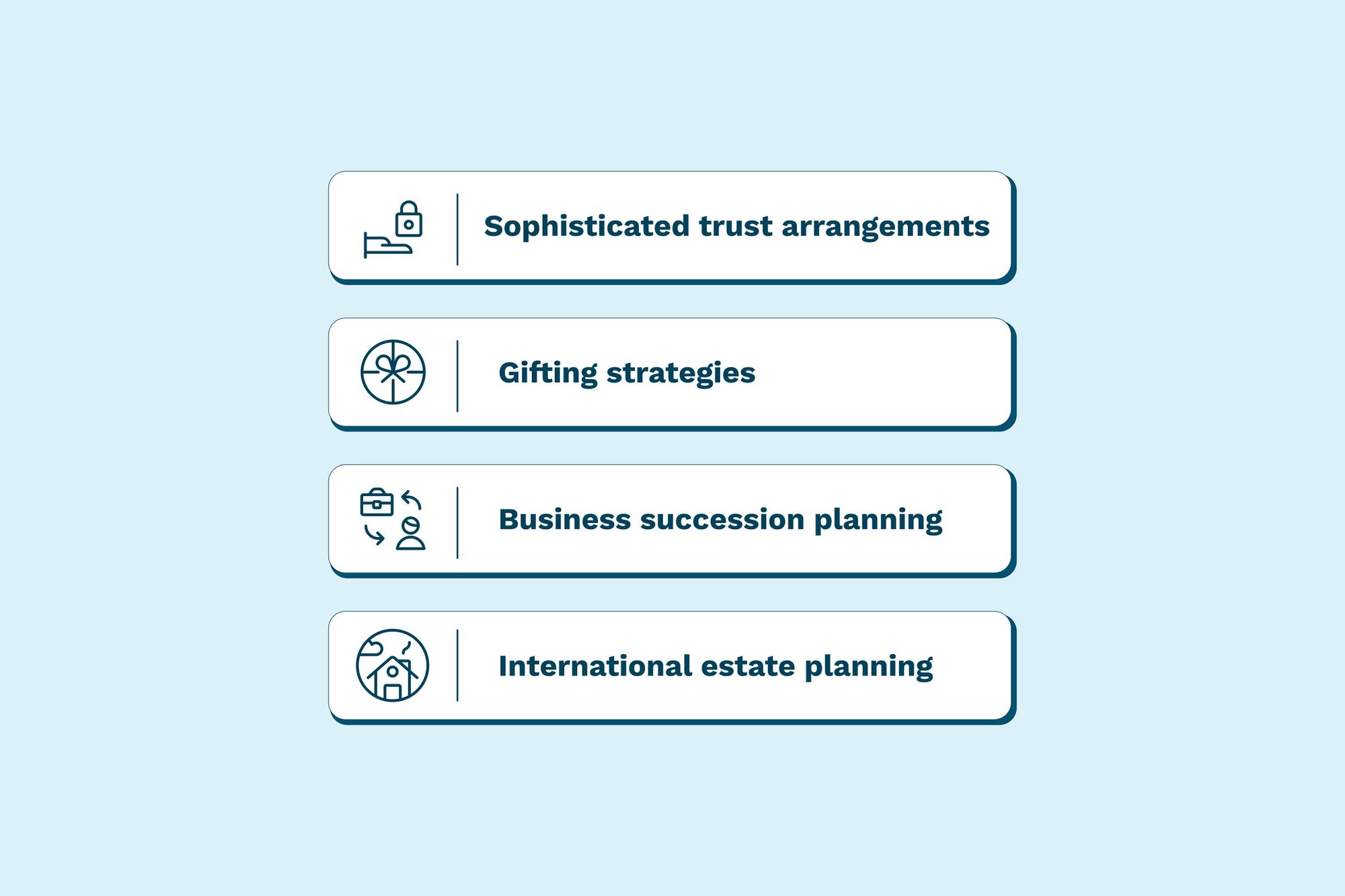
Sophisticated trust arrangements
Trusts are at the core of advanced estate planning. They allow families to help shield assets from estate taxes, provide for heirs in a structured way, and support charitable goals. For example, a credit shelter trust (also known as a bypass trust) can help married couples minimize federal estate taxes by utilizing each spouse’s estate tax exemption, in line with the IRS’ portability rules.
For UHNW families, more advanced strategies, such as dynasty trusts, grantor-retained annuity trusts (GRATs), and charitable remainder trusts, can further reduce tax exposure, protect assets from creditors, and ensure long-term financial security across multiple generations.
Gifting strategies
Strategic gifting enables families to transfer wealth during their lifetimes while minimizing tax exposure over time. Annual exclusion gifts, direct payments for tuition or medical expenses, and leveraging the lifetime gift tax exemption can reduce the size of a taxable estate. For larger estates, techniques such as intrafamily loans or discounted transfers of business interests are common.
Business succession planning
Many HNW families have privately held businesses at the center of their wealth, so a clear succession plan is critical to avoid disputes and ensure continuity. Tools such as buy-sell agreements, family limited partnerships, and management transition strategies help balance family dynamics while safeguarding business operations.
International estate planning considerations
Global assets and beneficiaries add another layer of complexity. Different jurisdictions impose varying inheritance, estate, and income taxes, making careful coordination essential for effective tax planning. Families with international ties may need multiple wills, cross-border trusts, or tax treaties to reduce conflicts and avoid double taxation.
How can tax planning protect wealth from estate taxes?
One of the biggest risks wealthy families face is the erosion of wealth through estate taxes. Without careful planning, a significant portion of an estate can be allocated to federal or state tax obligations, thereby reducing the amount that can be passed on to future generations.
High-net-worth and ultra-high-net-worth families often use tax-efficient strategies to protect assets. Charitable giving not only supports meaningful causes but also helps lower taxable estate values. Tools like GRATs, family limited partnerships (FLPs), and family foundations can be structured to transfer wealth in a way that minimizes tax exposure while keeping assets within the family.
It’s also important to consider state-specific rules. While some states impose estate or inheritance taxes in addition to the federal estate tax, others are more tax-friendly. Families with multi-state or international ties need to account for these differences when designing their estate plans.
Tax-efficient strategies for high-net-worth families
Wealthy families often rely on a range of strategies to preserve assets while minimizing estate tax exposure.
- Charitable giving. Contributions to charities or donor-advised funds can reduce the taxable estate. Families also benefit from income tax deductions, aligning wealth transfer with their philanthropic values.
- Grantor retained annuity trusts. GRATs allow assets to be transferred at a reduced gift-tax cost, with future appreciation passing to heirs outside the taxable estate.
- Family limited partnerships. Transfer business or investment interests into FLPs to enable discounted valuations for gift and estate tax purposes, while still allowing centralized management.
- Family foundations. Establish a private foundation to provide long-term philanthropic impact and significant estate tax deductions.
- State-specific planning. Federal estate tax rates can reach up to 40%, but state rules vary widely. States like Florida and Texas impose no estate or inheritance taxes, while states such as New York, Massachusetts, and Oregon levy their own, making residency and asset location critical planning factors.
Why are trusts crucial for asset protection and wealth preservation?
For HNW families, trusts are one of the most powerful tools in estate planning. They go beyond simply passing assets to the next generation—they help protect wealth, maintain privacy, and ensure that family legacies are preserved according to personal wishes.
Core reasons families use trusts
Asset protection: Certain types of trusts can shield assets from creditors, lawsuits, and other risks, ensuring that wealth remains intact for future generations.
Privacy: Unlike wills, which go through probate and become public record, trusts allow families to transfer assets privately.
Avoiding probate: By placing assets in a trust, families can bypass the time, expense, and publicity of the probate process.
Types of trusts to consider
Different trusts serve different purposes. Wealthy families often use a combination of the following.
- Revocable trusts: The most commonly used type of trust that can be changed or revoked during the grantor’s lifetime
- Irrevocable trusts: Fixed structures that provide stronger asset protection and potential estate tax benefits
- Dynasty trusts: Designed to preserve wealth across multiple generations without being eroded by estate taxes at each stage
- Wealth replacement trusts: Often paired with charitable giving, these allow families to donate assets to charity while using life insurance to “replace” the value for heirs
- Charitable trusts: Enable philanthropic goals while also offering tax advantages
How to choose estate planning professionals for high-net-worth families
When managing significant wealth, not every professional is equipped to handle the complexity of high-value estates. HNW attorneys and consultants bring specialized knowledge of tax laws, wealth transfer strategies, and multi-generational planning that goes beyond what a general practitioner may provide.
Key professionals involved in estate planning for wealthy families
- Attorneys: They draft and structure trusts, wills, and other legal instruments tailored to minimize tax exposure and protect assets.
- Tax advisors: They provide guidance on federal and state tax implications, ensuring compliance while optimizing savings.
- Wealth managers: They oversee investment portfolios, align financial strategies with long-term estate goals, and balance risk with growth.
- Estate planning consultants: They offer holistic planning by coordinating legal, financial, and tax strategies across multiple generations.

How to evaluate expertise and services
Families should look for proven experience with high-net-worth estates, a strong understanding of state-specific and federal tax laws, and the ability to coordinate seamlessly with other advisors. Referrals, professional credentials, and demonstrated case experience are often the best indicators of whether a professional can deliver the level of guidance needed.
What role does financial planning play in estate planning?
For HNW individuals, estate planning and financial planning are deeply connected. A strong financial plan ensures that wealth is not only preserved during one’s lifetime, but also transferred smoothly and tax-efficiently to the next generation.
Integration of financial and estate planning
When financial planning and estate planning work in tandem, families can create a clear path for preserving their wealth. This means aligning investments, savings, and retirement goals with long-term plans for passing assets to the next generation.
The importance of insurance planning
Insurance is more than just protection. Life, health, and long-term care policies can provide peace of mind while also acting as practical tools. For example, life insurance can give heirs immediate funds to cover estate taxes or debts, so valuable assets don’t have to be sold quickly.
Liquidity strategies for estate tax obligations
One of the biggest challenges for HNW estates is ensuring sufficient liquidity to pay estate taxes without having to sell valuable assets, such as real estate or businesses. Well-structured financial planning incorporates liquidity solutions—such as life insurance proceeds, credit arrangements, or cash reserves—that can efficiently cover these obligations.
What are the best approaches to legacy and wealth transfer planning?
For UNWH families, wealth transfer is about more than numbers—it’s about values, responsibility, and legacy preservation that lasts across generations.
Prepare heirs for the future
Passing on wealth also means passing on the knowledge to manage it wisely. Families often use education, mentorship, and structured involvement in family businesses or philanthropy to prepare heirs for the responsibilities that come with significant assets.
Balance control and flexibility
It’s natural to want to protect family wealth, but too much control can restrict the next generation. Effective planning strikes a balance—ensure safeguards are in place while still giving heirs room to make decisions and grow.
Legacy planning vs. estate planning
While estate planning focuses on the transfer of assets, legacy planning is about the bigger picture: values, traditions, and long-term family vision. Combining the two ensures heirs inherit not only wealth, but also the principles behind it.
Philanthropy as part of legacy
Charitable trusts and family foundations allow wealth to make a lasting social impact while offering tax benefits. For many families, giving back is as much a part of their legacy as passing wealth to the next generation.
The role of family governance
Clear communication and structured family governance can prevent disputes and misunderstandings. Regular family meetings, shared decision-making, and agreed-upon rules help preserve harmony along with wealth.
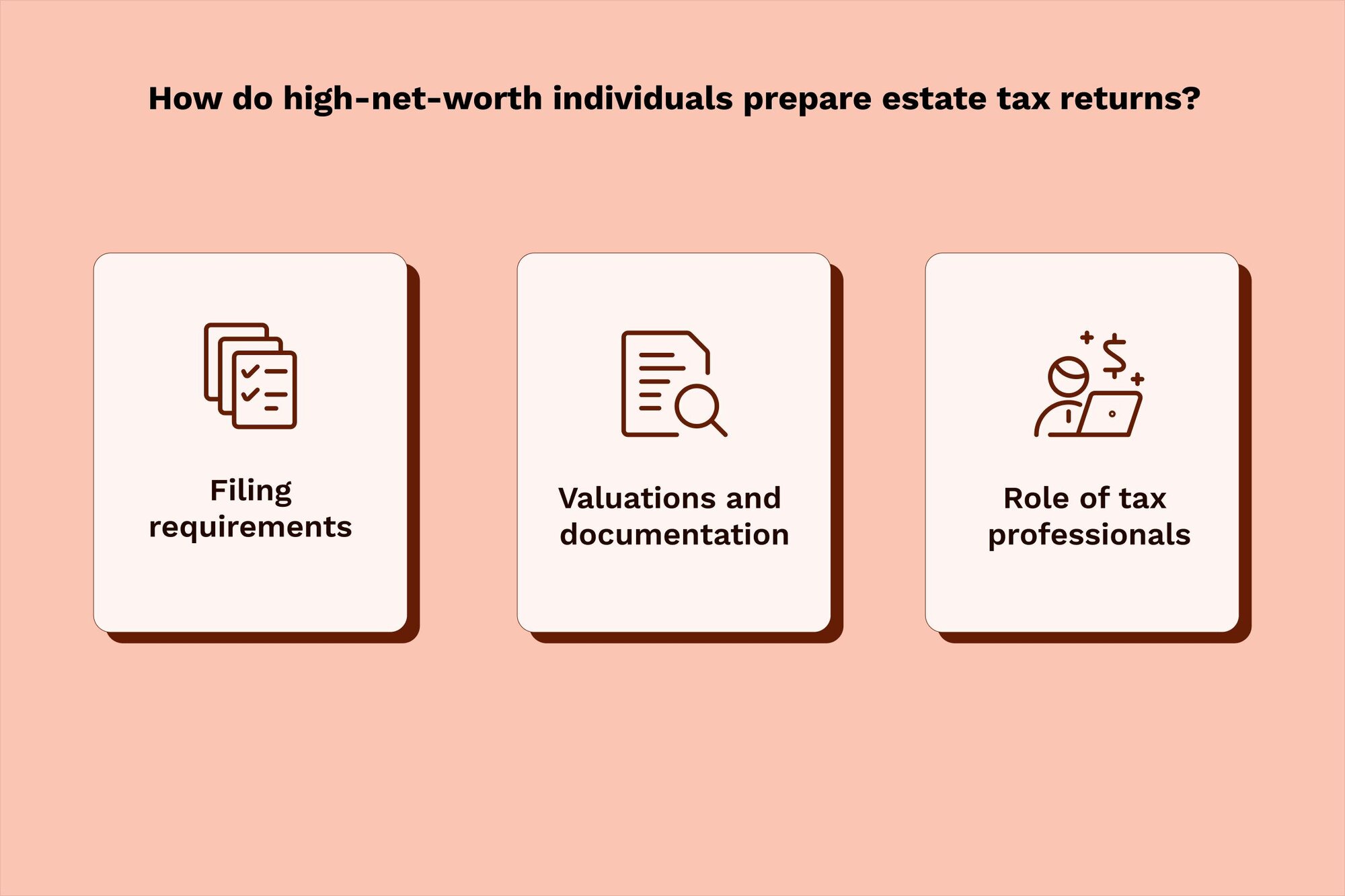
How do HNW individuals prepare estate tax returns?
For high-net-worth individuals, estate tax preparation is a complex process that requires precision, documentation, and professional guidance. Because large estates often involve diverse assets, such as businesses, real estate, art, or international holdings, filing requirements are far more rigorous than standard returns.
- Unique filing requirements and IRS compliance. The IRS has strict rules for estates above certain thresholds. These requirements involve detailed reporting of assets, debts, and deductions, with accuracy being crucial to avoid audits or penalties.
- Valuations and documentation. Proper valuation of assets is one of the most critical steps. Independent appraisals for real estate, businesses, or collectibles are often required, accompanied by meticulous documentation to support the reported values.
- The role of tax professionals. Given the complexity, most wealthy families rely on estate attorneys, CPAs, or specialized tax advisors to navigate deadlines, minimize tax exposure, and ensure compliance. Their expertise helps protect against errors that could cost the estate time and money.
What mistakes should wealthy individuals avoid in estate planning?
Even the most carefully built estate can lose value or create family conflicts if common mistakes aren’t addressed early. Some pitfalls that wealthy families should watch out for include:
- Not keeping the plan current. Life changes such as marriages, divorces, births, or new investments often require updates. An outdated plan may no longer reflect your wishes or family circumstances. For instance, a business owner who remarried but never updated her estate plan may end up unintentionally leaving a large portion of her company to her ex-spouse. Regular reviews help ensure your plan reflects your current life and relationships.
- Overlooking state-level estate or inheritance taxes. Federal estate tax gets most of the attention, but several states have their own tax rules. Ignoring them can lead to unexpected liabilities.
- Failing to plan for liquidity. Estates that are asset-rich but cash-poor can leave heirs scrambling to cover taxes or expenses. Plan ahead for liquidity to ensure obligations can be met without forced sales.
- Relying only on a will. While a will is essential, wealthy families often need advanced strategies, such as trusts, family partnerships, or charitable vehicles, to minimize taxes and maintain control. For example, families who incorporate trusts into their estate plan are able to preserve privacy, reduce taxes, and keep assets under family control—advantages a will by itself can’t offer.
How to get started with estate planning today
The estate planning process may feel overwhelming, but breaking it into clear steps makes it manageable.
Take stock of your net worth. List out your assets—real estate, investments, businesses, insurance, and valuables—so you have a clear picture of what needs to be planned for.
Work with specialized professionals. High-net-worth planning often requires expertise beyond a general attorney. Estate planning lawyers, tax advisors, and wealth managers can help you structure your plan to minimize taxes and protect assets.
Clarify your family and legacy goals. Think about more than money. Do you want to fund education for future generations, support philanthropy, or ensure smooth business succession? Having clarity here guides every decision.
Put legal structures in place. Draft wills, establish trusts, and update beneficiary designations so your intentions are legally enforceable and protected.
Get started now so you have more options and more control over how your wealth is preserved and passed on. Consult with estate planning professionals to safeguard your family’s financial future.
What are some options to get started in estate planning for HNW individuals?
Consider finding an estate planning attorney with experience creating plans for high-net-worth individuals. An attorney can help you understand your options and determine which strategies may fit your financial situation and goals.
For basic revocable trusts, LegalZoom’s estate plan services offer a convenient, affordable, and accessible way to establish a strong foundation for your estate plan. From ensuring compliance with essential requirements to streamlining key documents, LegalZoom helps you take the first critical steps with confidence, while leaving room to integrate more advanced strategies with the guidance of specialized advisors.
- Efficient, guided, and cost-effective estate planning. LegalZoom enables users to create essential documents, such as trusts, wills, powers of attorney, and healthcare directives, through a step-by-step online process.
- Access to attorney guidance and unlimited annual revisions. The Premium Trust package includes a year of unlimited 30-minute calls on new legal topics with an estate planning attorney, along with annual revisions for your documents, an attractive value compared to traditional hourly legal fees.
- Trusted and widely used platform. LegalZoom has helped millions create estate planning documents.
- Convenient and flexible online access. LegalZoom’s platform enables you to create, review, and store estate planning documents online, making it easy to update or access them at any time. This flexibility is especially helpful for families managing assets or loved ones across different states.
FAQs about HNW estate planning
What qualifies someone as “high-net-worth” for estate planning?
There is no single legal definition of “high-net-worth” for estate planning. HNW individuals generally have substantial assets that may require more complex tax, trust, and wealth-transfer planning. The level of planning needed depends on factors such as the types of assets owned, tax considerations, family circumstances, and wealth-transfer goals.
What role does life insurance play in estate planning for HNW individuals?
Life insurance can be a critical tool for liquidity, as it provides funds to pay estate taxes, debts, or other obligations without forcing the sale of assets. It can also support wealth transfer strategies, equalize inheritances among heirs, or fund irrevocable life insurance trusts to keep proceeds outside the taxable estate.
Should I create separate estate plans for different states or countries?
Yes, if you have assets or beneficiaries across multiple states or countries, separate estate planning documents may be needed. State-specific estate or inheritance taxes and differing legal requirements can affect how assets are transferred, while international holdings may require cross-border trusts, tax treaties, or multiple wills to avoid double taxation and ensure smooth administration.
What happens if you don’t file an estate tax return?
Failure to file can result in penalties, interest, and delays in distributing assets to heirs. In some cases, the IRS may audit your estate or take legal action, which can complicate wealth transfer and increase costs. Couples can also miss out on key filing deadlines such as the portability election.
Who should I choose as trustee, and why does it matter?
A trustee manages your trust assets and ensures your wishes are executed. Choose someone trustworthy, financially savvy, and capable of handling complex responsibilities. Professional trustees, like trust companies or professional fiduciaries, are often used for high-net-worth estates.
Do I still need a will if I have a trust in place?
Yes. Even with a trust, a “pour-over” will ensures any assets not formally transferred to the trust are still distributed according to your wishes, which helps prevent probate complications.
How do I prepare my heirs to handle inherited wealth responsibly?
Education and structured planning are key. This can include family meetings, financial literacy training, phased distributions, and guidance from wealth advisors who help heirs make informed decisions and preserve family wealth.
'%20/%3e%3c/svg%3e)

'%3e%3cpath%20fill-rule='evenodd'%20clip-rule='evenodd'%20d='M9.31239%2025.5316H13.0679V14.1032H9.31239V25.5316ZM11.1913%208.46875C9.93945%208.46875%209%209.25086%209%2010.505C9%2011.5995%209.78211%2012.5389%2011.1913%2012.5389C12.6005%2012.5389%2013.3826%2011.5995%2013.3826%2010.505C13.3826%209.4082%2012.6005%208.46875%2011.1913%208.46875ZM27%2018.9577V25.5316H23.2445V19.4275C23.2445%2017.8609%2022.6174%2016.7664%2021.3679%2016.7664C20.2711%2016.7664%2019.644%2017.5463%2019.3316%2018.1756C19.1743%2018.488%2019.1743%2018.8004%2019.1743%2019.1128V25.5316H15.4165V13.9458H19.1743V15.5123C19.644%2014.7302%2020.5835%2013.6357%2022.6174%2013.6357C25.1234%2013.7908%2027%2015.3573%2027%2018.9577Z'%20fill='white'/%3e%3c/g%3e%3cdefs%3e%3cclipPath%20id='clip0_952_9489'%3e%3crect%20width='18'%20height='18'%20fill='white'%20transform='translate(9%208)'/%3e%3c/clipPath%3e%3c/defs%3e%3c/svg%3e)

