



What is a power of attorney?
A power of attorney (POA) is a document that grants an agent, also known as an attorney-in-fact, the legal authority to make certain decisions on behalf of the principal. A general power of attorney is usually used for this purpose, though other, more specific POAs are also available to limit the power of an agent to particular areas. The scope of an agent’s powers depends on the type of POA used and the terms outlined within it, so it’s important to take special care when drafting any power of attorney document.

Key takeaways
A POA in place brings peace of mind to both the parent and family, knowing someone trusted can manage affairs and help avoid legal and financial chaos when needed.
- There are several types of POAs, ranging from general POAs that grant broad powers to limited/specific POAs with short timelines or restricted authority.
- Set up a POA early to allow elderly parents to ensure their wishes are followed in case of incapacity or family disputes. Early planning can also prevent the need for lengthy and costly court proceedings for guardianship (aka Conservatorship).
- The agent (person given POA) must act in the best interests of the parent, keep their finances separate, keep good records, and follow the terms of the POA document.
- Crucial points to consider before creating a POA in your parent's state are POA rules, notarization, and witness requirements.
- A mentally competent grantor can revoke or amend their POA anytime by following the proper legal process.
- Open conversations with your elderly parent(s) about their wishes, the role of the agent, and expectations help ensure transparency and respect for the parent’s desires.
- A power of attorney only authorizes actions specified in the document. An agent can’t act beyond what is granted, can’t change a will, and their authority ends upon the parent’s death.
When is a power of attorney necessary for elderly parents?
It’s wise to establish a power of attorney proactively, even if your parent is currently capable of managing their own affairs. Proactively setting up a POA early prevents the complications of court-appointed guardianship should your parent become incapacitated unexpectedly.
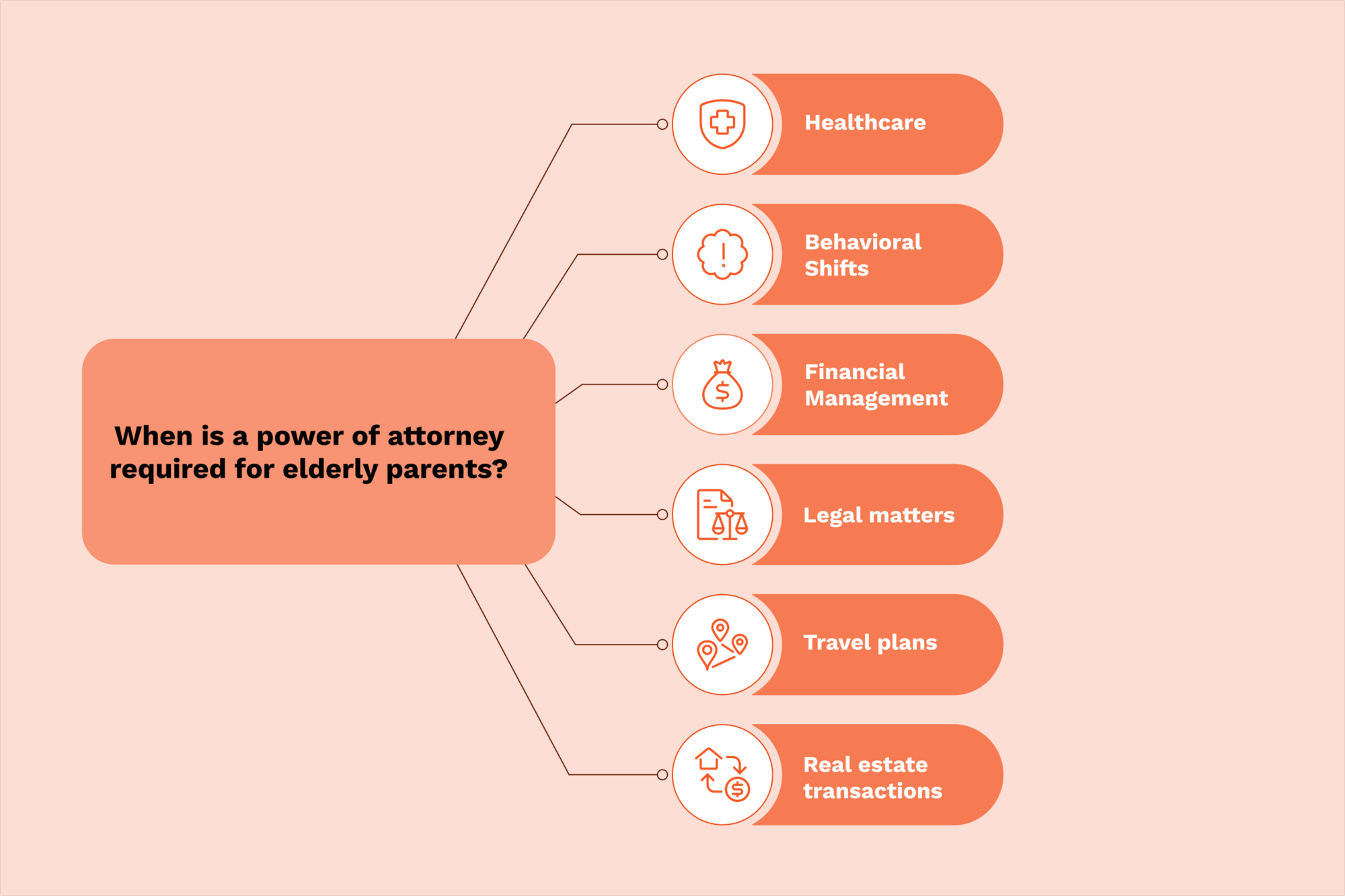
A power of attorney can be used in a variety of situations when dealing with your elderly parent(s).
Health care aspects
Once your parent’s physical and mental health starts to decline, they may no longer be able to make sound health care decisions for themselves.
- Memory issues. If you observe subtle or increasing forgetfulness, confusion, or difficulty managing daily tasks, it may be an early sign that your parent is in cognitive decline and needs assistance with decision-making. These signs sometimes appear gradually and can be overlooked until they are functionally incapacitated.
- Health diagnoses indicating potential incapacity. A serious medical diagnosis, such as dementia, Alzheimer’s disease, or a stroke, may cause subtle or dramatic incapacitation that could get worse over time.
- Frailty. When physical decline affects a person’s ability to live independently or manage personal care and daily chores, it may be time to consider drafting a POA before their cognition begins to decline.
Behavioral shifts
If your parent is starting to show behavioral shifts, it could be a sign that they’re heading towards cognitive decline, and it is important to have the discussion about setting up a POA for them.
- Changes in behavior or social withdrawal. When your parent(s) suddenly stop participating in social activities they previously enjoyed or become irritable when questioned about their health or memory, these behavioral shifts are indicators that it may be time to create a POA, as cognitive or health decline may soon be approaching.
- Refusal or resistance to help or care. A parent who refuses necessary medical care or assistance but needs support may require a POA to intervene when they can no longer make sound decisions.
Experts strongly recommend you start as soon as these signs appear or are anticipated, because the parent must be mentally competent to create a valid POA. If you wait too long, you can mean losing the opportunity for your parent to designate an agent themselves, potentially requiring court involvement later.
What can a POA be used for?
Financial management
When your parent is no longer able to manage their regular financial affairs, such as paying bills, handling investments, or filing taxes, a financial power of attorney can grant the authority for someone to manage these aspects on their behalf. Signs that they may need help can include:
- Missed EMIs or regular payments
- Unpaid bills
- Difficulty in managing bank accounts effectively
Legal and tax matters
If your parent(s) can’t make legal and tax decisions, you can use a general power of attorney to represent them in various legal situations. Examples include signing contracts for their property sale, filing tax returns with the IRS, handling real estate transactions, or settling disputes in court.
Real estate transactions
If your parent is willing to engage in real estate transactions but needs assistance with buying or selling property, a POA can facilitate these transactions.
Travel plans
If you have an elderly parent who loves traveling, the parent can draft a POA to grant you authority to manage their financial or legal matters while they’re away. In that case, a temporary power of attorney allows them to travel with peace of mind knowing that their financial and legal matters are in good hands back home.
Key terms and definitions
- Principal (or grantor/donor): The individual who creates the POA and grants authority to another person to act on their behalf
- Agent (or attorney-in-fact): The person or institution appointed by the principal to make decisions and take actions as specified in the POA document
- Health care power of attorney (healthcare proxy or medical power of attorney): A document in which the principal appoints an agent to make medical and healthcare decisions for the principal if they are unable to decide for themselves
- Revocation: The act of canceling or withdrawing the authority granted under a POA. Must be done by the principal when competent
- Notarization/witnessing: Often required for the POA to be notarized and/or witnessed for validity, especially for durable powers or healthcare matters
- Mental capacity: The mental ability a principal must have at the time of signing a POA to understand the nature and consequences of the document
- Conservatorship/guardianship: A court process where someone is appointed to manage a person’s affairs if they’re incapacitated and no valid POA exists
- Fiduciary duty: The legal responsibility of the agent to act in good faith and in the best interest of the principal, avoiding conflicts of interest and self-dealing
To learn more about common terminology used in law and business, explore our glossary of legal and business terms.
What are the different types of power of attorney available for elderly parents?
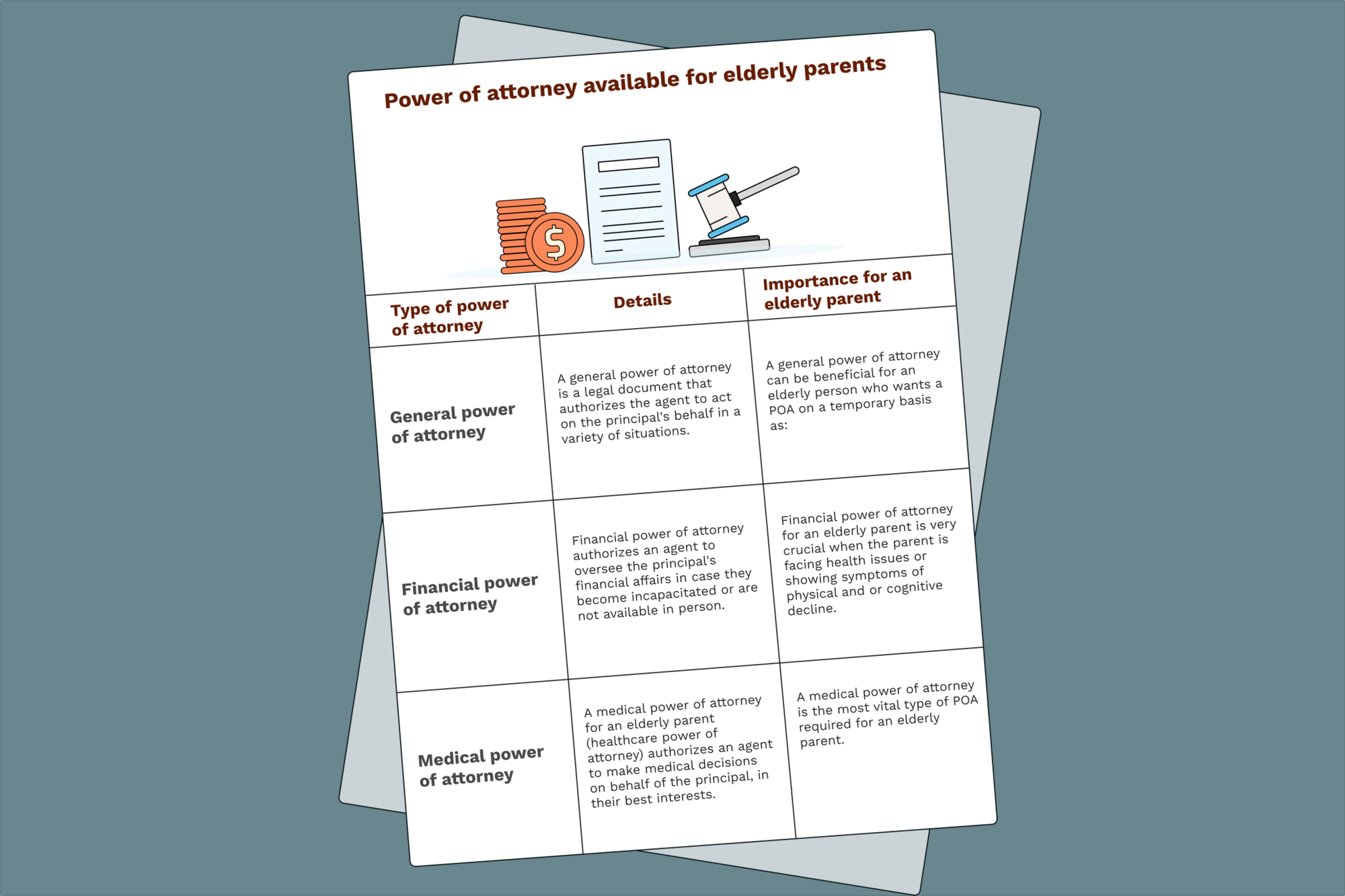
There are several types of power of attorney available for elderly parents, each designed to meet specific needs or situations. Here’s an overview of the main types:
| Type of power of attorney | Details | Importance for an elderly parent |
|---|---|---|
|
General power of attorney |
A general power of attorney is a legal document that authorizes the agent to make financial decisions on the principal's behalf in a variety of situations. This could mean signing important papers, managing real estate deals, or even making legal decisions for the principal. It gives the agent broad powers. If the principal wants to only give limited powers to their agents (e.g., handling one specific bank account), you can grant a limited power of attorney instead of a general power of attorney.
|
A general power of attorney can be beneficial for an elderly person who wants a POA on a temporary basis, such as:
|
|
Medical power of attorney |
A medical power of attorney (healthcare power of attorney) for an elderly parent authorizes an agent to make medical decisions on behalf of the principal, in their best interests.
|
A medical power of attorney can be beneficial for an elderly person in the following ways:
|
How do you get power of attorney for an elderly parent?
Obtaining power of attorney for an elderly parent is a legal process. The following steps and state-specific requirements can help.
Step 1: Start the conversation
Have an open and honest discussion with your parent(s) about the need for a POA. Remind them that a POA doesn't take away their autonomy or control over their life; it is simply a legal recourse for the event of their incapacitation. Discuss when a temporary POA may be necessary, such as during their recovery from an upcoming medical procedure or during an extended period of travel, and consider a limited POA, such as a real estate POA that lets you handle a home sale for them to take the burden off their plate.
Don't forget: Your parent must be mentally competent to grant this authority and must agree voluntarily to its execution.
Step 2: Choose the type (or types) of POA
Identify which type of power of attorney fits your parents' needs. In most cases, they should have both.
- General power of attorney. A general POA grants broad authority over financial and legal matters.
- Medical (healthcare) POA. A medical POA covers medical decisions.
Decide if you want the POA to be limited or broad in scope, springing or immediately effective, or durable upon incapacity or temporary. Remember that your parent can revoke a POA at any time so long as they're mentally competent.
Step 3: Select the right agent
Your parent will need to designate an agent. This is often a trusted friend, associate, relative, or family member who will act on their behalf.
Step 4: Define the authority
Your parent must clearly specify the powers granted to them. These can range from broad management of all affairs to limited duties, such as healthcare or paying bills.
Step 5: Draft the POA document
LegalZoom's attorney-drafted online POA templates are a budget-friendly option that allow you to personalize your document to meet your needs and your state's requirements. If you use a template or draft your POA on your own, it's wise to have an attorney review it. LegalZoom's service also comes with the option to add attorney review.
Step 6: Check your state's laws
POA requirements vary by state. Always check your state's specific rules or consult an attorney for guidance.
Step 7: Complete the legal formalities
Sign, date, and execute the POA according to your state's laws, which may require witnessing or notarization. Many states require signing in front of a notary public and witnesses to prevent fraud and ensure legal recognition. Be sure to check your state's requirements.
Step 8: Distribute the POA document
Once completed, provide copies to relevant parties (e.g., banks, healthcare providers), so they recognize the agent's authority when required.
If your parent lacks mental competence, they can't get a POA, and you may need to seek court-appointed guardianship. You should consult an elder law attorney if you think your situation may be complicated or require court action.
What are the eligibility and competency requirements for obtaining a POA?
To obtain a power of attorney for elderly parents, it's essential to meet two main requirements: competency and eligibility.
Competency requirements
The parent must be mentally competent when they sign the POA document. Competency means that the parent understands the nature, purpose, and consequences of the POA, essentially grasping the rights and powers they are granting to the agent.
This is referred to as contractual capacity, the legal ability to understand and agree to the terms and consequences of a binding contract. It differs from testamentary capacity, which is the mental ability to comprehend one's assets, heirs, and understand the effects when making a valid will.
- The principal must understand and appreciate the nature and extent of the consequences of creating a POA, including the effect of the document and the powers granted, much like signing a binding contract. They must fully comprehend the implications, risks, and benefits of the POA.
- They must be able to use logic and reasoning when they consider their options and decisions related to the POA.
- They should be able to make a choice and communicate their decision clearly and consistently enough that the agent can understand their duties.
- Even if an elderly parent has some cognitive impairment at the time of signing, they can still show competence by demonstrating an understanding of what they're signing. For instance, they can explain the POA's purpose and agent selection in their own words.
- If there is doubt about their competency, you may request a professional assessment by a physician, psychologist, or neurologist to confirm it for legal documentation.
Mild dementia or other cognitive impairments don't automatically disqualify someone from signing a POA. Capacity is assessed at the specific time of signing. Sometimes it's supported by a medical evaluation such as the Hopkins Competency Assessment Test (HCAT).
What are the signs of incompetence in elderly parents
Mental incompetence may develop gradually or come on more suddenly. The common signs include:
- Changes in behavior or temperament
- Memory loss
- Disorientation
- Confusion
- Forgetfulness
- Struggle with basic tasks that were previously done easily by them
- Neglecting personal hygiene due to fatigue
- Mismanagement of personal finances
- Prefer to stay isolated
Learn to recognize these symptoms early to help family members plan before serious issues arise.
How to determine capacity
A medical assessment by a professional, such as a neurologist or psychiatrist, is one way to assess your parent's cognitive functioning and mental state. You may get clarity on the level of mental impairment and can also identify any underlying conditions that may contribute to their symptoms, like dementia or depression. An official diagnosis provides a more precise understanding and establishes the necessary documentation, which at times may be necessary for future legal proceedings. Though there are many cognitive tests to assess memory, these elderly competency tests aren't literally diagnostic, but they can help you decide if you should seek a professional evaluation.
What steps should one take when an elderly parent is mentally incompetent?
If a parent becomes legally incompetent, it's generally too late to execute a POA. In this situation, loved ones may need to pursue legal guardianship or conservatorship through the court system.
How do you obtain a power of attorney for an elderly parent with early signs of dementia?
If you're considering how to obtain power of attorney for an elderly parent with dementia, the steps outlined below can guide you through the process effectively.
Discuss it with your parent
Have a patient and compassionate conversation with your parent soon after they're diagnosed with dementia, while they still have the mental capacity to understand and consent. Explain what a POA is, the powers it will grant, and the importance of planning for their future care and finances.
Evaluate medical capacity
If there are concerns about your parents' ability to understand the POA, consider having them evaluated by a medical professional to document their competency at the time of signing so that it will hold up in court if challenged.
Draft the POA document
It is highly recommended to have an attorney draft the document in this situation. It's a good practice to create a durable power of attorney because it ensures that the authority given to the agent is effective, even if your parent becomes incapacitated.
Clearly define what powers to grant—whether it's for financial, healthcare decisions, or both. It's also wise to consider any limitations you might want to set, as well as who would be the successor agent.
Execute the POA
When signing a power of attorney document, it's crucial that your parents do it willingly, without feeling any pressure from anyone. Given the potential for a legal challenge around the capacity of your parent, the signing process typically happens in the presence of two witnesses or a notary public, according to your state's rules. The notary or witnesses must ensure that your parent is fully capable of making this decision and isn't being pushed into it. It's all about making sure everything is done the right way!
Notify immediate family members and relevant institutions
Share copies of the power of attorney document with banks, doctors, healthcare facilities, and anyone else who might need to recognize the authority of your agent. Ensure it's easily accessible, but also keep it in a secure location. It's also a good idea to inform other family members about the location of the POA and its existence—this way, everyone is on the same page, and there won't be any confusion.
Can a dementia patient revoke power of attorney?
A person with dementia may eventually want to revoke their power of attorney, and they are subject to the same capacity requirements as when they signed it. Determining whether someone can change this decision will depend on their mental capacity and ability to understand the consequences. Each situation is unique. Revoking a decision involves legal, ethical, and practical considerations. Healthcare providers and family members need to recognize how dementia impacts an individual's ability to make legal decisions, because despite their condition, individuals with dementia can still make choices that protect their rights and well-being.
How is POA set up in different U.S. states? (State-by-state guide)
Use this state-by-state guide to compare Power of Attorney (POA) setups across different U.S. states that either have the most specific and distinctive POA requirements (such as unique witnessing, notarization, statutory-form, or recording rules) or are among the most-searched by people looking for POA information for elderly parents, healthcare, banking, and financial matters.
This includes states like California, Florida, New York, Texas, and Arizona, which have detailed statutory frameworks and frequently asked questions, as well as states with notable rules around health care POA, parental POA, tax-related authority, and real estate transactions. Together, these states offer a practical cross-section of how POA laws vary across the country.
Alabama
In Alabama, a power of attorney for an elderly parent must comply with the state's execution requirements to help ensure it is legally valid and accepted by financial institutions and other third parties.
- A power of attorney signature is presumed to be genuine if the principal acknowledges it before a notary public.
- Financial institutions may have their own requirements for accepting a power of attorney, so check with your bank before relying on the document for banking transactions.
Sources: AlabamaLegalHelp.org, Elder Rights Guide for Older Albamians, Alabama Department of Senior Services
Arizona
If you're looking to get a power of attorney in Arizona, the following must be fulfilled:
- Arizona law requires the principal to sign a power of attorney in the presence of a notary public. A witness must also sign a statement before a notary.
- General and durable powers of attorney are governed by the Arizona Revised Statutes (A.R.S.) Title 14, Chapter 5, Article 5, starting at § 14-5501 and following.
The following power of attorney forms can also be used:
- Health care power of attorney
- Mental health care power of attorney
- Power of attorney delegating parental powers
Sources: Arizona Judicial Branch .gov, Power of Attorney Resource Guide, Maricopa County Superior Court, State Bar of Arizona
Arkansas
In Arkansas, a power of attorney for an elderly parent should clearly describe the authority granted to the agent and be executed in accordance with Arkansas law. If the POA will be used for health care decisions, a separate advance directive or medical power of attorney may also be appropriate. Consult with an Arkansas attorney if you need guidance to ensure the document is properly drafted and executed.
Sources: Power of Attorney and Declaration of Representative, Arkansas Law Help, Arkansas Advance Directive
California
If you've ever wondered how to get power of attorney for an elderly parent in California, let's explore the main requirements:
- The POA document must be acknowledged by a notary public or signed by at least two witnesses who are adults (an agent cannot be a witness).
- If your parent wants a durable power of attorney, the document should include the necessary language to ensure it remains valid even if the principal becomes incapacitated.
- The power of attorney document must comply with the provisions of the California Probate Code from Section 4000 through Section 4465.
Sources: Power of Attorney (Superior Court of California, County of Santa Clara)
Florida
To get a durable power of attorney form in Florida for an elderly parent, the following is required:
- The POA document must be acknowledged by a notary public and signed by at least two witnesses who are adults (an agent cannot be a witness).
- Both witnesses must be mentally competent adults and must be present at the time that the principal signs the power of attorney in front of the notary.
- A durable power of attorney remains valid despite the principal's later incapacity, except as specified in §709.08, Florida Statutes.
- In Florida, the principal may create a health care power of attorney, which is referred to as a designation of a health care surrogate.
Florida law outlines specific requirements to create a valid power of attorney.
Agent's authority
- Gifting. Agents can't make gifts to themselves or others unless explicitly stated in the durable power of attorney.
- Decision-making. An agent's authority is limited to what is outlined in the document and Florida law.
- Changes to plans. Agents can't change the principal's plans unless permitted by the durable power of attorney.
Co-agents, successors, and additional fiduciary roles
- Independent authority. Each co-agent can make decisions and act independently unless the document states otherwise.
- Successor agent appointment. A successor agent may be named to act if the original agent can no longer serve. A successor agent has no authority if the original agent is able to act.
- Additional fiduciary roles. A principal may have a guardian of the property, a representative payee for handling Social Security benefits, or a VA fiduciary for managing veterans' benefits.
Business responsibilities
- Written refusal. Businesses must provide a written reason for refusing to accept a document within four business days.
- Use of documents. Businesses can't require the principal to sign their own forms if authority is granted in the durable power of attorney. Copies of the document must be honored as originals.
- Record-keeping disclosure requirements. Records don't need to be shared unless ordered by a court or requested by the principal.
Sources: U.S. Government Publishing Office
Georgia
In Georgia, a power of attorney must meet specific requirements, including being signed by two witnesses and a notary public. There are standardized forms available for financial and health care powers of attorney.
The Georgia legislature has passed a law regarding durable power of attorney for health care. The Georgia "Durable Power of Attorney for Health Care Act," specifically in Code Sections 31-36-6, 31-36-9, and 31-36-10, outlines a specific form that can be used for making durable power of attorney decisions related to health care.
Sources: Establish power of attorney, Power of Attorney, Understanding Durable Power of Attorney for Healthcare
Maryland
In 2010, the Maryland legislature enacted the Power of Attorney Act, formally known as the Maryland General and Limited Power of Attorney Act. This legislation simplified the process for individuals seeking to delegate authority to others to manage financial matters and other responsibilities.
A power of attorney that is executed on or after October 1, 2010, must meet specific requirements.
- The POA document must be in writing.
- It must be signed by the principal, or by another person in the principal's physical presence and at their express direction.
- The principal must acknowledge the document in front of a notary public, either physically or electronically.
- The power of attorney must also be signed by two or more adult witnesses, who can sign it either in the physical presence of the principal and each other, in their electronic presence, or through a combination of both.
Michigan
In Michigan, a durable power of attorney for health care is called a patient advocate designation.
- The document must be signed by the principal in the presence of two witnesses. Certain individuals, such as the principal's spouse, parent, child, grandchild, sibling, presumptive heir, physician, or an employee of a health facility where the principal resides, generally cannot serve as witnesses.
- The patient advocate must accept the appointment in writing before exercising any authority under the designation.
- The patient advocate may exercise authority only after the principal is unable to participate in medical or mental health treatment decisions, as provided under Michigan law.
Source: Michigan Legislature
New Jersey
In New Jersey, a power of attorney for an elderly parent should comply with state law to help ensure it is legally valid.
- The principal should sign the power of attorney in the presence of a notary public.
- For health care decisions, New Jersey uses an advance directive for health care, also known as a proxy directive, to appoint a health care representative.
Sources: Department of Health I Advanced Directives, New Jersey State Bar Foundation, New Jersey General Durable Power of Attorney
New York
New York also has similar requirements to other states, as follows:
- Sign the POA document in front of a notary public.
- Two witnesses must also sign the POA document.
In New York State, a power of attorney form allows the principal to include a rider which permits the agent to make gifts or support checks to themselves or others at the principal's discretion. It's recommended to exercise caution and discuss with an attorney the scope of your agent's gifting power. The principal can also appoint a monitor who can request records of the principal's accounts from the agent to guard against abuse or theft.
Sources: New York City Bar, NY Statewide Senior Action Council
Ohio
In Ohio, the execution requirements for a power of attorney depend on the type of authority being granted.
- A financial power of attorney must be signed by the principal before a notary public.
- A medical power of attorney must be signed in the presence of either a notary public or two competent adult witnesses. Witnesses cannot be a family member, the principal's physician, or anyone who stands to inherit the principal's assets.
- If a financial power of attorney authorizes the agent to transfer or convey real estate, the document must be recorded with the county recorder's office before it can be used for those transactions.
Sources: Ohio Legal Help, Ohio State Bar Association
Washington state
In Washington state, for a durable power of attorney, it's crucial for the elderly parent, who is the principal, to sign the necessary forms in the presence of a notary.
If a notary is unavailable, the forms can alternatively be signed in front of two disinterested witnesses. However, it is generally preferred to have the document notarized, particularly when it pertains to financial institutions.
If you're looking for more information to manage the retirement accounts of your elderly parent, explore the Uniform Power of Attorney Act in the Washington State Legislature for more insights.
Sources: Durable Power of Attorney, WashingtonLawHelp.org
What are the responsibilities and risks for power of attorney holders?
Acting as an agent in a power of attorney arrangement involves significant responsibilities and potential risks, including:
- Fiduciary duty. The POA holder (agent) must act in the best interests of the principal (the person granting authority) while managing their finances, property, or health care decisions within the limits set by the POA document.
- Transparency and recordkeeping. Agents must maintain proper records of all actions taken under the POA, keep their finances separate from those of the principal's expenses, and regularly account for decisions to the principal or a third party.
- Acting within scope. The agent must only act on matters authorized in the POA document and cannot overstep boundaries; acting outside those powers can result in liability for any damages.
- Obedience to the principal's wishes. The agent must try to follow the explicit directives and best interests of the principal, and cannot use the POA for personal gain.
- Legal and ethical conduct. Misuse, fraud, or negligence can be prosecuted civilly or criminally. Agents must be careful, as in some instances they can be sued for breach of duty or face criminal penalties for abuse.
Potential risks faced by agents
- Personal liability. If an agent breaches fiduciary duty, acts outside their legal authority, or is negligent, they may be held personally liable for resulting damages.
- Family and legal disputes. Actions viewed as questionable by heirs or others can lead to lawsuits, demands for accountings, or criminal charges.
- Responsibility for debts. Although agents typically are not personally liable for the principal's debts, any wrongful or unauthorized act could incur legal action or require restitution.
- Limitations. Agents can't act beyond the POA's terms, change a principal's will, transfer POA authority, or make decisions after the principal's death (at which point the executor takes over).
A POA holder has a legal duty to act honestly and transparently and to act in the principal's best interests. Risks—mainly legal liability—arise if these boundaries are not respected, especially regarding financial management and adherence to the principal's wishes.
What are the duties of a POA with respect to care, bills, and finances?
To understand the duties and responsibilities of a power of attorney in elderly care, let's get answers to the following questions, which many of us may have:
Can a POA put someone in a nursing home?
A medical power of attorney grants the appointed agent the authority to make health-related decisions for the principal if they are incapacitated. This document may enable the agent to make critical medical choices, such as whether to admit your elderly parent to a nursing home.
A health care power of attorney authorizes an agent to do the following, if required:
- Choose which health care providers the principal will see.
- Determine if the principal should live in a nursing home.
- Make decisions regarding medical treatment and care.
Is a POA agent responsible for nursing home bills?
If the resident has created a power of attorney with a designated agent, the agent can use that access to pay the bills from the principal's bank account. This is typically handled with the power of attorney for finances. However, the nursing home cannot require a POA agent to cover the resident's care with their personal funds.
Does a power of attorney override parental rights?
While a POA can grant someone significant authority, it doesn't take away parental rights.
Laws protect parental rights to ensure a child's well-being, and a power of attorney can't override these rights. The powers granted in a POA are limited to what's written in the document and don't include custody or legal guardianship of children. Those rights are considered fundamental, and changing them requires a court order.
Sometimes, a POA might come into play for temporary situations, like when someone needs to step in as a guardian for a while. But even then, the parents still have their rights intact. For example, if a parent allows a relative to make decisions about school or medical care temporarily, the parent still holds the ultimate authority unless a court decides otherwise.
Can a POA be a paid caregiver?
Yes, a POA can be a paid caregiver, but it needs to be handled with care. Make sure your elderly parent consents to the arrangement.
For instance, in Illinois, family members can get paid to care for their elderly parents through the Illinois Department on Aging's Community Care Program (CCP). This program, in conjunction with Medicaid, provides options for self-directed care, which enables individuals to hire and compensate family members as caregivers.
If you hold a financial power of attorney as a caregiver, you should keep detailed records of all relevant documentation in a transparent manner.
- It's a good idea to maintain separate bank accounts for the principal's and the caregiver's (or agent's) expenses.
- Keep thorough records of caregiving activities, including receipts of expenses, financial transactions, and communications with other family members.
A signed caregiver agreement, in conjunction with a properly documented power of attorney, ideally reviewed by an attorney, provides protection for both the person receiving care and the person providing it.
What are the risks of not having a power of attorney for your elderly parent?
Not having a power of attorney exposes your elderly parent and your family to significant legal, financial, and healthcare risks.
Court-appointed guardianship or conservatorship
Consider the following scenarios of having guardianship vs. power of attorney for your elderly parents.
- If your parent becomes incapacitated without a POA, the court steps in and appoints a guardian or conservator to manage their affairs.
- The appointed person can be a family member or a professional trustee, not necessarily someone your parent or family would choose.
- Guardianship proceedings can be lengthy, expensive, and stressful, resulting in delays in making urgent decisions.
Delayed or denied access to assets
If there is no power of attorney in place for an elderly parent who becomes incapacitated, the following may take place:
- Banks and financial institutions can freeze accounts, which makes it impossible for family members to pay bills, manage mortgages, or handle investments until they obtain a court order.
- Essential payments (property taxes, medical bills, etc.) may go unpaid, which risks foreclosure or loss of property.
Family conflict and stress
Without a power of attorney designating an agent, some family members may have to take on the required responsibilities, which can lead to issues and disagreements over critical financial and healthcare decisions.
Disputes among family members can create lasting rifts and may require court intervention to resolve, adding further stress during difficult times.
Medical care delays and unwanted decisions
At times, not having a healthcare power of attorney may cause concerns of life and death:
- Without a healthcare POA, no one clearly has the authority to make medical decisions if your parent becomes incapacitated.
- Providers may seek court instructions, potentially leading to unwanted or inappropriate care choices.
Additional legal costs
- Families incur legal fees for court filings, guardianship proceedings, and ongoing reporting requirements, which can quickly become financially burdensome.
What risk does an elderly person have if they don't have a financial power of attorney?
Without a financial POA, your ability to help your elderly parent in a crisis is drastically limited. You also lose control over who manages their financial affairs, risking family turmoil, legal complications, and financial losses. A financial power of attorney protects their interests, simplifies routine banking decisions, and helps avoid these pitfalls.

How to talk to your elderly parent about creating a power of attorney
Anyone considering how to explain a power of attorney to their elderly parents may wonder how. Before bringing the topic up and explaining POAs to the elderly, consider the following.
Choose the right time and setting
- Bring up the topic in a calm, private, and comfortable setting.
- Avoid discussing it during a stressful event or medical crisis. Instead, approach the topic while your parents are healthy and relaxed.
Lead with care and respect
- Emphasize that the goal is to protect their wishes, not to take away their independence.
- Use supportive language, such as "Honoring your choices is most important for us."
Explain what a POA is in simple ways
- Avoid legal jargon.
- Keep it simple, such as “A power of attorney lets you choose someone you trust to make certain decisions for you if you're ever unable to—such as handling your bills or talking to doctors on your behalf.”
Highlight the benefits
- Peace of mind that their wishes will be honored.
- Avoidance of expensive and stressful court proceedings.
- Preventing family disputes in case of emergencies.
Listen to their concerns
- Give space for questions or fears.
- Acknowledge their feelings—it’s common for parents to worry about losing control.
- Reinforce that a POA doesn’t remove their say while they’re capable; it only activates when needed.
Share real-world scenarios in a gentle manner
- Some examples can be: “If you were in the hospital and couldn’t speak for yourself, who would you want making decisions? A POA lets you choose right now.”
- Don’t scare them—keep it focused on preparation and peace of mind.
Involve trusted family or professionals
- Suggest including siblings in the conversation to reduce misunderstandings.
- Offer to meet with an elder law attorney together so they can get answers from a neutral, expert source.
Give them full control
- Let them decide who the agent should be and what powers to grant.
- Reassure them that they can change or revoke the POA at any time they deem necessary.
Be patient with them
- You may need several conversations—don’t rush.
- Show that you’re bringing it up out of love and concern, not out of urgency or a desire to control.

What are the common challenges and solutions to family dynamics when setting up a power of attorney?
Setting up a power of attorney for an elderly parent in the U.S. can trigger numerous family challenges, which, if unaddressed, may lead to conflict, misunderstanding, or even legal battles. Here are the most common challenges in family dynamics when making decisions for elderly parents concerning a power of attorney.
Disagreement over agent selection
Siblings may have disagreements regarding the choice of the agent, lack of capability, or potential for misuse of the POA. The chosen agent may face criticism or analysis from other family members, which can increase tension and rivalry.
Unequal responsibilities or perceived power
- The designated agent may feel overwhelmed, while others feel excluded or powerless.
- Siblings not named as agents may accuse the agent of mismanaging the parent's finances, medical care, or overstepping authority.
Lack of communication
- Families may not clearly discuss the reasons for agent selection or the scope of POA.
- Families may not honor their parent's wishes.
- Miscommunication or secrecy can breed suspicion, misunderstandings, and resentment.
Multiple agents (co-agents/joint POAs)
- Naming co-agents may seem like a compromise, but it often leads to deadlock if agents disagree.
- Some states require unanimous consent for co-agents, which complicates decision-making. Others allow independent action, risking conflicting choices.
Allegations of abuse or undue influence
- Family members may suspect undue influence by a particular individual, especially if a parent is vulnerable or has cognitive decline.
- Concerns about financial exploitation or neglect can result in legal challenges, court petitions, or demands for guardianship.
Legal challenges and court involvement
- Family members can contest the validity of a POA or claim the parent was not competent when signing.
- These disputes often end up in court, which is time-consuming, expensive, and emotionally costly for all involved.
Solutions to minimize family conflict
There are a few steps that can be taken to avoid as much familial conflict as possible, such as:
- Have an open dialogue and transparency. Discuss the POA process and agent selection openly with all family members involved. Transparency helps build consensus and trust.
- Honor your parents' wishes. Make it clear that the parent's wishes are paramount and will be honored in decision-making, starting with who they want as their agent, what powers to grant, and how they want decisions handled.
- Consider co-agents carefully. If you consider co-agents, describe how they will collaborate to resolve disagreements. Consult an elder law attorney to draft clear roles and decision-making protocols.
- Engage neutral professionals. Mediators, elder law attorneys, and financial advisors can facilitate productive conversations, offer unbiased advice, and help draft documents that reflect the parent's true wishes.
- Document everything. Use written records to clarify duties, decisions, and communications about the POA. Keep other family members informed of significant actions or changes that may affect them.
Legal recourse for harm or dispute
If there are any legitimate fears of elderly POA abuse, family members always have the option to challenge a POA through the court system and petition for its revocation if necessary. Seek professional help (legal advice or mediation) if disagreements threaten family harmony.
Proper planning, transparency, and respect for all voices can prevent many common POA-related disputes and help keep family relationships intact.
What are the alternatives and next steps if a power of attorney isn't enough?
If a power of attorney isn't enough to manage your elderly parent's affairs, several alternatives and next steps can provide the necessary support or legal authority. People usually consider these factors when a parent becomes incapacitated or when limitations of the power of attorney arise.
Guardianship or conservatorship
- A court-appointed guardian or conservator takes over decision-making for an individual who is incapacitated.
- It's often a last resort if no POA exists or if the POA agent is unable or unwilling to act.
- The guardian's authority includes managing finances, healthcare, and personal care, but it also involves court supervision and legal procedures.
- It can be costly, time-consuming, and can restrict the individual's independence.
A court looks at many aspects. It may include whether a person can take care of themselves or handle their money, and poor choices by themselves do not mean someone needs a guardian.
The guardian must live in the state, be at least 18 years old, be mentally capable, and not have a felony conviction unless they have received a pardon.
Supported decision-making
Supported decision-making is an alternative to guardianship that allows an individual to retain the legal authority to make their own decisions while receiving assistance from trusted family members, friends, or other supporters.
- Supporters help the individual understand information, weigh options, and communicate decisions, but they do not make decisions on the individual's behalf.
- This approach preserves the individual's independence while providing the support they need to make informed choices.
- State laws governing supported decision-making vary, and it may not be available or formally recognized in every state.
Living trust
- A trustee manages assets for the benefit of the individual in a legal arrangement.
- Trusts can provide continuity in managing financial assets if the person becomes incapacitated, thereby eliminating the need for court involvement.
- The trustee steps in as specified by the trust document, which can avoid probate and reduce court oversight.
Advance directives and health care proxies
- These specify preferences for medical care and appoint someone to make healthcare decisions.
- They are limited to medical decisions and do not cover financial or legal matters.
Social Security representative payee or VA fiduciary
Government-appointed representatives manage Social Security or Veterans Affairs benefits for the person. It's more limited in scope and is typically used only for managing benefits.
Specific court orders or protective arrangements
Courts may grant specific authority for particular actions (e.g., consenting to medical treatment or property transactions) without full guardianship.
Create a power of attorney for your elderly parents with LegalZoom
LegalZoom makes it easy to create a power of attorney online. Whether you need a durable, financial, or medical power of attorney, our guided process helps you prepare a document tailored to your needs. With LegalZoom, you can:
- Create essential estate planning documents from the comfort of your own home, at your own pace, without disturbing your daily routine.
- 24/7 access to your documents via secure online storage.
- Get attorney review and consultation options for added confidence at an affordable price.
- Customer support is available to answer your questions.
Take control of your future with LegalZoom. With more than 800,000 powers of attorney created, we're a trusted name in online estate planning. Create a personalized power of attorney with confidence, backed by a platform that has earned thousands of positive customer reviews, including many 5-star ratings on Trustpilot.

I was very pleased with how fast Legal…
I was very pleased with how fast Legal Zoom put together a great DPOA!

Very easy to create and obtain wills…
Very easy to create and obtain wills and power of attorney that my husband and I needed. The cost was also very reasonable. I also like that I am able to go in and make changes to my documents whenever I want.
When You Need it Done Rights, Go to the Pros!
I had a lot of moving parts in this P.O.A., helping a friend, changing e-mail addresses, phone numbers, etc., and I needed it expedited right away. I spoke to several of your highly skilled staff, and they all came through for this wonderful lady who needed everybody on board, A.K.A. All hands on deck! I want to thank each and every one of you involved. We got it done under the wire, and now she will be able to look after her family properly, as she has always done, but now legally without repercussions or reprisals! ¡Mucho Grassy Ass! William
Fast and easy to use
Fast and easy to use. I had The Power of Attorney paperwork notarized at a bank and they told me this was the most up to date paperwork that they have seen for POA.
I set up my Trust
I set up my Trust, Will, Health Directive, and Power of Attorney all at the same time with their estate plan. Incredibly easy. Of course I had to dig out all the info, but the input was simple and straightforward, and the free consults were priceless. Had I used an attorney alone, it would easily have cost me 3k+. Thanks Legal Zoom!
User-Friendly Will & Estate Plan Process
The process to create a personal Will & Estate Plan, including a power of attorney and advanced medical directive was very user friendly and fast. The signing directions and explanatory documentation was also very helpful. The cost was reasonable and the on-line assistance chat feature allowed for quick resolution of a special request.
Jona was amazing
Jona was amazing! I chatted to find the best way to become power of attorney for my parents and she went above and beyond to help me complete the process. She emailed me her information and was soooo helpful. Above and beyond what I expected but much appreciated.
Incredible Service
I called to ask about cost estimates for Power of Attorney. Sarah McLain was extremely helpful and considerate. She patiently explained the LegalZoom offerings, helped me re-establish my old account, and provided me with the exactly the forms I needed to fill out. She has a wonderful no-pressure disposition and made me feel she truly cared about my situation. Excellent, exceptional person.
Rey was very helpful
Rey was very helpful as I went through the questions to create a power of attorney for my elderly father.
Living Will and Durable POA changes
I need to change the name of the primary contact for both my living will and durable power of attorney. Your representative walked me through the online process in about five minutes.
Tammy is my “go to” contact with all…
Tammy is my “go to” contact with all things Legalzoom. Navigating power of attorney and living trusts for elderly parents is not easy, especially when decisions are now mine. She is so knowledgeable and caring every time I call, and never rushes me when I have questions. I will always use Legalzoom! Thank you again.
Impeccable customer service and great value!
I initially purchased the legal zoom documents for just the basic will and power of attorney at what I thought to be a very fair price although I now do not remember the amount. I called customer service to ask how to make changes. After resetting my forgotten password, I was offered free updates where I completely changed my will and power of attorney and was given several other documents that I hadn't even requested. ALL AT NO CHARGE! I was totally blown away! I did pay $9.99 for an ID card that contained my request not to extend life support under my individual directives, organ-donor, etc. Anyway, how could I not recommend legal zoom? I had called customer support twice with questions.......immediately answered my call and stayed on line until all questions resolved.

Showing selected reviews
'%20/%3e%3c/svg%3e)

'%3e%3cpath%20fill-rule='evenodd'%20clip-rule='evenodd'%20d='M9.31239%2025.5316H13.0679V14.1032H9.31239V25.5316ZM11.1913%208.46875C9.93945%208.46875%209%209.25086%209%2010.505C9%2011.5995%209.78211%2012.5389%2011.1913%2012.5389C12.6005%2012.5389%2013.3826%2011.5995%2013.3826%2010.505C13.3826%209.4082%2012.6005%208.46875%2011.1913%208.46875ZM27%2018.9577V25.5316H23.2445V19.4275C23.2445%2017.8609%2022.6174%2016.7664%2021.3679%2016.7664C20.2711%2016.7664%2019.644%2017.5463%2019.3316%2018.1756C19.1743%2018.488%2019.1743%2018.8004%2019.1743%2019.1128V25.5316H15.4165V13.9458H19.1743V15.5123C19.644%2014.7302%2020.5835%2013.6357%2022.6174%2013.6357C25.1234%2013.7908%2027%2015.3573%2027%2018.9577Z'%20fill='white'/%3e%3c/g%3e%3cdefs%3e%3cclipPath%20id='clip0_952_9489'%3e%3crect%20width='18'%20height='18'%20fill='white'%20transform='translate(9%208)'/%3e%3c/clipPath%3e%3c/defs%3e%3c/svg%3e)
