




Starting a nonprofit in Alabama means working through approvals from multiple agencies: state incorporation through the Alabama Secretary of State, federal tax-exempt status from the IRS, charitable solicitation registration with the Alabama Attorney General, and a separate sales-tax exemption through the Alabama Department of Revenue (for organizations that qualify).
This guide covers every required step in the correct order, with the forms, fees, and timelines you need to plan your launch.
Nonprofit vs. 501(c)(3): What is the difference?
“Nonprofit” and “501(c)(3)” get used interchangeably, but they describe two different qualifications granted by two different agencies. A nonprofit is a legal business entity formed under state law—in Alabama, that means filing with the Alabama Secretary of State. 501(c)(3) is a federal tax-exempt designation issued by the IRS. You can be one without the other, and the distinction matters when it comes to entity formation.
Incorporating as a nonprofit in Alabama gives you a corporate structure and liability protection for your directors. It also gives you the ability to open a bank account and sign contracts. What it does not do is make you tax-exempt in the eyes of the federal government.
That’s where 501(c)(3) comes in. Section 501(c)(3) of the Internal Revenue Code exempts qualifying charitable, religious, and educational organizations from federal income tax. Donors to entities with 501(c)(3) status are also allowed to deduct contributions on their federal tax returns. Most grant funders require this designation before they’ll consider your application.
How to start a nonprofit in Alabama: Step by step
You can’t apply to the IRS before completing state incorporation, and most nonprofits can’t legally fundraise before registering with the Alabama Attorney General. Follow the steps below in order.
Step 1: Reserve your nonprofit name with the Alabama Secretary of State
Alabama requires a name reservation before you can file your certificate of incorporation. Use the Alabama Secretary of State’s business entity search or LegalZoom’s business name check tool to confirm your preferred name is available. Your name must be distinguishable from other business entities on file with the Secretary of State. Nonprofit corporations in Alabama are not required to include a corporate designator such as "Inc." or "Corp."
Submit your name reservation through the Alabama Secretary of State’s website for a $28 fee (or $25 if submitted by mail). Keep the certificate—you’ll need to attach it to your certificate of incorporation when you file in Step 3. The name reservation is valid for one year, and the reservation is renewable for successive one-year terms.
Free Alabama Business Name Check
Starting a business? Use our free name check tool to check your business name against the Alabama Secretary of State records.
By clicking "Check Availability," I agree to LegalZoom's Terms of Use. This search is a preliminary check of state databases and does not include variations or trademarks. Results do not guarantee name availability or compliance with legal requirements.
Step 2: Appoint a registered agent
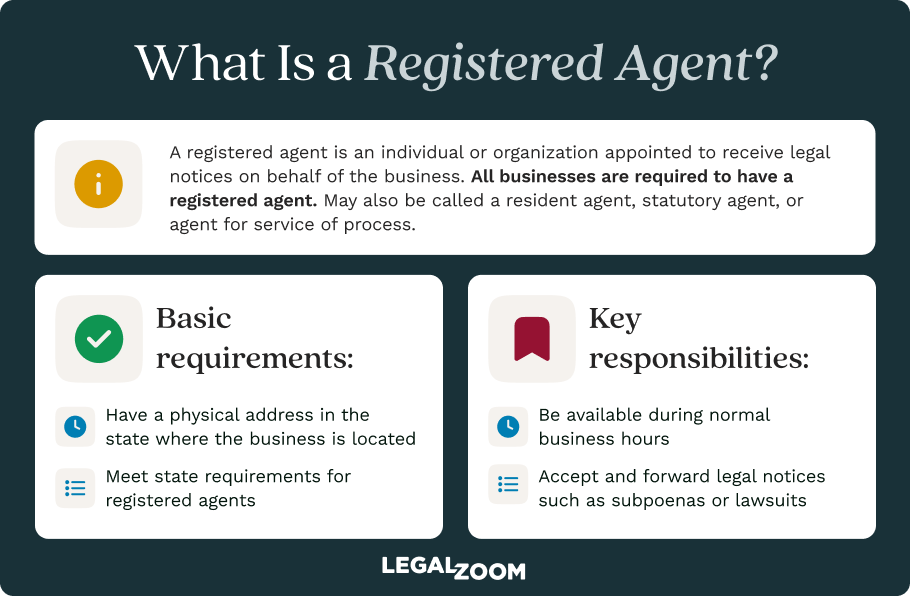
A registered agent receives official documents—lawsuits, government notices, service of process—on behalf of your nonprofit. Alabama requires every nonprofit corporation to designate a registered agent with a publicly listed physical Alabama street address available during normal business hours. P.O. boxes are not accepted.
The registered agent’s name and street address must appear in your certificate of incorporation and become part of the public record. You can serve as your own registered agent if you have a physical Alabama address and can reliably be present during business hours, or you can hire a commercial service. If your agent changes, you must update the Alabama Secretary of State’s records promptly.
Step 3: File the Alabama certificate of incorporation
The certificate of incorporation is the foundational document that legally creates your nonprofit corporation. The filing fee is $200 for mail submissions, or $208 for online submissions.
Your certificate of incorporation must include:
- Nonprofit name
- (Optional) name reservation certificate
- Registered agent’s name
- Physical Alabama street address
- Incorporator’s name and address
- Statement of whether your nonprofit will have members
Additionally, the IRS requires certain clauses, which can appear in the certificate or in your bylaws, to approve your 501(c)(3) application.
- Dissolution clause: States that upon dissolution, remaining assets will be distributed to one or more organizations exempt under Section 501(c)(3), or to a federal, state, or local government for a public purpose
- Purpose clause: Limits your organization’s activities to exempt purposes (such as charitable, religious, or educational goals)
Alabama’s nonprofit certificate of incorporation form does not automatically include IRS-compliant language for these clauses. Without them, the IRS will reject your tax exemption application regardless of how well-prepared the rest of your filing is.
Step 4: Recruit your initial board of directors
You are not required to include a list of directors with your incorporation form, but it is considered best practice. Your board of directors governs the organization. They approve bylaws, oversee finances, and set strategic direction. Alabama’s nonprofit corporation law requires just one director, although three or more unrelated directors is generally considered best practice.
Directors do not need to be Alabama residents but must be at least 19 years old. The IRS reviews board composition as part of the 501(c)(3) application, so a board with independent members strengthens your case.
Step 5: Draft nonprofit bylaws and hold the organizational meeting
Bylaws are your nonprofit’s internal rulebook. They govern how the board operates, how decisions get made, and how officers are selected. Alabama does not require bylaws to be filed with the state, but they must be written and officially adopted.
If you apply for 501(c)(3) status, a copy of your bylaws must be attached. Well-drafted bylaws should address:
- Board composition and director terms
- Officer roles and how the board elects them
- Meeting frequency and notice requirements
- Quorum and voting procedures
- Bylaw amendment process
- A statement saying whether or not the board may act without a formal meeting
- A conflict-of-interest policy that bars individuals from profiting off the corporation (the IRS will look for this)
The organizational meeting is your first official board meeting. At it, your board should:
- Adopt bylaws
- Elect officers
- Endorse its certificate of incorporation
- Ratify the EIN application
- Authorize opening a bank account
This meeting must happen before you apply to the IRS for 501(c)(3) status. Document everything in written minutes, as those records may be requested by the IRS, grant funders, or auditors.
Step 6: Obtain an EIN from the IRS
An employer identification number (EIN) is your nonprofit’s federal tax identification number. It’s required to open a bank account, hire employees, register as a charity, and apply for tax exemptions. It’s also required to apply for 501(c)(3) status.
Apply using IRS Form SS-4, and there is no filing fee. If you apply online through the IRS website, you’ll receive your EIN immediately.
Step 7: Apply for 501(c)(3) status
There are two application options. The right one for your organization depends on your organization’s projected size.
- Form 1023-EZ is for organizations with projected gross receipts of $50,000 or less and total assets of $250,000 or less, excluding churches, schools, hospitals, supporting organizations, and several other categories. The IRS requires you to complete an eligibility worksheet first, and even one "yes" answer means you must use the standard Form 1023. The filing fee for Form 1023-EZ is $275, and processing takes approximately 22 days.
- Form 1023 (full application) is required if your organization exceeds either size threshold or falls into an excluded category. The filing fee is $600, and processing can take about six months.
Both forms are filed online through the federal government’s payment portal.
Your nonprofit can operate and accept contributions during the IRS waiting period. However, it cannot assure donors that their donations will be tax-deductible until the IRS issues its determination letter. Most grant funders require that letter before approving an application, so factor the processing timeline into your planning.
Step 8: Register for charitable solicitation with the Alabama Attorney General
Your IRS determination letter does not authorize you to solicit donations from the Alabama public. That authorization comes from a separate registration with the Alabama Attorney General’s Office and must be in place before you fundraise. The initial registration fee is $25, with the same fee for annual renewals.
Not every Alabama nonprofit is required to register. Exempt categories include:
- Religious organizations, political organizations, and educational institutions and their authorized foundations.
- Fraternal, patriotic, benevolent, social, educational, alumni, health care foundation, historical, and civil rights organizations (including fraternities and sororities)
- Any charitable organization that does not intend to solicit and does not actually receive contributions exceeding $25,000 during a fiscal year, provided all fundraising functions are carried on by unpaid volunteers
Important: If your organization crosses the $25,000 threshold during the fiscal year, you must register within 30 days of the date gross contributions pass that threshold. Track incoming contributions carefully from day one.
Alabama nonprofit tax exemption: State-level approval through the Department of Revenue
Alabama nonprofits are effectively exempt from state income tax upon obtaining the IRS determination letter—no separate state income tax exemption application is required. The sales and use tax exemption, by contrast, requires eligibility and an active application process.
Without a sales tax certificate of exemption from the Alabama Department of Revenue, your nonprofit pays Alabama sales and use tax on purchases of tangible personal property like any other buyer. When these organizations sell tangible personal property at retail, they are also required to collect and remit sales and use tax.
Nonprofits in Alabama are not automatically eligible for a state-level sales and use tax exemption. Only named organizations that fall under specific statutory exemptions are eligible. These organizations include The March of Dimes, the Salvation Army, and the Girl Scouts of America.
How much does it cost to start a nonprofit in Alabama?
Starting a nonprofit in Alabama costs a minimum of roughly $525 if you complete forms by mail, qualify for Form 1023-EZ, and act as your own registered agent. It will cost more if you complete forms online and don’t qualify for Form 1023-EZ.
| Filing step | Agency | Fee |
|---|---|---|
| Name reservation | Alabama Secretary of State | $25 (mail) / $28 (online) |
| Certificate of Incorporation | Alabama Secretary of State | $200 (mail) / $208 (online) |
| EIN application | IRS | $0 |
| Form 1023 (full application) | IRS | $600 |
| Form 1023-EZ (streamlined) | IRS | $275 |
| Sales tax exemption (if eligible) | Alabama Department of Revenue | $0 |
| Charitable solicitation registration (annual) | Alabama Attorney General | $25 |
Below are some optional costs that you might incur.
- Registered agent service: Roughly $50–$400 per year, depending on the provider.
- Attorney fees: Alabama’s state-provided certificate of incorporation template does not handle IRS-compliant dissolution and purpose language on its own. Many founders work with a nonprofit attorney to draft or review formation documents and bylaws.
- Accounting and financial setup: Depending on projected activity, a CPA can help set up bookkeeping systems and prepare for your first IRS Form 990 filing.
Ongoing Alabama nonprofit compliance
Formation is the beginning, not the finish line. Once your nonprofit is operating, you take on recurring obligations to the Alabama Attorney General, the IRS, and the Alabama Secretary of State that keep your organization legally active and your tax-exempt status intact. Missing any of these deadlines can cost you your good standing, your ability to fundraise, and your 501(c)(3) designation itself.
Charitable solicitation registration
Your nonprofit’s charitable solicitation registration must be renewed annually within 90 days of the close of your fiscal year, but the Attorney General can grant an extension. It has a $25 fee, and the state does not always send proactive reminders, so tracking the deadline falls on your organization.
IRS Form 990
Most 501(c)(3) organizations must file an annual information return with the IRS by the 15th day of the 5th month after the end of the organization’s accounting period. For calendar-year organizations, that means May 15 of the following year.
| Form | Revenue/asset threshold |
|---|---|
| Form 990-N (e-Postcard) | Gross receipts normally $50,000 or less |
| Form 990-EZ | Gross receipts under $200,000 and total assets under $500,000 at year-end |
| Form 990 (full return) | Gross receipts of $200,000 or more, or total assets of $500,000 or more at year-end |
Tax-exempt status does not mean tax-filing exempt. If your nonprofit fails to file for three consecutive years, the IRS will automatically revoke its tax-exempt status. You can request an automatic six-month extension by filing Form 8868 by the original due date.
Registered agent and state record maintenance
Alabama law requires every nonprofit corporation to maintain a registered agent with a valid physical Alabama street address at all times. If your registered agent changes, update the Alabama Secretary of State’s records promptly.
How LegalZoom can help
LegalZoom has helped more than 4 million businesses get started since 2001, including over 100,000 nonprofits. Our nonprofit formation service guides you through the state filing process and can connect you with a network of attorneys who can review your formation documents. And when it’s time to apply for 501(c)(3) status, we can help you file your IRS Form 1023-EZ.
FAQs about starting a nonprofit in Alabama
How do I start a nonprofit with no money?
The state and IRS filing fees are unavoidable. Plan for a minimum of $525 in required government fees. You can reduce costs by filing without an attorney, using Form 1023-EZ if your organization qualifies, and serving as your own registered agent. Some Alabama community foundations and nonprofit support organizations offer technical assistance grants to new nonprofits that can offset startup costs.
Is it better to have an LLC or a nonprofit?
LLCs are for-profit entities whose members can receive profits from the business. Nonprofits are mission-driven entities where no individual owns the organization and any surplus must be reinvested in the mission. Only a nonprofit can apply for 501(c)(3) status and receive tax-deductible donations. For a detailed structural comparison, see LegalZoom’s guide on the difference between a nonprofit corporation and an LLC.
Do Alabama nonprofits need to file an annual report with the Secretary of State?
No. Alabama nonprofits have no annual reporting requirements with the Secretary of State. Your primary recurring state-level filing obligation is the annual charitable solicitation renewal with the Alabama Attorney General.
Can an Alabama nonprofit apply for grants before receiving 501(c)(3) status?
Most government and foundation grants require a 501(c)(3) determination letter before they will consider an application. However, some local community grants are available to incorporated nonprofits without federal tax-exempt status, and fiscal sponsorship—where an existing 501(c)(3) acts as a financial umbrella for your organization—is a common strategy for nonprofits still awaiting IRS determination.
How long does it take to start a nonprofit in Alabama?
If you’re filing via Form 1023-EZ, it may take less than three months from name reservation to IRS determination letter. If you’re filing via Form 1023, it may take up to six months or longer. The IRS waiting period dominates the nonprofit formation schedule. Everything before it—state incorporation, EIN, bylaws—can move in days or weeks.
'%20/%3e%3c/svg%3e)

'%3e%3cpath%20fill-rule='evenodd'%20clip-rule='evenodd'%20d='M9.31239%2025.5316H13.0679V14.1032H9.31239V25.5316ZM11.1913%208.46875C9.93945%208.46875%209%209.25086%209%2010.505C9%2011.5995%209.78211%2012.5389%2011.1913%2012.5389C12.6005%2012.5389%2013.3826%2011.5995%2013.3826%2010.505C13.3826%209.4082%2012.6005%208.46875%2011.1913%208.46875ZM27%2018.9577V25.5316H23.2445V19.4275C23.2445%2017.8609%2022.6174%2016.7664%2021.3679%2016.7664C20.2711%2016.7664%2019.644%2017.5463%2019.3316%2018.1756C19.1743%2018.488%2019.1743%2018.8004%2019.1743%2019.1128V25.5316H15.4165V13.9458H19.1743V15.5123C19.644%2014.7302%2020.5835%2013.6357%2022.6174%2013.6357C25.1234%2013.7908%2027%2015.3573%2027%2018.9577Z'%20fill='white'/%3e%3c/g%3e%3cdefs%3e%3cclipPath%20id='clip0_952_9489'%3e%3crect%20width='18'%20height='18'%20fill='white'%20transform='translate(9%208)'/%3e%3c/clipPath%3e%3c/defs%3e%3c/svg%3e)

