



Starting a nonprofit in Florida requires coordinating with state and federal agencies. First, you must form a nonprofit corporation under Florida state law, then you can obtain 501(c)(3) tax-exempt status from the IRS. While this may seem easy enough, there are a few key points to follow to ensure your Florida nonprofit qualifies for federal tax exemption.
This guide explains how to start a nonprofit in Florida, from choosing your organization's name through the ongoing compliance obligations that protect your nonprofit status after formation.
Nonprofit vs. 501(c)(3): What's the difference?
A nonprofit is a formal business structure. When you incorporate as a nonprofit, you're agreeing that the organization won't distribute profits to owners or shareholders.
501(c)(3) status is what exempts your nonprofit from paying certain federal tax. Once the IRS approves your 501(c)(3) application, your organization becomes exempt from federal income tax and donations become tax-deductible for donors, which is often what funders and granting organizations require before they'll contribute.
The process is sequential. You need to incorporate in Florida first, which establishes the legal entity you need to apply to the IRS for tax exempt status.
How to start a nonprofit in Florida: Step by step
In order to start a nonprofit in Florida, take the steps detailed below. Please note that the steps are sequential, so order matters.
Step 1: Choose a name for your Florida nonprofit
Your nonprofit's name must be distinguishable from all existing entities in the Sunbiz name database or use LegalZoom’s free name check tool below. For more information, read our comprehensive guide to Florida business names.
Free Florida Business Name Check
Starting a business? Use our free name check tool to search the Florida Secretary of State database and see if your business name is available.
By clicking "Check Availability," I agree to LegalZoom's Terms of Use. This search is a preliminary check of state databases and does not include variations or trademarks. Results do not guarantee name availability or compliance with legal requirements.
Step 2: Appoint a registered agent in Florida
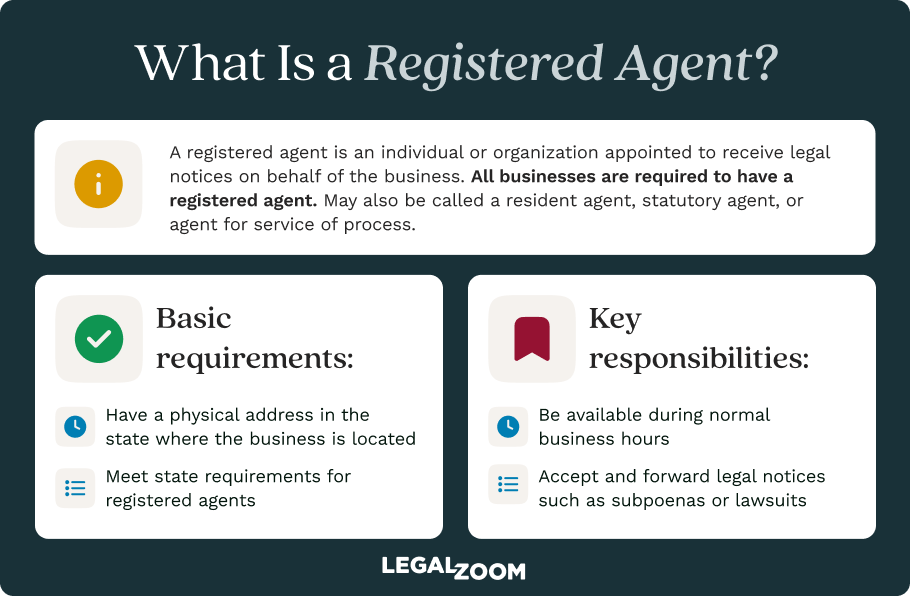
A registered agent is a person or entity designated to receive legal correspondence on your behalf. The registered agent must have a Florida street address where they can be reached during normal business hours (a P.O. box does not fulfill this requirement). The registered agent's name and address must appear in your articles of incorporation, and the agent must consent to the appointment.
The registered agent can be an individual director or officer or a commercial registered agent service. If you run your nonprofit from your home and serve as your own agent, your name and home address will appear on public records for your business. If your registered agent moves, resigns, or becomes unavailable, you must update that information with Sunbiz promptly. A lapsed registered agent can lead to administrative dissolution, which is when the state strips your organization's legal status.
Step 3: File Florida articles of incorporation with Sunbiz
Articles of incorporation are the formal document that creates your business as a formal entity. You can file online or by mail to the Florida Division of Corporations. The filing fee is $70. Online filings are processed within one to three business days. Mail filings typically take between five and 10 business days to process.
Your articles must include the following information:
- Name of the corporation
- Principal office address
- Name and address of the registered agent
- Name and address of each incorporator
- Whether the corporation will have members
If you plan to seek 501(c)(3) status, your articles must also include three additional IRS-required clauses. Omitting any of these clauses can result in the IRS rejecting or delaying your application.
- Purpose clause: The articles must state that the corporation is organized exclusively for one or more exempt purposes under IRC Section 501(c)(3). A generic statement of purpose is not sufficient.
- Dissolution clause: The articles must state that upon dissolution, remaining assets will be distributed to another 501(c)(3) or to a federal, state, or local government for a public purpose.
- Private inurement prohibition: The articles must state that no part of the organization's net earnings inures to the benefit of any private shareholder or individual, which effectively confirms that no one can use the nonprofit as a vehicle for personal profit.
Note: These clauses must appear on your articles of incorporation. It is not sufficient to solely have them in your bylaws.
Step 4: Choose your board of directors and officers
Florida law requires a minimum of one director. In practice, most grant funders and the IRS expect at least three unrelated directors, which means no family members and no individuals financially dependent on one another, to demonstrate independence and reduce the risk of self-dealing.
Florida also requires a president and a secretary as minimum officer roles. The same person can hold both offices unless the bylaws state otherwise. Directors can be compensated only if the bylaws permit it, the compensation is reasonable, and the board—not the individual being paid—approves the decision.
Step 5: Draft nonprofit bylaws and hold your organizational meeting
Bylaws are the internal operating rules of your nonprofit. You don't file them with the state, but you must formally adopt them at your organizational meeting and keep them in your corporate records. The IRS will review your bylaws as part of the 501(c)(3) application.
Your bylaws should cover the following:
- Purpose and mission statement
- Board composition, terms, and election procedures
- Officer roles and responsibilities
- Meeting frequency, notice requirements, and quorum rules
- Voting procedures, including proxy and written consent rules
- Conflict of interest policy, which is required by the IRS for 501(c)(3) applicants)
- Amendment procedures
- Dissolution procedures consistent with your articles of incorporation
The organizational meeting is where the board formally adopts the bylaws, elects officers, and approves initial policies, including authorizing the EIN application. Make sure to keep minutes in your corporate records book since the IRS may request them.
Step 6: Obtain an EIN from the IRS
An EIN is your nonprofit's federal tax identification number. You need it to open a bank account, hire employees, and file your 501(c)(3) application. It is free to request an EIN, and you can get one online at IRS.gov. Once requested, the IRS typically issues an EIN immediately. Your nonprofit must be incorporated before you apply.
Step 7: Apply for 501(c)(3) status with the IRS
You can apply for 501(c)(3) status using either Form 1023 (standard) or Form 1023-EZ (streamlined). Both forms can be filed online at pay.gov.
The choice is not discretionary.
- Organizations projecting gross receipts of $50,000 or less annually for the next three years and total assets under $250,000 need to use Form 1023-EZ. The filing fee is $275.
- All other nonprofit organizations must use Form 1023. The filing fee is $600.
Once the proper form is filed, the IRS will review your organization’s stated purpose, governance documents, conflict of interest policy, and financial projections. Form 1023-EZ applications are typically processed within two to four weeks. Standard Form 1023 applications typically take between three and six months to process, but could possibly take longer.
Step 8: Register for charitable solicitation with FDACS
Before soliciting donations from Florida residents, you need to register with the FDACS. The filing fee for new organizations is typically $0, with a few exceptions.
This must be renewed every year, tied to your fiscal year end. Renewal fees range from $0 to $400 based on prior-year contribution levels.
Note: Once approved, your organization can operate and solicit donations while the federal 501(c)(3) application is pending, but donor contributions are not tax-deductible until the determination letter is issued.
Step 9: Apply for Florida state tax exemptions
Federal 501(c)(3) status does not automatically exempt your nonprofit from Florida state taxes. You will still need to submit separate applications through the Florida Department of Revenue.
- Florida corporate income tax exemption. Organizations with federal 501(c)(3) status are generally exempt. File Form DR-5 with the Florida Department of Revenue to obtain a Consumer's Certificate of Exemption.
- Florida sales tax exemption. Qualifying nonprofits can apply for exemption from Florida sales and use tax, also using Form DR-5. This exemption applies to purchases made by the organization, not to all sales it makes.
The Department of Revenue may require a copy of your IRS determination letter. There is no fee for this application.
Ongoing Florida nonprofit compliance
Incorporation and 501(c)(3) approval are milestones, not the finish line. Florida nonprofits carry four recurring compliance obligations that must be satisfied every year for as long as the organization exists. The risk is not complexity, it is forgetting. Miss a filing and you can lose good standing with the state, lose your federal tax-exempt status, or lose your legal right to fundraise in Florida.
Annual report with Sunbiz
Florida nonprofits must file an annual report between January 1 and May 1 each year. Nonprofits that fail to file by the third Friday of September face administrative dissolution.
Sunbiz does not send pre-deadline reminders. Build the May 1 deadline into your calendar at the start of every year.
IRS Form 990 filing
The form you file depends on your organization's gross receipts.
- Form 990-N (e-Postcard): annual gross receipts normally $50,000 or less
- Form 990-EZ: gross receipts between $50,001 and $200,000 and total assets under $500,000
- Form 990 (standard): gross receipts of $200,000 or more, or total assets of $500,000 or more at year end
The filing is due the 15th day of the fifth month after your fiscal year ends, which means May 15 for calendar-year organizations. You can request a six-month extension by filing Form 8868 before the due date.
Organizations that fail to file for three consecutive years automatically lose their tax-exempt status, which means losing your federal income tax exemption, donor tax-deductibility, and likely grant eligibility, which all require a separate IRS reinstatement application and fee to fix. This is why you should file every year, even when your organization is engaged in minimal activity.
Maintain your registered agent
If your registered agent moves or resigns, update that information in Sunbiz promptly. You can change your registered agent by submitting the appropriate form with a $35 fee, or at no additional cost when you file your annual report.
If the state cannot deliver legal notices to your registered agent, your organization can be administratively dissolved without your awareness.
FDACS charitable solicitation renewal
FDACS registration must be renewed annually, tied to your fiscal year end. Keep track of your FDACS renewal date separately from your Sunbiz annual report deadline, because the two do not align. A lapsed FDACS registration means you cannot legally solicit contributions from Florida residents until you renew.
How LegalZoom can help
LegalZoom's nonprofit formation services can help mission-based organizations prepare and file articles of incorporation, obtain an EIN, and work through the 501(c)(3) application process, reducing the risk of errors that could delay IRS approval. We’ve helped more than 100,000 nonprofits launch their mission, and our filings are backed by our 100% accuracy guarantee.
Florida nonprofit FAQs
Can you pay yourself if you run a nonprofit?
Yes. Founders and executives can receive reasonable compensation for services rendered. The IRS requires that compensation be "reasonable and not excessive," and the board, not the compensated individual, must approve salary decisions. Document all compensation approvals in board meeting minutes.
How do you start a nonprofit in Florida with no money?
It’s impossible to start a nonprofit for $0. You can reduce required costs by self-filing all documents, designating a director as your registered agent, and applying for your EIN directly through IRS.gov at no charge. Some early-stage organizations use fiscal sponsorship arrangements to fund formation costs before they are fully established, and some grants are designed for nonprofit startups.
Does a Florida nonprofit need to register with the Florida Attorney General?
No. You file charitable solicitation registration with FDACS, not the Florida Attorney General. The Attorney General enforces the Solicitation of Contributions Act and investigates charitable fraud but does not administer the registration.
Do Florida nonprofits need to register with the state before applying for grants?
Most Florida grant funders require active 501(c)(3) status, current Sunbiz annual report standing, and a valid FDACS charitable solicitation registration before they will consider an application. Some funders also require a minimum operating history of one to two years. Confirm each funder's specific requirements before applying.
Does a Florida nonprofit need to register with the Florida Department of Revenue separately from the IRS?
Yes. Federal 501(c)(3) status does not automatically exempt a Florida nonprofit from state taxes. To obtain Florida corporate income tax and sales tax exemptions, file Form DR-5 with the Florida Department of Revenue. The application is free, but the IRS determination letter is typically required as supporting documentation.
What records should a Florida nonprofit keep after formation?
Florida nonprofits should maintain articles of incorporation, bylaws, board meeting minutes, officer and director records, financial statements, IRS determination letter, Form 990 filings, and FDACS registration documents. Best practice is to retain governance documents permanently and financial records for at least seven years.
'%20/%3e%3c/svg%3e)

'%3e%3cpath%20fill-rule='evenodd'%20clip-rule='evenodd'%20d='M9.31239%2025.5316H13.0679V14.1032H9.31239V25.5316ZM11.1913%208.46875C9.93945%208.46875%209%209.25086%209%2010.505C9%2011.5995%209.78211%2012.5389%2011.1913%2012.5389C12.6005%2012.5389%2013.3826%2011.5995%2013.3826%2010.505C13.3826%209.4082%2012.6005%208.46875%2011.1913%208.46875ZM27%2018.9577V25.5316H23.2445V19.4275C23.2445%2017.8609%2022.6174%2016.7664%2021.3679%2016.7664C20.2711%2016.7664%2019.644%2017.5463%2019.3316%2018.1756C19.1743%2018.488%2019.1743%2018.8004%2019.1743%2019.1128V25.5316H15.4165V13.9458H19.1743V15.5123C19.644%2014.7302%2020.5835%2013.6357%2022.6174%2013.6357C25.1234%2013.7908%2027%2015.3573%2027%2018.9577Z'%20fill='white'/%3e%3c/g%3e%3cdefs%3e%3cclipPath%20id='clip0_952_9489'%3e%3crect%20width='18'%20height='18'%20fill='white'%20transform='translate(9%208)'/%3e%3c/clipPath%3e%3c/defs%3e%3c/svg%3e)


