




Starting a nonprofit in Illinois involves coordinating with three separate government agencies: the Illinois Secretary of State, the IRS, and the Illinois Attorney General. Each has its own forms, fees, and processing timelines.
State incorporation and federal 501(c)(3) tax-exempt status are distinct legal processes—you must complete incorporation first, then apply to the IRS. This guide covers every required step, from naming your organization through registering to solicit donations, including what each filing costs and how long it takes.
Nonprofit formation in Illinois at a glance
- Illinois nonprofits start by filing articles of incorporation with the Illinois Secretary of State.
- To apply for 501(c)(3) status, most organizations file IRS Form 1023; smaller organizations may qualify for the streamlined Form 1023-EZ.
- Illinois nonprofits that plan to solicit charitable donations must register with the Illinois Attorney General's office before fundraising begins.
- After formation, Illinois nonprofits must file an annual report with the Secretary of State and may need to separately apply for Illinois sales tax exemptions through the Illinois Department of Revenue.
- The entire process, from state incorporation through IRS approval, typically takes four to twelve months.
Nonprofit vs. 501(c)(3) in Illinois
A nonprofit corporation is a business entity formed at the state level. Your organization legally exists the moment the Illinois Secretary of State approves your articles of incorporation—you can open a bank account, enter contracts, and hire employees. But state incorporation alone does not make your organization tax-exempt.
A 501(c)(3) designation is a federal tax-exempt status granted by the IRS, filed after state approval. It means your organization generally does not pay federal income tax on its related charitable income, donors can deduct contributions on their federal returns, and your org will qualify for a broader range of private and public grant programs.
You can operate as an Illinois nonprofit without federal 501(c)(3) status, but you'll miss those tax advantages. Most Illinois nonprofits pursue both.
How to start a nonprofit in Illinois: Step by step
Step 1: Choose a name for your Illinois nonprofit
Your nonprofit's name must be distinguishable from every other entity registered with the Illinois Secretary of State. Search the Secretary of State's business entity database before committing. The name must include a corporate designator, such as "Corporation," "Incorporated," "Corp.," or "Inc.," unless you apply for an exemption.
Free Illinois LLC Lookup
Starting a business? Use our free name check tool to check your business name against the Illinois Secretary of State records.
By clicking "Check Availability," I agree to LegalZoom's Terms of Use. This search is a preliminary check of state databases and does not include variations or trademarks. Results do not guarantee name availability or compliance with legal requirements.
If you find a name you like but you’re not ready to form your business yet, you can reserve an available name for 90 days. Read more in our comprehensive guide to Illinois business names.
Step 2: Appoint a registered agent
A registered agent is a person or entity with a physical Illinois street address who agrees to receive legal documents and official state correspondence on behalf of your nonprofit.
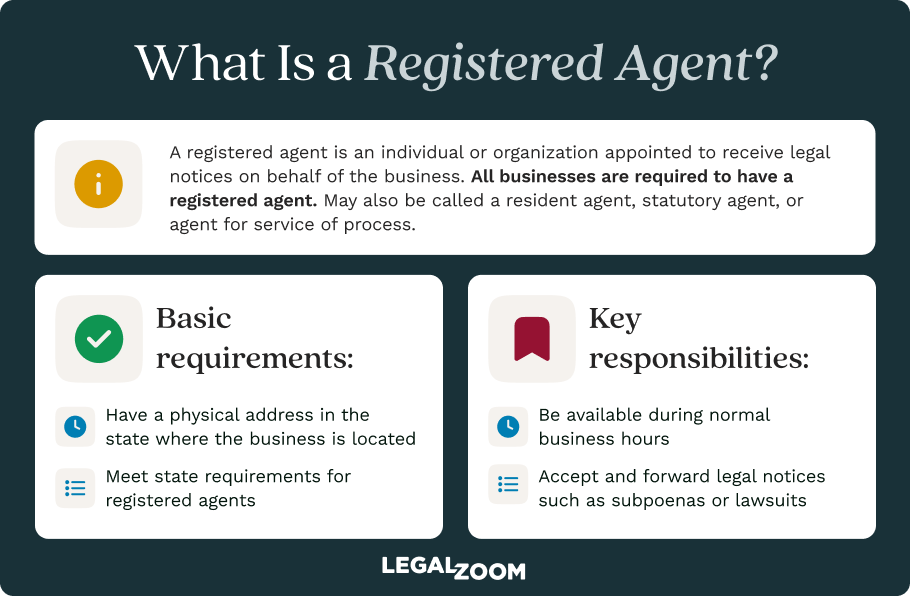
You, as a founder, can serve as your own registered agent if you have an Illinois street address and can reliably be reached during business hours. Many organizations use a professional registered agent service for privacy and reliability. Either way, the agent's name and address must appear on your articles of incorporation.
Step 3: Understand Illinois nonprofit board requirements
Illinois requires a minimum of three directors. The IRS also prefers at least three for organizations seeking tax-exempt status. Directors do not need to be Illinois residents.
Many grant funders look for unrelated board members as a signal of independent governance. If grant funding is a priority, build your board with that in mind from the start.
The names and addresses of your initial directors are required for filing your articles, so your board must be identified before you file.
Step 4: File Illinois articles of incorporation
Articles of incorporation are filed with the Illinois Secretary of State's Business Services Department. The standard filing fee is $50, and you can file online or by mail. Expedited processing is available online or in person at the Secretary of State's Springfield or Chicago office; it is not available by mail.
If you plan to apply for 501(c)(3) status, the articles should satisfy both Illinois requirements and the IRS. If either is missing or imprecise, your 501(c)(3) application may be delayed or denied.
Tip: Even if you’re not planning to pursue 501(c)(3) status right now, include these clauses in your articles so you have the option later.
What your articles of incorporation must include:
- Corporate name
- Registered agent and Illinois street address
- Names and addresses of initial directors (minimum three required)
- Dissolution clause stating that upon dissolution, assets will be distributed to another 501(c)(3) organization or to a federal, state, or local government entity for a public purpose
- Charitable purpose clause stating the specific purpose of the organization (charitable, educational, religious, or scientific)
- Private inurement prohibition. A clause stating that none of the organization's earnings will benefit any private individual.
- Incorporator name and signature
Draft the purpose and dissolution clauses carefully and consider working with an attorney before you file. Remember: The government puts a lot of scrutiny on nonprofits that seek tax-exempt status.
Step 5: Draft nonprofit bylaws and hold the first board meeting
Bylaws are your nonprofit's internal governance rules—how your board operates, how decisions get made, and what happens when disputes arise. Illinois does not require you to file bylaws with the state, but the IRS requires a copy with Form 1023.
Your bylaws should include the following.
- Organization name and principal office address.
- Statement of purpose aligned with the articles of incorporation.
- Board composition and director terms. Specify the number of directors, how they are elected or appointed, the length of their terms, and how vacancies are filled.
- Officer titles and duties. Identify each required officer position (president, secretary, and treasurer), describe their responsibilities, and state who has authority to appoint or remove them.
- Meeting frequency and quorum requirements. A quorum is a majority of directors in office immediately before the meeting begins, unless the articles or bylaws specify otherwise.
- Membership provisions (if applicable). If the nonprofit has members, bylaws must define their rights, admission and removal processes.
- Amendment procedures. Typically a majority or supermajority vote of the board, with proper notice.
- Conflict of interest policy. Establishes rules preventing board members and officers from using their positions for personal gain. The IRS reviews this policy as part of the 501(c)(3) application and will flag its absence.
The board formally adopts the bylaws at the first board meeting—the same meeting at which officers are elected, the employer identification number (EIN) application is authorized, and the bank account is approved. Every action should be recorded in written minutes, which become the legal record of how your organization was formed.
Step 6: Get an EIN for your nonprofit
An employer identification number is a federal tax ID issued by the IRS. It’s the equivalent of a Social Security number for your organization. You can apply online at no cost, and the IRS issues your number immediately.
You need the EIN before you can open a bank account, hire employees, or file your 501(c)(3) application.
Step 7: Apply for 501(c)(3) status: Form 1023 vs. Form 1023-EZ
This is a federal process filed with the IRS. Your articles of incorporation must already be approved before you submit either application. Both forms are filed electronically through www.pay.gov.
- Form 1023-EZ (streamlined application) is available to organizations that project gross receipts of $50,000 or less in each of the next three years, have total assets of $250,000 or less, and meet additional criteria on the IRS Form 1023-EZ eligibility worksheet. The user fee is $275.
- Form 1023 (full application) is required for all other organizations. The user fee is $600.
Note: If you file within 27 months of incorporation and the IRS approves your application, your 501(c)(3) status is generally recognized retroactively to your date of incorporation, so qualifying donations made while your application was pending are treated as tax-deductible from that earlier date.
Step 8: Apply for Illinois state tax exemptions
Once your organization receives federal tax-exempt status, Illinois automatically exempts it from state income tax—no separate filing required. However, if your organization earns unrelated business income, you must file Form IL-990-T with the Illinois Department of Revenue.
A nonprofit is not automatically exempt from Illinois sales tax. Some nonprofits may qualify for an exemption from paying sales tax on goods purchased for the organization's use if they are formed exclusively for charitable, religious, or educational purposes or for senior citizens. If you’re unsure if your nonprofit qualifies, you can write a letter to the Illinois Department of Revenue, Sales Tax Division.
In this letter, enclose photocopies of the following:
- Articles of incorporation
- Bylaws
- IRS exemption letter
- Any other documents that may help determine your status
If you are approved for an exemption, you’ll receive an exemption letter.
Additionally, if your organization owns property primarily used for charitable purposes, a property tax exemption may be available through your local county assessor's office—a separate filing from both the income and sales tax exemptions.
For more information on Illinois tax exemptions, refer to the Department of Revenue’s guide.
Step 9: Register for charitable solicitation with the Illinois Attorney General
Before you ask a single Illinois resident for a donation, you are required to register with the Illinois Attorney General's Charitable Trust Bureau. This applies whether your organization is based in Illinois or another state.
Registration requires Form CO-1, a $15 fee, and supporting documents including your IRS determination letter and financial statements. The Solicitation for Charity Act imposes a $200 late registration fee on any organization that solicits before registering.
Registration is not a one-time obligation. Annual reports are due within six months of your fiscal year end, with a $15 filing fee and a $100 late fee for reports filed past the deadline.
Financial statement requirements scale with revenue. Check with the Attorney General’s office or review the latest guidance before assuming an exemption applies.
How much does it cost to start a nonprofit in Illinois?
Starting an Illinois nonprofit typically costs between $340 and $665 in required government fees, depending primarily on whether you file Form 1023 or Form 1023-EZ.
| Filing | Agency | Fee |
|---|---|---|
| Articles of Incorporation | Illinois Secretary of State | $50 |
| Expedited processing | Illinois Secretary of State | +$25 |
| Form 1023 (full application) | IRS | $600 |
| Form 1023-EZ (streamlined application) | IRS | $275 |
| Charitable solicitation registration | Illinois Attorney General | $15 |
Annual fees begin as soon as your first fiscal year ends. $15 for the Attorney General's annual report (with a $100 late fee for late filings) and a separate annual report to the Secretary of State, which carries a small state filing fee (currently around $10 plus an online service fee). Always verify the current Secretary of State fee before you file.
How long does it take to start a nonprofit in Illinois?
The total timeline typically runs four to twelve months. The IRS review accounts for nearly all of that range.
| Step | Typical timeframe |
|---|---|
| Illinois articles of incorporation—standard processing | ~10 business days |
| Illinois articles of incorporation—expedited processing | 1 business day |
| EIN application (IRS Form SS-4, filed online) | Immediate |
| Bylaws drafting and first board meeting | 1–2 weeks |
| IRS Form 1023-EZ approval | 2–4 weeks (80% within 22 days) |
| IRS Form 1023 approval | 3–6 months; can extend to 12 months or more |
| Illinois Attorney General charitable solicitation registration | 2–4 weeks |
Expedited Secretary of State processing is available online or in person (not by mail) and reduces the incorporation step to one business day for an additional $25.
The most controllable variable is application quality. If the IRS asks for more information or something is filed incorrectly, the timeline can grow. Missing purpose or dissolution clauses in your articles are among the most common triggers for IRS follow-up.
Ongoing compliance for Illinois nonprofits
Staying in good standing requires meeting recurring obligations across three agencies. Missing a deadline can trigger penalties, knock your organization out of good standing, or result in administrative dissolution.
Annual report
Every Illinois nonprofit must file an annual report listing current officers and directors. The filing fee is $10, due before the first day of the organization's incorporation anniversary month. Failure to file may result in involuntary dissolution if the report remains delinquent for six months or more. You can file online through the Secretary of State’s website.
IRS Form 990
You will also need to keep the IRS informed on your nonprofit. Each year you must file a version of Form 990 with them. The version is determined by your gross receipts.
- Form 990-N (e-Postcard): Gross receipts normally at or below $50,000
- Form 990-EZ: Gross receipts under $200,000 and total assets under $500,000
- Form 990 (long form): Gross receipts of $200,000 or more, or total assets of $500,000 or more
Form 990 is always due on the 15th day of the 5th month after your fiscal year ends (May 15 for calendar-year organizations). Failure to file for three consecutive years results in automatic revocation of federal tax-exempt status; reinstatement requires reapplying to the IRS.
Annual Illinois financial report
The annual financial report is due to the Illinois Attorney General within six months after the fiscal year ends, alongside a copy of your IRS Form 990, 990-EZ, or 990-N. Any organization receiving contributions exceeding $500,000 must file an audit; those between $300,000 and $500,000 must file reviewed financial statements. Illinois accepts these filings electronically through the Attorney General's online portal.
Other maintenance
- Keep your registered agent current. All Secretary of State communications go to your registered agent; stale information means missed notices.
- Keep officer and director information updated via your annual Secretary of State report.
- Track your fiscal year end. The IRS 990, the AG990-IL, and the charitable solicitation renewal all run off that date. Build a compliance calendar before your first fiscal year closes.
- Document board actions. Illinois law requires nonprofits to maintain appropriate corporate records, including records of board actions. Keep written minutes from every meeting, organized and stored securely.
How LegalZoom can help
Ready to get your Illinois nonprofit up and running? Register your nonprofit in 3 easy steps with LegalZoom. We'll assemble your documents and file them directly with the Illinois Secretary of State, backed by our 100% accuracy guarantee. And when it’s time to apply for federal tax-exempt status, we can help file your 501(c)(3).
FAQs about Illinois nonprofits
Is it better to have an LLC or a nonprofit?
An LLC is a for-profit structure designed to generate returns for its owners. A nonprofit corporation serves a public or charitable mission, with no profits distributed to founders. Only a nonprofit can apply for 501(c)(3) status, accept tax-deductible donations, and qualify for most charitable grants. If your goal is charitable work, a nonprofit is the appropriate structure.
Can you pay yourself if you start a nonprofit?
Yes. Founders and employees can receive reasonable compensation for services rendered. "Nonprofit" means the organization does not distribute profits to owners, not that no one is paid. Compensation must be reasonable and documented. Excessive pay to insiders can jeopardize 501(c)(3) status and trigger IRS scrutiny under the private benefit and private inurement rules.
Does FMLA apply to nonprofits?
Yes, if the nonprofit employs 50 or more employees within 75 miles of a worksite. Nonprofit status does not exempt an organization from federal employment law. Nonprofits below the 50-employee threshold are generally not covered by FMLA, though Illinois may impose additional state-level leave requirements.
Does a nonprofit need to register in Illinois if it is already incorporated in another state?
Yes. A nonprofit incorporated in another state that wants to operate in Illinois must register as a foreign nonprofit corporation with the Illinois Secretary of State—a separate process from forming a new Illinois entity. Contact the Secretary of State's Business Services Department for current requirements and fees.
Can a nonprofit apply for grants before receiving 501(c)(3) status?
Most private foundations and government grant programs require 501(c)(3) status as a condition of eligibility, so in practice the answer is usually no. One exception is fiscal sponsorship, in which an existing 501(c)(3) receives grant funds on behalf of your organization while your IRS application is pending. Fiscal sponsorship is a separate legal arrangement—talk to an attorney before entering one.
'%20/%3e%3c/svg%3e)

'%3e%3cpath%20fill-rule='evenodd'%20clip-rule='evenodd'%20d='M9.31239%2025.5316H13.0679V14.1032H9.31239V25.5316ZM11.1913%208.46875C9.93945%208.46875%209%209.25086%209%2010.505C9%2011.5995%209.78211%2012.5389%2011.1913%2012.5389C12.6005%2012.5389%2013.3826%2011.5995%2013.3826%2010.505C13.3826%209.4082%2012.6005%208.46875%2011.1913%208.46875ZM27%2018.9577V25.5316H23.2445V19.4275C23.2445%2017.8609%2022.6174%2016.7664%2021.3679%2016.7664C20.2711%2016.7664%2019.644%2017.5463%2019.3316%2018.1756C19.1743%2018.488%2019.1743%2018.8004%2019.1743%2019.1128V25.5316H15.4165V13.9458H19.1743V15.5123C19.644%2014.7302%2020.5835%2013.6357%2022.6174%2013.6357C25.1234%2013.7908%2027%2015.3573%2027%2018.9577Z'%20fill='white'/%3e%3c/g%3e%3cdefs%3e%3cclipPath%20id='clip0_952_9489'%3e%3crect%20width='18'%20height='18'%20fill='white'%20transform='translate(9%208)'/%3e%3c/clipPath%3e%3c/defs%3e%3c/svg%3e)

