




There are multiple unique processes to keep track of if you want to form a nonprofit in Utah. First, file formation documents with the Utah Department of Commerce, Division of Corporations and Commercial Code (DCCC). Then, apply for tax-exempt status with the IRS. After you’ve done that, you can apply for Utah-based tax exemptions.
Here’s everything you need to know to get your mission off the ground, including Utah nonprofit corporation requirements, costs, timelines, and more.
How to start a nonprofit in Utah at a glance
- Form a nonprofit corporation by filing articles of incorporation with the Utah Division of Corporations and Commercial Code. This creates your legal entity but doesn’t make it tax exempt.
- Get federal 501(c)(3) status by filing Form 1023 or Form 1023-EZ with the IRS. Utah tax exemptions require separate filings.
- Register with the Utah State Tax Commission to apply for Utah nonprofit tax exemptions, such as sales and use tax exemptions.
- Utah law requires at least three directors who are adult individuals and a registered agent to incorporate.
- Utah nonprofits must file an annual report each year with the DCCC to remain active in the state.
- The total startup cost ranges from around $334 to $659 or more depending on whether or not you choose to utilize professional guidance.
- The full process typically takes one to six months or more depending on your organization's size. The IRS 501(c)(3) application accounts for the bulk of that time.
How to start a nonprofit in Utah: Step by step
Step 1: Choose a name for your Utah nonprofit
Before you file articles of incorporation, make sure your organization's name meets Utah nonprofit name requirements:
- It can’t imply that the organization exists for a purpose other than what’s stated in its articles.
- It must be distinguishable (noticeably different) from all other entity names registered or reserved with the state.
- It can’t suggest affiliation with a regulated agency or institution without consent from the proper authority.
Check if your name is available in the state by conducting a Utah entity search, which checks The Division of Corporations’ database of registered business names. Make sure to check the business’ active status. If a business has been inactive for more than two years, its name may be available again for use.
Free Utah Business Name Check
Starting a business? Use our free name check tool to search the Utah Division of Corporations records for business names.
By clicking "Check Availability," I agree to LegalZoom's Terms of Use. This search is a preliminary check of state databases and does not include variations or trademarks. Results do not guarantee name availability or compliance with legal requirements.
If you need more time, the DCCC allows you to reserve a name for 120 days for a $22 filing fee. To do so, create a UtahID through the DCCC’s Business Registration System.
Step 2: Appoint incorporators, initial directors, and a registered agent
An incorporator is simply the person who signs and files the articles of incorporation. Utah law requires nonprofit corporations to have one or more incorporator(s) who are adult individuals.
The directors are the individuals who govern your organization. They set policy, approve budgets, and actively oversee the organization’s operations and finances. Utah requires at least three directors who are adult individuals to serve on the board of a nonprofit.
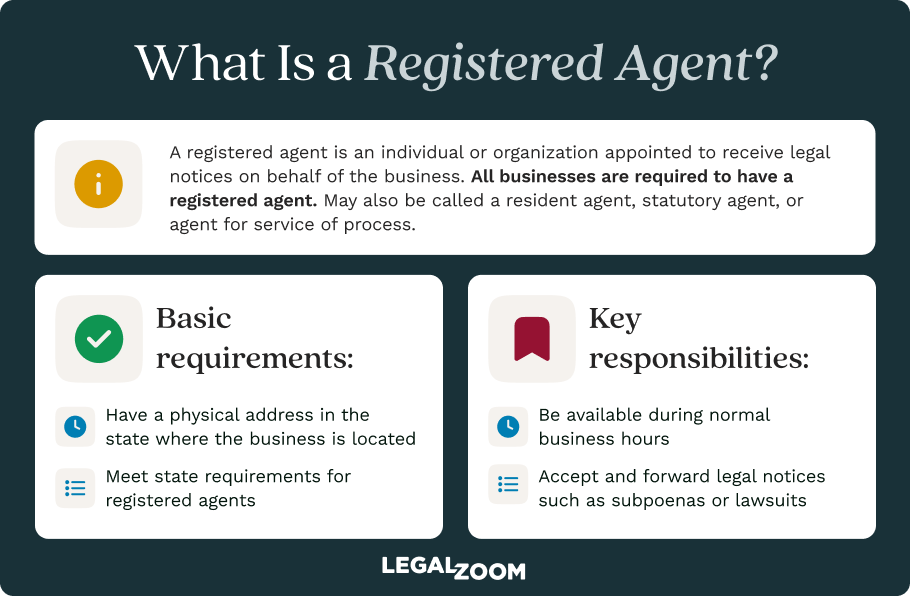
A registered agent is a person or entity that you appoint to receive legal notices, lawsuits, and government correspondence on behalf of your organization. A nonprofit corporation in Utah must appoint and maintain a registered agent who meets state requirements:
- They must have a physical Utah street address, not just a P.O. box.
- They must be either an individual Utah resident, a business entity authorized to operate in Utah, or a commercial registered agent that has registered with the DCCC.
- They must consent to perform the role.
You can be your own agent, appoint an employee, or work with professional registered agent service. The perk of working with a professional is that they’ll stay on top of important mail and related deadlines so that you can focus on your mission.
Step 3: File Utah nonprofit articles of incorporation
Articles of incorporation are your Utah nonprofit formation documents. Once approved by the DCCC, they officially create your nonprofit corporation under Utah law. You can file articles of incorporation online through Utah’s Business Registration System by creating a UtahID, if you haven’t already.
The filing fee for Utah nonprofit corporation articles of incorporation is $59. Here’s what to include:
- Nonprofit name
- Business purpose
- Registered agent name and office address
- Whether or not the organization will have voting members
- Number of shares and share classes (if the nonprofit will issue shares)
- Name and address of each incorporator
- Provisions on the distribution of assets should the organization dissolve
- Name and address of each director (optional until the first annual report)
- Principle office address (optional until the first annual report)
To get 501(c)(3) status in Utah, make sure to include these two provisions required by the IRS:
- Purpose clause. Your articles must state that your nonprofit is organized for one or more of the IRS’ exempt purposes. The form provides a space for you to include this clause in the “purpose” section.
- Dissolution clause. Your articles also need to state that it will distribute its assets for charitable purposes should the corporation dissolve. You can include this clause in a separate document attached to your articles.
Important: Utah will accept your articles of incorporation even if you don’t include a purpose or dissolution clause, but the IRS will not approve 501(c)(3) status without them.
Step 4: Hold and organizational meeting and draft bylaws
The organizational meeting is where your initial board of directors adopts bylaws and appoints officers or members. If you haven’t yet elected directors, the incorporator(s) can hold the meeting to adopt bylaws, elect directors, and appoint officers instead.
Bylaws are your organization’s internal operating rules. They create a framework of rules and practices that your board can return to every time a governance question comes up. Utah doesn’t require nonprofits to file bylaws with the state, but you’ll need them to file for tax-exempt status with the IRS.
You can customize your bylaws to fit your organization’s needs, but they should, at minimum, address the following:
- Organization name and principal office. State the nonprofit's legal name and its primary place of business in Utah.
- Mission or purpose statement. Echo the purpose language in your articles of incorporation.
- Membership rules. If the organization has members, explain how members are admitted, their voting rights, and removal process.
- Board of directors structure. Define the minimum number of directors (at least three by Utah law), the election process, length of terms, and removal procedures.
- Officer titles, duties, and election process. At a minimum, define a president (or chair), secretary, and treasurer. Utah requires at least one officer (generally the secretary) be responsible for recording meeting minutes for board meetings.
- Meeting requirements. Specify how often the board meets, how much advance notice is required, and what constitutes a quorum (the minimum number of directors present for a meeting to take place and its actions to be binding).
- Conflict of interest policy. The IRS expects a written policy that requires board members and officers to disclose personal or financial interests in any transaction the organization considers. You must indicate whether a conflict of interest policy is in place in your 501(c)(3) application.
- Amendment procedures. Include a clear process for how the board can amend the bylaws.
- Dissolution procedures. Include a dissolution clause that’s consistent with your articles. State that any remaining assets will be distributed for charitable purposes.
You can also work with a business attorney or use an online legal service to help ensure your bylaws cover all the important points. Your bylaws will often act as a supporting document when registering with state and federal agencies, so it's important to create a comprehensive document that adds credibility to your mission.
Step 5: Get an employer identification number for your Utah nonprofit
A federal employer identification number (FEIN or EIN) is a nine-digit ID that the IRS assigns businesses to identify them for tax purposes. You’ll need an EIN to file for tax-exempt status, hire employees, and apply for grants. Some banks may also require an EIN to open a bank account. It’s completely free to obtain an EIN through the IRS website.
You can also use LegalZoom’s EIN filing service if you want someone to take it off of your plate. Keep in mind, an EIN doesn’t make your organization tax-exempt. It's an identification number that the IRS, banks, and other agencies use to identify your organization.
Step 6: Apply for 501(c)(3) federal tax-exempt status
Now you have an EIN, you’re ready to apply for tax-exempt status with the IRS. This is the next major step that can make donations tax-deductible and exempt your organization from federal income tax. The IRS grants 501(c)(3) status through one of two main forms.
Form 1023 is the more complex application.
- Who qualifies: Larger exempt organizations that don’t qualify for the simpler form.
- Filling fee: $600.
- How to file: Submit the completed form online through www.pay.gov.
- Processing time: Generally, six months or more.
- Other filing requirements: Articles of incorporation and bylaws.
Form 1023-EZ is a simplified version of the 1023 for smaller organizations.
- Who qualifies: U.S. exempt organizations whose current or projected gross receipts don’t exceed $50,000/year and total assets value at $250,000 or less.
- Filling fee: $275.
- How to file: Submit the completed form online through www.pay.gov.
- Processing time: Generally, about a month.
- Other filing requirements: Articles of incorporation.
After the IRS reviews your application, you’ll receive a determination letter approving your status, a request for additional information, or a rejection letter. If you’d like help filing the application, LegalZoom’s 501(c)(3) application service can guide you through the Form 1023-EZ process.
Step 7: Apply for Utah state tax exemptions
501(c)(3) status doesn't automatically exempt your nonprofit from Utah state taxes. You’ll have to apply separately with the Utah State Tax Commission to qualify for state exemptions.
Here are some of the main tax exemptions for Utah nonprofits:
- Utah income tax exemption. Use Form TC-161 to apply for exemptions from corporate franchise or income tax in Utah. You’ll need a copy of your IRS determination letter to apply.
- Utah sales tax exemption. Most charitable nonprofits will use Form TC-721 to apply for sales and use tax exemptions.
- Utah property tax exemption. If your nonprofit owns and uses property exclusively for charitable, religious, or educational purposes, it may be exempt from property tax. Apply through your local county assessor’s office.
You can apply for most of these exemptions through Utah TAP, the State Tax Commission’s online filing portal.
How much does it cost to start a nonprofit in Utah?
While the full cost of starting a nonprofit in Utah will vary based on the needs, location, and size of your organization, these are some of the basic costs that you should be aware of.
- Articles of incorporation: $59
- Name reservation (optional): $22
- EIN: Free or for a fee using a service like LegalZoom
- Form 1023: $600
- Form 1023-EZ: $275
Therefore, the total basic initial cost to start a nonprofit in Utah ranges from around $334 to $659. Professional assistance would increase these numbers, but is often worth it for the peace of mind and accuracy.
Ongoing compliance for Utah nonprofits
Once your nonprofit is off the ground, it's important to stay compliant with federal and state laws so that you can keep making a difference.
Federal Form 990 filing requirements
Most section 501(c)(3) public charities need to file annual reports with the IRS. Which form you file depends on your organization's size.
- Form 990-N (e-Postcard): Public charities with gross receipts normally under $50,000.
- Form 990-EZ: Public charities with gross receipts under $200,000 and total assets under $500,000.
- Form 990 (full): Public charities with gross receipts of $200,000 or more, or total assets of $500,000 or more.
The deadline for all three is the 15th day of the 5th month after your fiscal year ends (May 15 for a December 31 year-end). If you still haven’t received your determination letter from the IRS by this time, file Form 990 anyway.
Utah annual report/renewal
Utah nonprofit corporations must file an annual report with the Utah DCCC each year. The main purpose of this report is to update the state on your organization’s basic information, such as registered agent, director, and officer details.
- When to file: By the end of the nonprofit’s anniversary month. This is the month that the nonprofit originally formed with the DCCC.
- Where to file: Online using your UtahID.
- What you’ll need: A copy of your organization’s most recent 990 form, if you file 990s with the IRS.
- Filling fee: $18.
How to start a nonprofit in Utah with LegalZoom
LegalZoom makes it easy for mission-driven founders to establish their charitable organization and secure tax-exempt status. We are a one-stop-shop for nonprofit formation and compliance, from filing articles of incorporation with the Utah Division of Corporations and Commercial Code, to handling your Form 1023-EZ 501(c)(3) tax-exempt status application with the IRS and managing your ongoing compliance requirements.
We stand behind our work with a 100% accurate filing guarantee. Our technology, combined with our decades of experience, ensures your nonprofit is formed accurately and in compliance with Utah state and federal regulations.
FAQs about starting a nonprofit in Utah
How long does it take to start a nonprofit in Utah?
It’s wise to plan for six to 12 months from your first filing to full recognition. Here’s a breakdown of some of the timelines.
- Articles of incorporation: Generally, 2–4 business days
- EIN application: Typically same day
- Form 1023-EZ: Generally around one month
- Form 1023: 3–12 months, but typically around six
Can I pay myself if I run a nonprofit?
Yes. Nonprofit founders and executives can receive reasonable compensation for their services. However, the IRS does prohibit compensation that’s excessive or structured to benefit insiders at the expense of the mission.
Does a Utah nonprofit need to register with the Utah Attorney General?
No, but you might see outdated information on other websites. As of 2025, nonprofit organizations no longer need to register with the Utah Division of Consumer Protection. However, nonprofits do need to register with the Division of Corporations and Commercial Code and annually update the Division with the most recent copy of their 990 filed with the IRS.
What is the difference between a nonprofit corporation and a 501(c)(3)?
A nonprofit corporation is a legal entity, governed by state law, that you can form by filing a certificate of incorporation or articles of incorporation, depending on the state.
501(c)(3) is a federal tax designation that the IRS grants qualifying organizations. It exempts those organizations from federal income tax and allows donors to deduct contributions.
Forming a nonprofit corporation doesn’t automatically grant your organization 501(c)(3) status. You must apply for each separately.
'%20/%3e%3c/svg%3e)

'%3e%3cpath%20fill-rule='evenodd'%20clip-rule='evenodd'%20d='M9.31239%2025.5316H13.0679V14.1032H9.31239V25.5316ZM11.1913%208.46875C9.93945%208.46875%209%209.25086%209%2010.505C9%2011.5995%209.78211%2012.5389%2011.1913%2012.5389C12.6005%2012.5389%2013.3826%2011.5995%2013.3826%2010.505C13.3826%209.4082%2012.6005%208.46875%2011.1913%208.46875ZM27%2018.9577V25.5316H23.2445V19.4275C23.2445%2017.8609%2022.6174%2016.7664%2021.3679%2016.7664C20.2711%2016.7664%2019.644%2017.5463%2019.3316%2018.1756C19.1743%2018.488%2019.1743%2018.8004%2019.1743%2019.1128V25.5316H15.4165V13.9458H19.1743V15.5123C19.644%2014.7302%2020.5835%2013.6357%2022.6174%2013.6357C25.1234%2013.7908%2027%2015.3573%2027%2018.9577Z'%20fill='white'/%3e%3c/g%3e%3cdefs%3e%3cclipPath%20id='clip0_952_9489'%3e%3crect%20width='18'%20height='18'%20fill='white'%20transform='translate(9%208)'/%3e%3c/clipPath%3e%3c/defs%3e%3c/svg%3e)

