




Starting a nonprofit in Virginia involves coordinating filings across multiple state and federal agencies. First, you'll incorporate as a nonstock corporation through the Virginia State Corporation Commission (SCC), then separately apply to the IRS for federal tax-exempt status, register to fundraise with state regulators, and meet annual compliance requirements at the state and federal levels.
Despite the extra scrutiny on nonprofits, the rewards are immense. This guide will walk you through each step necessary to start your nonprofit in the state of Virginia.
Virginia nonprofit vs. 501(c)(3)
A Virginia nonprofit corporation is a state-level legal structure created under Virginia law. 501(c)(3) status is a federal tax exemption granted by the IRS. The state and federal agencies don’t coordinate with one another, so it’s up to you to pursue your qualifications individually.
This has a few implications:
- You aren’t automatically exempt from taxes. You can be a nonprofit and not be a 501(c)(3) tax-exempt organization. Even after you receive federal 501(c)(3) status, you must apply separately to the Virginia Department of Taxation for exemption from Virginia corporate income tax and sales and use tax.
- Your articles of incorporation affect your IRS eligibility. The Virginia SCC will accept articles that meet state requirements, but if your articles don't meet federal requirements, your 501(c)(3) application will be rejected even if your nonprofit is validly formed under Virginia law.
- Donors care about 501(c)(3), not just nonprofit status. A Virginia nonprofit that lacks 501(c)(3) recognition cannot offer donors a federal tax deduction. Most nonprofit grants also require active 501(c)(3) status before your organization will be considered.
How to start a nonprofit in Virginia: Step by step
Step 1: Choose a name for your Virginia nonprofit
Your nonprofit's name must be distinguishable from every other entity on record with the Virginia SCC. Under Virginia law, your name can't imply a purpose that contradicts your actual mission, and certain words—like "bank," "trust," or "insurance"—require additional regulatory approval.
You can search for available nonprofit names in Virginia through the SCC's business entity search tool or use LegalZoom’s Virginia business name search below to check for availability of your name. Do this before you file anything—a name conflict will get your articles rejected and delay the entire process. Read more in our comprehensive guide to Virginia business names.
Free Virginia Business Name Check
Starting a business? Use our free name check tool to check your business name against Virginia state records.
By clicking "Check Availability," I agree to LegalZoom's Terms of Use. This search is a preliminary check of state databases and does not include variations or trademarks. Results do not guarantee name availability or compliance with legal requirements.
Step 2: Appoint a Virginia registered agent
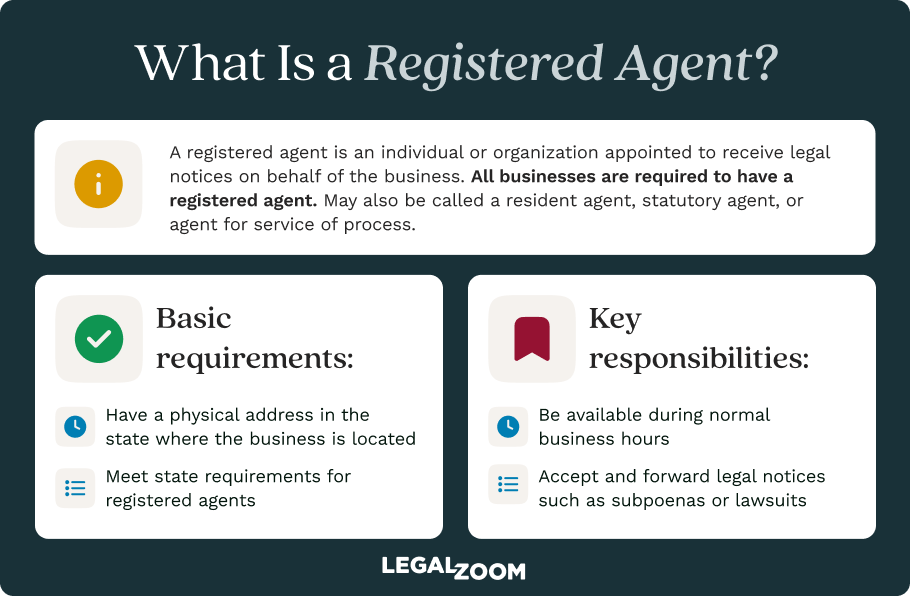
Virginia law requires every nonstock corporation to maintain a registered agent—a person or business designated to receive legal documents, government notices, and service of process on behalf of your nonprofit.
The agent must have a physical street address in Virginia (a P.O. box does not qualify). Your registered agent can be an individual Virginia resident or a business entity authorized to do business in the state. If your registered agent moves or becomes unavailable, you're responsible for updating the SCC promptly.
Step 3: File articles of incorporation with the Virginia SCC
Virginia nonprofits file articles of incorporation with the Virginia State Corporation Commission. File online through the SCC's CIS portal or submit Form SCC819-DOC by mail. The filing fee is $75.
Be prepared to provide the following information:
- The corporate name
- The organization's purpose
- A statement on whether the corporation will have members
- The name and street address of your registered agent
- The name and address of each incorporator
These are the requirements for incorporation, but to qualify for 501(c)(3) status, your articles must also include two clauses the IRS requires beyond what Virginia law mandates:
- A purpose clause limiting the organization's activities to one or more exempt purposes
- A dissolution clause directing all remaining assets to another 501(c)(3) organization or to a government entity if the nonprofit dissolves
- It’s also beneficial to include an inurement clause stating that the organization exists solely for public benefit and not personal or private benefit
Including these clauses costs nothing. Omitting either means amending your articles and restarting the IRS application process later.
Step 4: Create bylaws and hold your organizational meeting
Bylaws are the internal rules that govern how your nonprofit operates. You don't file them with the state, but you must adopt them at your first organizational meeting, and the IRS will ask for a copy when you apply for 501(c)(3) status.
Your Virginia nonprofit bylaws should address:
- Board composition, size, and terms
- Officer roles and responsibilities
- Meeting frequency and advance notice requirements
- Quorum rules
- Voting procedures
- Conflict of interest policy
- Procedures for amending the bylaws
- Fiscal year
Important: The IRS specifically looks for a conflict of interest policy in your 501(c)(3) application as evidence that the board takes independent governance seriously. Draft it before your organizational meeting. It's not optional in practice, even though Virginia law doesn't legally require it.
Step 5: Get an EIN from the IRS
An employer identification number (EIN) is your nonprofit's federal tax identification number. You need one to open a bank account, hire employees, and file your 501(c)(3) application.
The IRS issues EINs for free through its online application at IRS.gov and you receive the number immediately. Your nonprofit does not need to have employees to get an EIN.
Step 6: Apply for 501(c)(3) status with the IRS
501(c)(3) status is a federal tax exemption that exempts your organization from federal income tax and allows donors to deduct their contributions. You apply using one of two forms:
- IRS Form 1023: This is the form most nonprofits will use. The cost to file is $600 and processing typically takes three to six months, sometimes longer.
- IRS Form 1023-EZ: This streamlined form is available to organizations with projected annual gross receipts of $50,000 or less and total assets of $250,000 or less. It costs $275 to file and processing typically takes two to four weeks.
If your organization meets the eligibility thresholds, the EZ form is almost always the better choice. The lower fee and dramatically faster processing make it the practical default for smaller and newer organizations. If you expect to grow quickly, have complex activities, or anticipate significant assets, the full Form 1023 gives you more room to explain your programs and may reduce IRS follow-up questions.
When the IRS approves your application, it issues a determination letter confirming your tax-exempt status. Keep that letter permanently—grant-makers, donors, and government agencies will ask for it, and you'll need it for the next step.
Step 7: Apply for Virginia state tax exemption
IRS 501(c)(3) approval does not automatically exempt your organization from Virginia state taxes. For exemption from Virginia corporate income tax, submit a copy of your IRS determination letter to the Virginia Department of Taxation. For sales and use tax exemption, file Form NP-1 with the same agency.
One nuance: Sales tax exemption applies to purchases your nonprofit makes, not necessarily to every sale your nonprofit conducts. Certain sales activities may still be taxable depending on the nature and frequency of the transactions.
Step 8: Register for charitable solicitation in Virginia
Most Virginia nonprofits that solicit charitable contributions—including donations through your website from Virginia residents—must file a registration statement (Form 102) with the Virginia Department of Agriculture and Consumer Services (VDACS) before they begin soliciting. The form is available on the VDACS website, and registration must be renewed annually.
Some organizations are exempt, including those that receive less than $5,000 in annual contributions and do not use paid solicitors, and religious organizations. Verify current exemption thresholds directly with VDACS before assuming you qualify.
How much does it cost to start a nonprofit in Virginia?
The total cost to start your nonprofit in Virginia is determined by a number of factors, such as whether you hire professional help and which IRS form you’re required to file.
Here’s a breakdown of some common costs associated with starting a nonprofit:
- Articles of incorporation filing fee: $75
- IRS Form 1023: $600
- IRS Form 1023-EZ: $275
- VDCAS charitable solicitation registration: Varies—initial registration fees run up to $100, with annual renewal fees ranging from $30 to $325 based on gross contributions.
In general, you should expect to spend anywhere from a few hundred dollars for basic formation to up to a few thousand dollars if you use the help of an attorney.
Ongoing Virginia nonprofit compliance
Once your Virginia nonprofit is operating, you have recurring obligations to four agencies: the Virginia SCC, the IRS, the Virginia Department of Taxation, and VDACS. Miss any of them and you risk losing good standing, paying penalties, or having your organization's legal existence automatically terminated.
Virginia SCC annual report
Virginia nonprofits must file an annual report with the SCC by the last day of their incorporation anniversary month, along with a $25 registration fee. Filing is required even when all information remains the same.
The late penalty is $10, but the stakes are higher than that amount suggests. If the annual report is more than four months late, the SCC will automatically terminate the corporation's existence by operation of law. Reinstatement requires filing all overdue reports, paying all outstanding fees and penalties, and submitting a reinstatement application.
IRS annual information return (Form 990)
The specific form depends on the size of your organization.
- Form 990-N (e-Postcard): Gross receipts of $50,000 or less
- Form 990-EZ: Gross receipts under $200,000 and total assets under $500,000
- Form 990: Larger organizations
The due date is the 15th day of the fifth month after the close of your fiscal year—May 15 for calendar-year organizations.
If a nonprofit fails to file for three consecutive years, the IRS automatically revokes its tax-exempt status. Reinstatement requires a new application, more fees, and no guarantee of retroactive restoration. The IRS publishes a list of organizations that have lost their exemption, which damages donor confidence and disqualifies the organization from grants. Revocation of your 501(c)(3) status also affects your Virginia state tax exemptions, which were granted based on that federal determination.
VDACS charitable solicitation renewal
If you registered with VDACS to solicit charitable contributions, that registration must be renewed annually. The renewal must be completed within 5.5 months after the end of your organization's fiscal year. Missing this deadline triggers an automatic $100 late fee.
How LegalZoom can help
LegalZoom has helped more than 100,000 organizations form their nonprofit. Our structured process walks you through the articles of incorporation form, then we file the paperwork directly. When you’re ready to apply for 501(c)(3) tax-exempt status, we can help you file your IRS Form 1023-EZ. Once you’re up and running, our suite of compliance services can help you stay in good standing so you can keep operating.
FAQs about Virginia nonprofits
How long does it take to start a nonprofit in Virginia?
The full timeline—from filing articles through obtaining all required registrations—typically runs four to twelve months. The range is that wide for one reason: IRS processing time. Every other step is measured in days or weeks.
Can I pay myself if I start a nonprofit?
Yes, you’re allowed to receive reasonable compensation for any services you render on behalf of the nonprofit, provided the compensation you receive is comparable to what similar organizations pay their employees for that same job. However, the IRS prohibits distributing profits or surplus funds to founders and directors of nonprofit corporations.
Can I hire a professional to help draft my nonprofit’s bylaws?
Yes, because the IRS will scrutinize your bylaws as part of your tax-exempt status application, it can be a good idea to have a professional help you draft them. However, keep in mind that hiring an attorney to help this process can add a considerable expense to your overall startup costs.
What is the 33% rule for nonprofits?
The 33% rule refers to the public support test mandated by the IRS. In practice, this rule mandates that public charities receive at least one-third of their total support from public sources like government grants and contributions from a broad donor base, rather than investment income or a small number of large donors. Organizations that fail the public support test are considered private foundations, which are subject to significantly more IRS restrictions and reporting obligations than public charities.
'%20/%3e%3c/svg%3e)

'%3e%3cpath%20fill-rule='evenodd'%20clip-rule='evenodd'%20d='M9.31239%2025.5316H13.0679V14.1032H9.31239V25.5316ZM11.1913%208.46875C9.93945%208.46875%209%209.25086%209%2010.505C9%2011.5995%209.78211%2012.5389%2011.1913%2012.5389C12.6005%2012.5389%2013.3826%2011.5995%2013.3826%2010.505C13.3826%209.4082%2012.6005%208.46875%2011.1913%208.46875ZM27%2018.9577V25.5316H23.2445V19.4275C23.2445%2017.8609%2022.6174%2016.7664%2021.3679%2016.7664C20.2711%2016.7664%2019.644%2017.5463%2019.3316%2018.1756C19.1743%2018.488%2019.1743%2018.8004%2019.1743%2019.1128V25.5316H15.4165V13.9458H19.1743V15.5123C19.644%2014.7302%2020.5835%2013.6357%2022.6174%2013.6357C25.1234%2013.7908%2027%2015.3573%2027%2018.9577Z'%20fill='white'/%3e%3c/g%3e%3cdefs%3e%3cclipPath%20id='clip0_952_9489'%3e%3crect%20width='18'%20height='18'%20fill='white'%20transform='translate(9%208)'/%3e%3c/clipPath%3e%3c/defs%3e%3c/svg%3e)

