




Estate planning often involves various tools to ensure that assets are managed efficiently after the owner’s death. Among these estate planning tools, some special types of trusts help individuals avoid probate and maintain control over their assets while simplifying the inheritance process for beneficiaries. One such trust, known for its simplicity and practicality, is the Totten trust.
In this comprehensive guide, we will explore what a Totten trust is, how it works, and why it remains a valuable option in modern estate planning. We will also discuss its advantages, potential limitations, and key steps to set one up correctly, helping you understand when and how this simple tool can best fit into your overall financial and legacy planning strategy.

Key takeaways
- A Totten trust (also called an “in trust for” or payable-on-death (POD) account) is a revocable arrangement created by naming a beneficiary on a bank account, so funds pass directly to that beneficiary at the owner’s death, avoiding probate.
- The account owner retains full control during life. They can spend, withdraw, change beneficiaries, or close the account at any time; the beneficiary has no rights until the owner dies.
- Totten trusts are simple to create (bank paperwork only) and typically can hold only cash or bank account funds, not real estate or other non-cash assets.
- A Totten trust can have multiple beneficiaries, and banks usually distribute funds equally unless otherwise directed. If a named beneficiary dies before the owner and no contingent beneficiary is named, the trust ends, and the funds remain the owner’s property to be distributed by will or state intestacy rules.
- Creditors can reach Totten trust funds to satisfy the owner’s debts during life or at death if the estate lacks sufficient assets; there are no special tax advantages beyond ordinary income and estate tax rules.
What is a Totten trust account?
A Totten trust is a type of revocable bank account trust used in estate planning where the account owner holds funds “ITF” or “in trust for” a named beneficiary. The owner retains complete control of the Totten trust account during their lifetime, including the ability to change the beneficiary or close the account. After the account holder’s death, the funds in the trust are automatically transferred to the designated beneficiary, thereby bypassing probate court proceedings. It enables efficient asset transfer through its ease of setup and avoidance of probate.
Totten trusts serve as a legal entity, originating from a 1904 New York court case called Matter of Totten. Individuals typically establish a Totten trust by opening a bank account, such as a checking or savings account. It’s a popular estate planning tool in many states, including New York, Florida, and California.
Key terms and definitions
- Beneficiary: The person or organization designated to receive the funds from the Totten trust after the account owner's death.
- Depositor/Grantor/Settlor: The individual who opens the Totten trust account, deposits funds, and names the beneficiary. During their lifetime, they also act as a trustee.
- Trustee: The person managing the trust property. In a Totten trust, the depositor acts as trustee during their lifetime.
- Payable-on-death (POD) account: A bank account that functions similarly to a Totten trust, with funds payable directly to a named payee upon the depositor's death.
- “In trust for”: The language used on bank accounts to signify they are held in a Totten trust for a beneficiary.
- Revocable trust: A trust that can be altered or revoked by the grantor during their lifetime.
- Probate: The legal process through which a deceased person’s will is validated and assets are distributed.
- Estate: The sum total of all assets and liabilities owned by an individual at death.
- Intestacy law: State laws that govern the distribution of assets and management of an estate till the estate is closed, when someone dies without a valid will or beneficiary designation..
- Estate tax: Taxes imposed on the transfer of the estate of a deceased person.
- Creditor claims: Legal rights that the creditors may have to collect debts from assets, including those in Totten trusts, under certain circumstances.
- Uniform Probate Code: A model law adopted by many states that standardizes probate and estate administration procedures, affecting Totten trust rules.
- Transfer on death account: Similar to a POD account but often used for securities or investment accounts.
How do you set up a Totten trust?
The person opening the Totten trust account must be at least 18 years old and have a valid Social Security number. To set up a Totten trust, the first step is to visit your bank or financial institution and request the opening of a POD account, which is the legal name of a Totten trust.
What paperwork is required to open a Totten trust?
The best part of a Totten trust is that it’s simple and easy to create. You submit paperwork to the financial institution, and there’s no need to file any documents with a court.
- Fill out the Totten trust form or POD paperwork.
- Complete and sign the bank’s required paperwork to establish the Totten trust or POD account.
Note that different banks may have slightly different processes or terminology, such as POD or "in trust for" on the account.
Who can be a beneficiary in a Totten trust?
A beneficiary is an individual who will receive the funds from the trust upon your death. It can be anyone, such as a friend, family member, charity, or any other organization. Clearly state on the bank account that it's "in trust for" your beneficiary.
A Totten trust allows you to even name multiple beneficiaries, with clear instructions on the percentage of funds going to each. Otherwise, the funds are usually split evenly among them. This process is relatively simple, involves minimal cost, and avoids probate delays and court fees.
How does a Totten trust work during your lifetime?
A Totten trust is a trust where the depositor opens a bank account in their own name as trustee for a chosen beneficiary, while retaining complete control over the funds throughout their lifetime. During the depositor's lifetime, the account operates like any standard bank account: The depositor can withdraw money, change beneficiaries, or close the account entirely. The beneficiary has no legal rights to the funds until the depositor's death.
- According to the Federal Deposit Insurance Corporation, the depositor is treated as the account owner and can add or withdraw funds at any time.
- The trust is revocable, meaning it can be changed or dissolved by the depositor before death.
- Creditors can generally claim against the account since the depositor maintains total control during their lifetime.
- The designated beneficiary has no claim to the funds or account activity before the depositor’s death.
- Funds in the account remain part of the depositor’s estate for debt or probate concerns until their death.
- Upon death, the funds are automatically transferred to the beneficiary, bypassing the need for probate.
What happens to a Totten trust when the account owner dies?
When the account owner dies, the funds in a Totten trust are automatically transferred to the named beneficiary, without the need for probate court proceedings. The beneficiary must provide proof of identity and a certified copy of the account holder's death certificate to the bank. The payout is typically immediate and direct, enabling the beneficiary to access the funds promptly.
Does a Totten trust avoid probate?
The core purpose of a Totten trust is to bypass the probate process. Upon death, the bank releases the funds directly to the beneficiary—no probate required.
What are the beneficiary rights and processes in a Totten trust account?
The beneficiary gets rights to the account assets after the account owner’s death. They must provide the required documentation, which is usually their ID and the owner’s death certificate, to claim the funds.
The transfer is non-contestable and overrides conflicting bequests in the deceased owner’s will. If there are multiple beneficiaries, they will likely receive equal shares, according to most bank procedures.
What are the steps taken by a bank to verify a Totten trust claim?
When the owner of a Totten trust dies, the bank verifies the necessary documents to process the claim. They examine all the documents and confirm the beneficiary's identity to ensure that the right person is entitled to the money.
- Review the death certificate. The beneficiary must provide a certified copy of the account owner’s death certificate to the bank, which serves as formal proof of the account owner’s death.
- Verify identity. The beneficiary must present a valid government-issued photo ID so the bank can confirm their identity and match it to the account records.
- Match beneficiary records. The bank checks its internal documentation to ensure the claimant is the named beneficiary on the account.
- Complete required forms. Some banks may need the beneficiary to fill out internal request or claim forms to initiate the transfer.
- Release of funds. After verification, the account balance is promptly transferred to the beneficiary, bypassing probate or court procedures.
If disputes arise regarding accounts, such as missing documents, banks may delay payment or require court intervention; however, standard cases typically proceed relatively quickly. Most banks only require a death certificate and proof of identity in uncomplicated situations, but more complex estates may involve additional steps.

How do joint accounts differ from Totten trusts?
Joint accounts are owned equally by two or more people, each with rights to access and control the funds during their lifetimes. Upon the death of one owner, the surviving owner(s) automatically inherits the account. Ownership is shared, and control is mutual while the individual is alive.
Totten trusts are owned solely by one individual (the trustee/depositor) who retains complete control over the account during their lifetime. A designated beneficiary receives the funds only after the account owner’s death, thereby bypassing the need for probate. The beneficiary had no access to or ownership rights before that time.
Is a Totten trust the same as a POD account?
A Totten trust and a POD account are nearly the same estate-planning tool, though they differ slightly in terminology and specific legal nuances. Both transfer bank account funds directly to a designated beneficiary upon the account owner’s death, bypassing the probate process. They are both fully revocable during the owner's or depositor’s lifetime and pass immediately to the beneficiary or payee when the death certificate is provided to the bank.
The Totten trust is a legal term originating from a 1904 court case, whereas POD is the more commonly used modern banking term. In a Totten trust, the account owner acts as the “trustee,” and the recipient holds the title of “beneficiary.” In a POD account, the owner is the “depositor,” and the recipient is the “payee.” Despite these title differences, both provide the owner with complete control during their lifetime and transfer funds directly upon death.
Totten trust vs POD
- The crucial difference under the California Probate Code is that POD accounts grant an absolute right to the surviving payee.
- If the beneficiary predeceases the owner and no contingent beneficiary is named, the funds typically revert to the owner under a Totten trust. POD accounts usually vest absolutely in the surviving payee unless otherwise specified.
- Neither arrangement protects the owner from creditors during their life, and the owner includes both funds in their taxable estate for estate tax purposes.
“In trust for” (ITF) is a phrase often used to title Totten trusts, while “payable on death” describes POD accounts. Both designations indicate the funds will pass to the named person after the owner's death.
How do Totten trusts compare with other estate planning options?
The key differences in estate planning options are outlined below.
Revocable living trusts
A revocable living trust enables you to manage your property and decide how to distribute it.
- You can set rules about how and when to share these assets. For instance, you might want someone to wait until they turn a certain age or experience specific events before receiving their share.
- These trusts can hold various types of assets, including real estate, investments, and personal property.
- You can customize a revocable living trust to address complex family situations and also provide added privacy. However, they can be expensive to set up and require ongoing management by a trustee.
Wills
Wills allow for the full distribution of assets (including real estate and personal effects), but require probate, which means additional costs and time before beneficiaries receive their assets. They also have a more involved creation process than a POD account.
Transfer-on-death accounts/deeds
Investors use TOD accounts or deeds for investment accounts, securities, and sometimes real estate. Just like a POD account for cash, TOD designations transfer ownership directly at death, bypassing probate and lawyers.
Advanced estate planning considerations
Are there state-specific rules for Totten trusts in New York, California, and Florida?
Yes, there are state-specific rules for Totten trusts in New York, Florida, and California. These differences are in regard to elective share laws, intestacy implications, and protections for surviving spouses.
California
California has codified the Totten trust doctrine by enacting a statute that adopts language consistent with the Uniform Probate Code (UPC) and emphasizes the flexibility of the survivorship provision.
Creditors may reach Totten trust funds in California during the owner’s lifetime and after death, if the estate owes debts.
New York
New York applies an elective share law, which allows surviving spouses to claim the Totten trust as part of the decedent’s estate, ensuring spousal protections so they cannot be disinherited
Florida
Florida’s elective share laws protect surviving spouses from being disinherited, so Totten trust funds are generally included in the probate estate or considered when calculating the elective share.
Florida law requires specific formalities for POD accounts and Totten trusts to be effective and enforceable.
Can creditors claim assets in a Totten trust?
A Totten trust does not guarantee protection from creditors. Creditors can generally claim assets in a Totten trust if the owner has outstanding debts, both during their lifetime and in some cases, after death, if the estate’s assets are insufficient to pay off the debts.
Creditor claims during the lifetime
When the account holder is alive, creditors can treat Totten trust assets as regular bank account funds and file claims to recover debts.
Creditor claims after death
- If an estate lacks enough assets to cover debts, creditors may also be able to reach funds in Totten trusts before those assets pass to the named beneficiaries.
- After settling all probate and estate obligations, the beneficiary receives the assets, and creditors generally can’t claim them.
What happens if the beneficiary predeceases the owner?
If the beneficiary of a Totten trust account predeceases the owner, the assets in the Totten trust typically don’t go to the deceased beneficiary's estate or heirs. They follow the account owner’s estate plan or the state intestacy law, unless the owner is named a backup beneficiary.
- The beneficiary must survive the account owner to receive the Totten trust funds; if the beneficiary dies first, the trust ceases to exist as a Totten trust, and no asset automatically transfers.
- If the account owner does not name a new beneficiary, the remaining funds will go to the owner’s will, or if there is no will, intestacy law will determine the distribution.
- Many financial institutions do not permit backup beneficiaries on Totten trusts, so owners need to update their beneficiary designations if circumstances change.
- Federal guidance from the FDIC confirms that, for trust accounts (including Totten trusts), if no contingent beneficiary is named, the assets remain with the owner’s estate and follow the procedures of probate or intestacy.

What are Totten trust tax consequences?
Totten trusts are broadly considered tax-neutral and don’t offer specific estate or income tax advantages. Beneficiaries receive the funds as an inheritance rather than as income, which means that they usually do not incur any income tax on the transfer itself. However, the transferred funds may be subject to estate tax if the total value of the decedent’s estate exceeds federal or state exemption thresholds.
According to IRS guidance, neither the owner nor the beneficiary can avoid federal estate tax through this structure. The account owner pays taxes on the income generated by the account during their lifetime, just like any regular bank account. The transfer to a beneficiary is treated as part of the estate and handled under general estate tax rules, not as an income-taxable event for the beneficiary, unless the trust itself generates income.
Tax consequences compared to other estate planning tools
There are no unique tax benefits for Totten trusts—the funds are included in the overall estate, subject to the general tax treatment outlined by the IRS and trusted resources. If you’re deciding between a Totten trust, POD, TOD, or revocable trust, remember all arrangements are tax-neutral for U.S. estate and income tax purposes. The main differences are asset-type coverage and survivorship rules.
What are the benefits of a Totten trust?
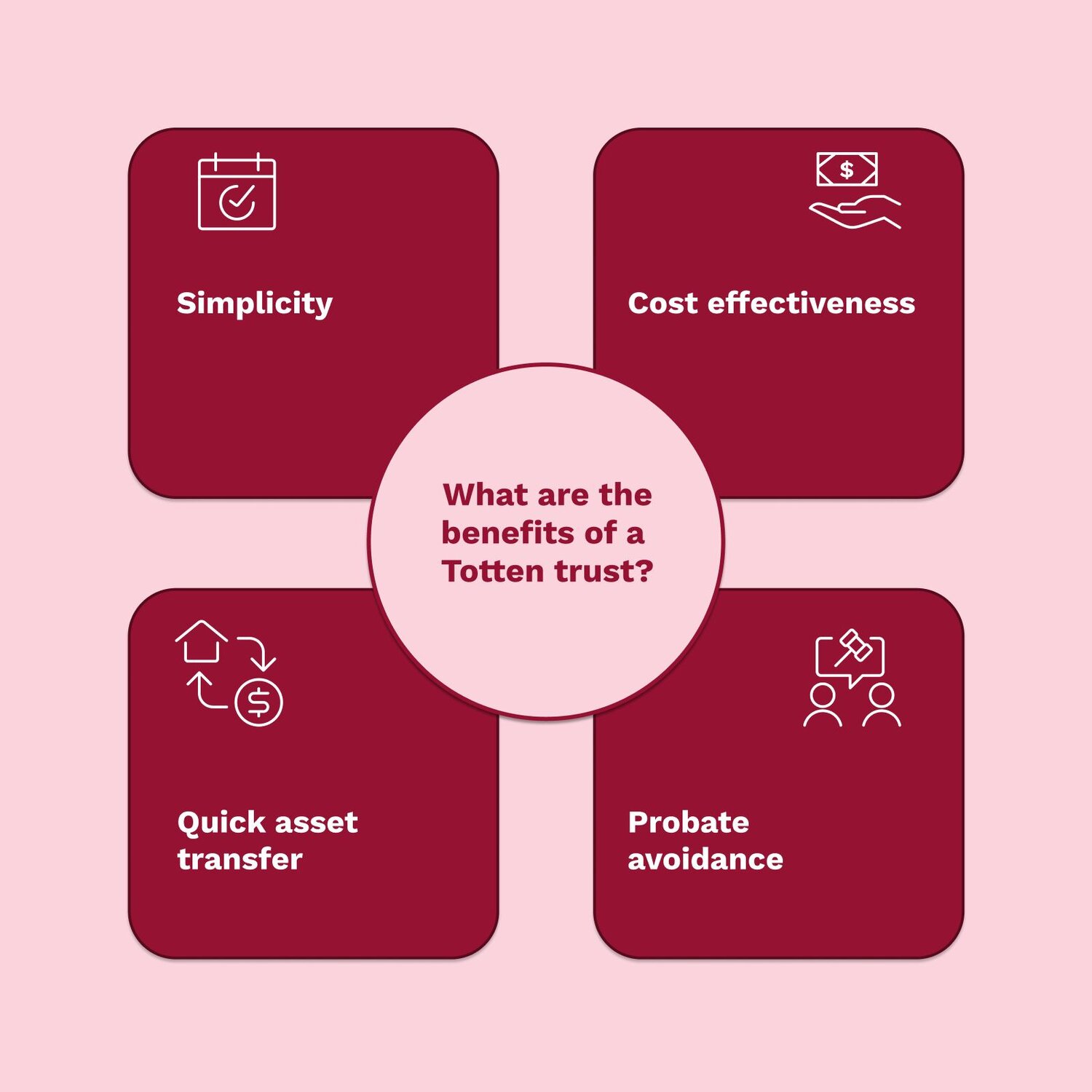
Totten trust is a simple, affordable, and private method of transferring bank account funds outside of probate, making it highly suitable for simpler estate planning needs where quick and direct asset transfer is a priority.
- Simplicity: A Totten trust is very easy to set up, often requiring just a bank form to name a beneficiary. There's no need for complex legal documents or an attorney. This option makes it accessible to a wide range of people.
- Cost-effectiveness: A Totten trust is less expensive than any other estate planning option. Typically, there is no legal fee. It avoids probate and reduces long-term costs for heirs.
- Probate avoidance: One of the main benefits of a Totten trust is that it enables assets to bypass probate. When the account owner dies, the funds go directly to the named beneficiary. This process avoids court delays, extra fees, and the need for public disclosure.
- Quick asset transfer: The beneficiary gains immediate access to the funds once the bank receives the death certificate and verifies their identity, ensuring timely financial support for heirs without the need to wait for months for probate to conclude.
- Privacy: Since Totten trusts avoid probate, details about the assets and beneficiaries remain private, unlike wills, which become public through the probate court.
Are there any drawbacks or risks associated with Totten trusts?
Despite the above-mentioned benefits and advantages of Totten trusts, they do have some limitations that potential users should know about.
- Allows for limited assets: Totten trusts hold cash or funds only in bank accounts. It can’t include real estate, investments, or other physical assets. As a result, Totten trusts help manage simpler estates.
- Lacks an alternate beneficiary designation: If the named beneficiary dies before the account owner, the account owner must update the beneficiary designation. This lack of substitute beneficiary options can complicate estate planning.
- Limited protection to assets: Totten trusts don’t protect assets from creditors during the account owner’s life or after their death, allowing creditors to claim funds to satisfy debts or legal judgments.
- Unrestricted access to beneficiaries: After the owner dies, the beneficiary gains immediate, unrestricted control over the funds, which may lead to mismanagement or premature spending.
- Blurs the line with wills: The beneficiary designation in a Totten trust generally supersedes will provisions for the same assets, which can lead to conflicts among heirs if the estate plan is not consistently updated.
- Limited privacy compared to formal trusts: While Totten trusts avoid probate, they don’t offer the same level of asset-management privacy or the comprehensive protection that formal irrevocable or living trusts provide.
A Totten trust is best suited for simple estate planning needs or for managing specific bank accounts, rather than complex estates. It’s a good idea to consult an estate planning attorney to determine if a Totten trust is the right fit for your goals and situation.
Who should consider a Totten trust?
Individuals with modest assets seeking a simple, cost-effective way to avoid probate can consider a Totten trust to streamline the transfer of bank account funds to beneficiaries. Individuals or families with complex estates, involving real estate, investments, or those requiring detailed asset management and protection, may require a formal trust or a comprehensive estate plan that is more appropriate for their situation.
Formal wills and trusts can offer greater flexibility than Totten trusts. An estate planning attorney can help determine the best approach based on one’s specific financial situation and goals.
FAQs about Totten trust
Can the owner change a Totten trust beneficiary?
Yes. A Totten trust is revocable, which means the account owner can generally change the beneficiary, withdraw money, or close the account at any time during their lifetime.
Can creditors claim money in a Totten trust?
Yes. Because the account owner controls the funds during life, creditors may be able to reach the account during the owner’s lifetime. Creditors may also have claims after death if the estate does not have enough assets to pay debts.
What assets can a Totten trust hold?
A Totten trust typically applies to bank account funds, such as checking or savings accounts. It generally does not hold real estate, personal property, or investment assets, which may require other estate planning tools.
Is a Totten trust right for everyone?
A Totten trust may work well for someone who wants a simple, low-cost way to transfer bank account funds outside probate. However, it may not be enough for complex estates, blended families, creditor concerns, or assets beyond bank accounts.
'%20/%3e%3c/svg%3e)

'%3e%3cpath%20fill-rule='evenodd'%20clip-rule='evenodd'%20d='M9.31239%2025.5316H13.0679V14.1032H9.31239V25.5316ZM11.1913%208.46875C9.93945%208.46875%209%209.25086%209%2010.505C9%2011.5995%209.78211%2012.5389%2011.1913%2012.5389C12.6005%2012.5389%2013.3826%2011.5995%2013.3826%2010.505C13.3826%209.4082%2012.6005%208.46875%2011.1913%208.46875ZM27%2018.9577V25.5316H23.2445V19.4275C23.2445%2017.8609%2022.6174%2016.7664%2021.3679%2016.7664C20.2711%2016.7664%2019.644%2017.5463%2019.3316%2018.1756C19.1743%2018.488%2019.1743%2018.8004%2019.1743%2019.1128V25.5316H15.4165V13.9458H19.1743V15.5123C19.644%2014.7302%2020.5835%2013.6357%2022.6174%2013.6357C25.1234%2013.7908%2027%2015.3573%2027%2018.9577Z'%20fill='white'/%3e%3c/g%3e%3cdefs%3e%3cclipPath%20id='clip0_952_9489'%3e%3crect%20width='18'%20height='18'%20fill='white'%20transform='translate(9%208)'/%3e%3c/clipPath%3e%3c/defs%3e%3c/svg%3e)

