.
.





To form a Colorado LLC, file articles of organization online with the Colorado Secretary of State. Colorado's current LLC formation process is completed through the Secretary of State's online filing system. The filing makes the LLC's name, principal office address, and registered-agent information part of the public record.
Learn the necessary formation steps, common Colorado fees, and the ongoing filings and registrations that may apply to an LLC.
Key takeaways
- Colorado's LLC formation process is completed through the Secretary of State's online system, and the current online articles of organization filing fee is $50.
- Your LLC needs a qualifying Colorado registered agent with a physical Colorado street address and the required consent or verification.
- A name search helps identify conflicts, but it does not clear trademark rights or guarantee acceptance.
- Sales tax, professional, industry, and local requirements depend on what the business does and where it operates.
- Colorado LLCs must file a periodic report each year during the entity's reporting window.
Step 1: Name your Colorado LLC
Colorado law requires your LLC's name to be distinguishable from other registered entities and to include an allowed LLC designator, such as "LLC" or "L.L.C." It’s also recommended to review the current Colorado naming rules before filing, especially if your proposed name involves a regulated profession or restricted term. Words that suggest government or educational affiliation, or else suggest regulated activities or licensed professionals, may incur extra scrutiny.
If your proposed name raises a regulatory issue, confirm the current requirement with the Colorado agency that oversees the profession or activity.
How do I choose a name for a Colorado LLC?
Pick a name with a required designator, no restricted words, and clear distinguishability from existing Colorado entities. If your name is not distinguishable from a name already on record, the Secretary of State may reject the filing, so search for each name through the Secretary of State's Name Availability Search or use the tool below before you get attached to it. Use the official state search first; a name search does not clear trademark rights.
Free Colorado Business Name Check
Starting a business? Use our free name check tool to check your business name against the Colorado Secretary of the State records.
By clicking "Check Availability," I agree to LegalZoom's Terms of Use. This search is a preliminary check of state databases and does not include variations or trademarks. Results do not guarantee name availability or compliance with legal requirements.
Do you need to reserve a name before filing?
You do not have to reserve a name, but you can for 120 days by filing a Statement of Reservation of Name online for a $25 fee. And, you can renew that reservation before expiration with a Statement of Renewal of Reservation of Name (check the current fee on the Secretary of State's fee schedule).
Can you operate under a different name?
Colorado calls this idea a trade name, but many other states refer to it as a DBA or fictitious business name. Register yours by checking availability and submitting the Statement of Trade Name online at mybiz.colorado.gov, plus a $20 fee. Colorado trade names are not exclusive.
For an LLC that is a reporting entity, the trade name generally remains effective while the LLC is in good standing and while non-compliant. However, if the LLC becomes delinquent or dissolved, the trade name generally remains effective for one year, subject to the applicable renewal rules. See our guide to filing a DBA in Colorado.
Step 2: Appoint a Colorado registered agent
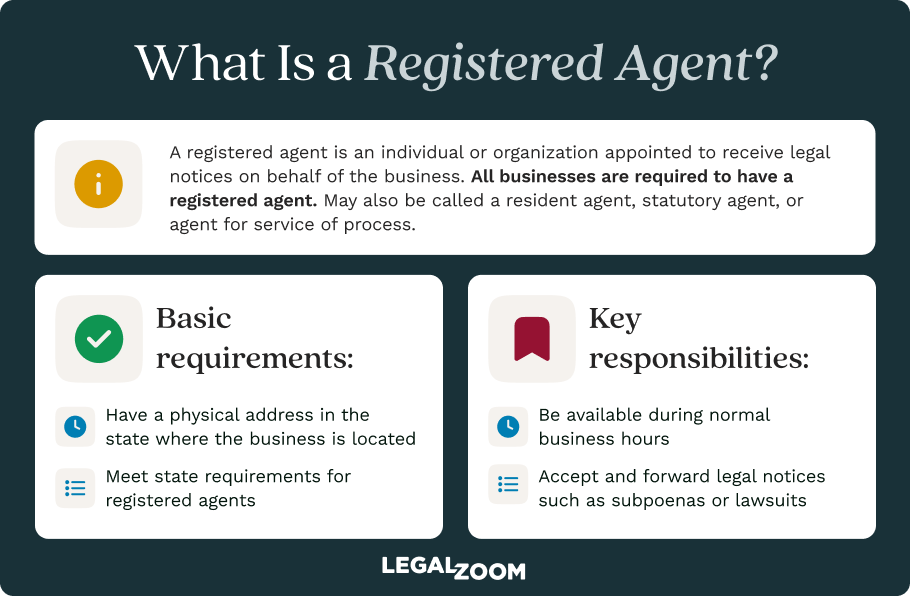
Colorado requires every LLC to continuously maintain a registered agent at all times. A registered agent is a person or company that receives service of process, legal notices, and state documents on your LLC's behalf. P.O. boxes and commercial mail-drop addresses don't satisfy Colorado's physical-address rule.
To qualify as a registered agent, you must meet certain requirements:
- The agent must be at least 18 years old.
- A business entity acting as the registered agent must be registered with the Colorado Secretary of State, in good standing, and have a usual place of business in Colorado.
- The agent must have a qualifying Colorado physical street address, not a P.O. box or commercial mail-drop address.
What are the downsides of being your own Colorado registered agent?
Everything in your articles of organization, including your registered agent's name and address and your LLC's principal office address, becomes public record the moment you file. The filing is publicly searchable through the Secretary of State's business database. Because these addresses are public, consider the privacy and availability tradeoffs before filing. Hiring a registered agent service with its own Colorado business address can keep your personal address off the registered-agent portion of the public filing.
Out-of-state founders can't serve as their own registered agent unless they meet Colorado's physical-address and eligibility rules. A qualifying Colorado individual or entity must serve.
Step 3: File Colorado articles of organization online
Filing articles of organization is the act that legally creates your LLC. Use the Colorado online filing system and review every field before submitting.
You can download your filed copy directly from mybiz.colorado.gov.
What information is required in your articles of organization?
The current Colorado checklist asks for the following information and choices.
- Entity name: exact LLC name, designator included.
- Principal office street address: must be physical, but doesn't have to be in Colorado. The Colorado-address rule applies only to your registered agent.
- Mailing address: optional; can be a P.O. box, anywhere.
- Registered agent information: name, consent, and Colorado street address.
- Management structure: "Members" for member-managed, "Managers" for manager-managed.
- A statement that at least one person is forming the LLC, plus that person's name and mailing address.
- Optional delayed effective date: up to 90 days from filing.
What’s the difference between member-managed and manager-managed LLCs?
In a member-managed LLC, members generally have authority to act for the LLC in the ordinary course of business, subject to the articles and operating agreement. If you don't affirmatively select manager-managed, the state treats your LLC as member-managed.
In a manager-managed LLC, management is vested in one or more managers, who may or may not be owners. Members do not have the authority to act for the LLC solely because they are members. Manager names and addresses don't appear on the articles of organization; the filing identifies the management structure.
Step 4: Create a Colorado LLC operating agreement
Colorado does not require an LLC to file an operating agreement with the state. A written agreement can document ownership, contributions, distributions, voting, management, member changes, and dissolution. If the agreement does not address an issue, Colorado's default LLC rules may apply.
You do not file an operating agreement with the Secretary of State, but a written agreement can make the company's internal rules easier to follow. Keep the signed agreement with the company's records and have it match the management choice in the articles. It does not by itself guarantee liability protection. Banks or lenders may ask for one before opening a business account.
The operating agreement is generally kept with the company's records rather than filed with the state. Its enforceability depends on its terms and how it is adopted; it may be adopted before, after, or at the time of filing. The articles of organization are part of the public record.
What should you include in your operating agreement?
You’ll want to include the following information in your operating agreement.
- Ownership percentages and how they tie to profit and loss splits.
- Capital contributions each member made, and what happens if more funding is needed.
- Management structure (member-managed or manager-managed), matching your articles of organization.
- Voting rights and decision-making, including how ties get broken.
- Profit and loss distribution timing and method.
- Membership changes: exits, transfers, new partners.
- Dissolution terms for winding down the LLC.
We make it easy to create your LLC operating agreement by answering a few questions online.
Step 5: Get an EIN for your Colorado LLC
An employer identification number (EIN) is a nine-digit federal ID for your business. A single-member LLC generally does not need a separate EIN if it has no employees and is treated as a disregarded entity for federal tax purposes, although it may obtain one for banking or privacy reasons. The IRS generally requires an EIN when the LLC has employees, is taxed as a corporation or partnership, or has certain federal filing obligations.
Apply directly through IRS.gov when you know the LLC's federal tax classification and save the confirmation for your records. Or let LegalZoom file the application on your behalf.
A Colorado state tax account is separate from a federal EIN. Check the Colorado Department of Revenue's current registration instructions for the accounts your business needs.
Building a business is enough work as it is. We'll help you start your LLC with confidence.

Step 6: Apply for Colorado business licenses and tax accounts
Filing your articles of organization creates your LLC but doesn't clear you to start selling products or hiring employees. Depending on your activity, you may need to register with the Colorado Department of Revenue and comply with city or county licensing rules.
Colorado has no general statewide business license for LLCs. What you need depends on activity and location, across three layers.
- Layer 1: State sales tax license. If your business must collect Colorado sales tax, apply through the Colorado Department of Revenue's Revenue Online service or the current CR 0100 registration form. The license fee is prorated, and a retail license may also require a $50 deposit. Confirm the current amount, deposit rules, and application requirements with the Department of Revenue.
- Layer 2: Occupational or industry-specific licenses. Depends primarily on your field, and sometimes on your location. Food service, construction, healthcare, and similar regulated fields typically need sign-off from a specific agency, often the Colorado Department of Regulatory Agencies (DORA) or another state board. Check the agency that regulates your specific profession.
- Layer 3: Local licenses. These vary by city or county. Denver, for example, may require a separate Denver business license; requirements and fees vary. Check with your local clerk's office before opening.
A license-research service may help organize these questions, but verify every result with the relevant state and local agency.
Step 7: File your Colorado periodic report and stay compliant
Colorado requires an ongoing periodic report for every LLC. It is similar to what most states call an annual report. Check your filing window and file on time to keep the LLC in good standing.
File directly with the state and set a reminder for the current reporting window.
What happens if you miss the deadline?
The current fee schedule lists a $25 periodic-report fee and a $50 late-filing penalty. If the LLC becomes delinquent, the cure or reinstatement path and fee depend on its record status. A missed report does not mean immediate dissolution, so file and cure any delinquency as soon as possible.
How much does it cost to run an LLC in Colorado?
The $50 online formation fee is the required starting cost. Optional and conditional costs may include name reservation, trade name filings, registered agent service, licenses, tax registrations, and compliance filings. You’ll also need to budget $25 each year for Colorado’s periodic report
| Cost | Amount |
|---|---|
| Articles of organization filing fee | $50 |
| Periodic report (annual) | $25 |
| Name reservation (optional) | $25 |
| Trade name filing (optional) | $20 |
What to do after your Colorado LLC is formed
Save the filed articles of organization and confirm that the public record shows the correct name, principal office, and registered agent.
Then:
- Open a business bank account and keep business and personal finances separate.
- Sign and store the operating agreement and ownership records.
- Register for applicable tax accounts and obtain required professional, industry, city, or county licenses and permits.
- Check whether your business needs payroll registration or insurance.
How to maintain your Colorado LLC
Keep the registered agent and principal office information current, renew licenses and tax accounts on their schedules, and retain formation and governance records.
The first periodic report is due during the LLC's assigned reporting window. Colorado generally allows filing beginning two months before the reporting month through the last day of the second month after it without penalty; check the Secretary of State record for the assigned month.
The current fee schedule lists a $25 periodic-report fee and a $50 late-filing penalty. If the LLC becomes delinquent, the cure or reinstatement path and fee depend on its record status. A missed report does not mean immediate dissolution, so file and cure the delinquency as soon as possible.
The risks of filing a Colorado LLC yourself
DIY filing can be straightforward, but Colorado-specific mistakes can cause filing delays, public-record exposure, or loss of good standing.
- Using an outdated Colorado form, fee schedule, or filing method. Colorado LLC articles of organization are filed online, and payment must be made electronically.
- Naming an ineligible registered agent. An individual agent must be at least 18 and have a primary residence or usual place of business in Colorado, and must satisfy current identity or residency-verification requirements. An entity agent must be in good standing in Colorado. The registered-agent street address cannot be a U.S. or commercial post-office box, and the agent must consent to the appointment.
- Listing an address without understanding Colorado’s public-record rules. The principal office and registered agent information become part of the public filing. A mailing address may be a P.O. box, but the registered-agent address must be a qualifying Colorado street address.
- Missing Colorado’s periodic-report cycle. The first periodic report is due no later than the last day of the second calendar month following the first anniversary month of the LLC’s effective formation filing, unless an alternative anniversary month was elected.
- Treating a Colorado name search as legal clearance. The Secretary of State’s search helps evaluate distinguishability from other registered entities, but it does not clear trademark rights or guarantee that a name is available for every use.
- Assuming articles of organization cover every business requirement. Colorado LLC formation does not replace sales-tax registration, professional or industry licensing, local permits, payroll registration, or other requirements based on the business’s activity and location.
How to start your Colorado LLC with LegalZoom
Seven steps, a field-by-field articles of organization checklist, and a periodic report deadline table add up to a lot to track while you're running a business. LegalZoom can take most of it off your plate, starting with our LLC formation services. Additionally, here’s what LegalZoom can provide for you:
- Registered agent service. Can help keep your personal address off the registered-agent portion of the public filing by providing a Colorado business address for your LLC.
- Operating agreement drafting. Helps you spell out ownership percentages, management structure, and profit splits in writing before a disagreement forces the issue.
- Business license and permit search. Our business license search helps identify which of the three licensing layers apply to your business and location.
- Legal consultation plans. Our attorney consultation plans connect you with licensed attorneys for questions on management structure, professional licensing, or deadline specifics.
Find the right state to form an LLC
Find the right state to form an LLC
Every state has different rules, costs, and considerations for LLC formation.


Colorado LLC formation FAQs
Can I form a Colorado LLC if I live outside Colorado?
Yes. You will still need a qualifying Colorado registered agent with a physical Colorado street address. If you already formed an LLC elsewhere and want to operate in Colorado, determine whether foreign registration is required for your activities.
Can one person own a Colorado LLC?
Yes. Colorado allows a single-member LLC. The single-member structure is separate from federal tax treatment, so review the EIN and tax rules that apply to your situation.
How do I change a Colorado LLC's registered agent?
File the current statement of change form with the Colorado Secretary of State and confirm the new agent's consent and Colorado street-address requirements. Verify the current filing fee and processing instructions before submitting.
Do regulated professionals have extra Colorado LLC requirements?
Some regulated professions have additional Colorado rules for LLC naming, ownership, licensure, and formation documents. The requirements vary by profession, so check the applicable Colorado licensing board before filing.
'%20/%3e%3c/svg%3e)

'%3e%3cpath%20fill-rule='evenodd'%20clip-rule='evenodd'%20d='M9.31239%2025.5316H13.0679V14.1032H9.31239V25.5316ZM11.1913%208.46875C9.93945%208.46875%209%209.25086%209%2010.505C9%2011.5995%209.78211%2012.5389%2011.1913%2012.5389C12.6005%2012.5389%2013.3826%2011.5995%2013.3826%2010.505C13.3826%209.4082%2012.6005%208.46875%2011.1913%208.46875ZM27%2018.9577V25.5316H23.2445V19.4275C23.2445%2017.8609%2022.6174%2016.7664%2021.3679%2016.7664C20.2711%2016.7664%2019.644%2017.5463%2019.3316%2018.1756C19.1743%2018.488%2019.1743%2018.8004%2019.1743%2019.1128V25.5316H15.4165V13.9458H19.1743V15.5123C19.644%2014.7302%2020.5835%2013.6357%2022.6174%2013.6357C25.1234%2013.7908%2027%2015.3573%2027%2018.9577Z'%20fill='white'/%3e%3c/g%3e%3cdefs%3e%3cclipPath%20id='clip0_952_9489'%3e%3crect%20width='18'%20height='18'%20fill='white'%20transform='translate(9%208)'/%3e%3c/clipPath%3e%3c/defs%3e%3c/svg%3e)