.
.






Virginia is one of the best states to start a limited liability company (LLC), thanks to its low $100 filing fee and straightforward application process. To form a Virginia LLC, you need to register your business with the Virginia State Corporation Commission (SCC). You can do this yourself by following the steps below, or you can launch your Virginia LLC through LegalZoom, with plans starting at $0 (plus the state filing fee).
Either way, let’s walk through the entire Virginia LLC formation process, from name selection to compliance obligations for new businesses.

Quick facts on how to form a Virginia LLC
- Where to register: The Virginia State Corporation Commission
- Virginia LLC registration fee: $100
- Processing times: Generally, between one to five business days depending on how you file and the time of year. You can also opt for same- or next-day expedited processing, which costs between $50 to $200 on top of the registration fee.
- Annual registration fee: $50
- Registered agent: Required. You must have a registered agent that meets state qualifications to form an LLC in Virginia.
- LLC operating agreement: Not required, but highly recommended.
How to get a Virginia LLC in 5 steps
You can register a Virginia limited liability company by filing articles of organization. To file online, which the SCC recommends, you'll need to create an account with the Virginia State Corporation Commission. You can also fill out a paper application and file it by mail if you prefer.
Either way, there are a few things you'll need to prepare first. Here’s how to get started.
Step 1: Name your Virginia LLC
First, you'll need to choose a unique name for your LLC. This means your name must be distinguishable from existing businesses registered in Virginia.
You can do a search through the SCC’s website to determine if a particular business name is in use. Be sure to check for any close matches to rule out names that sound too similar to yours.
Example: If you’d like to use the name “Richmond Flooring,” consider also searching for variants like “Richmond Tile and Flooring” or “Richmond Flooring Company”.
Business names must also comply with Virginia LLC name requirements:
- Your business name must include the words “limited company,” “limited liability company,” or an acceptable abbreviation (“LC,” “L.C.,” “LLC,” or “L.L.C.”). Professional limited liability companies can add the word professional or letter P to indicate their business structure.
- The business name cannot contain words used to name a government agency, like “State Department,” “CIA,” “FBI,” or “Treasury,” or identifiers associated with other business entities, such as “Inc.” or “Corp.”
- Certain restricted words, such as “bank,” “trust”, “engineer,” “architecture,” “land surveying,” or any variations that imply the same meaning, can only be used if your business entity offers these services.
Before you commit to the name in your articles, it’s a good idea to review all of Virginia's naming rules to prevent rejections and delays. You can also use LegalZoom’s free Virginia business name search tool below.
Free Virginia Business Name Check
Use our free name check tool to search the Virginia State Corporation Commission database and see if your business name is available.
By clicking "Check Availability," I agree to LegalZoom's Terms of Use. This search is a preliminary check of state databases and does not include variations or trademarks. Results do not guarantee name availability or compliance with legal requirements.
If you aren't ready to register your LLC but are concerned your name might be taken by someone else, you can reserve it for $10. In Virginia, names may be reserved for up to 120 days by paying the fee and submitting the proper form to the SCC.
Pro tip. If you want to operate under a business name that's different from the one on the company's formation paperwork, you can file a "doing business as" (DBA), also called a fictitious name in Virginia.
Step 2: Appoint a registered agent
All LLCs in Virginia must appoint a registered agent, which is a person or entity that you authorize to receive service of process, official legal documents, and notices on behalf of your LLC.
Virginia registered agents must meet these requirements:
- Be a Virginia resident or a business entity authorized to operate in the state
- Have a physical business address in Virginia, known as the registered office (a P.O. box doesn't count)
- Be available during regular business hours to receive service of process and other mail
In addition, if you appoint an individual to the role, they must be one of the following:
- Licensed to practice law in Virginia
- Part of business management (i.e., an active member or manager of your LLC)
Keep in mind that, while the business entity can't be its own registered agent, you can appoint yourself or a member of the business entity's management team to act as a registered agent, provided you or the employee meets the SCC’s registered agent qualifications.
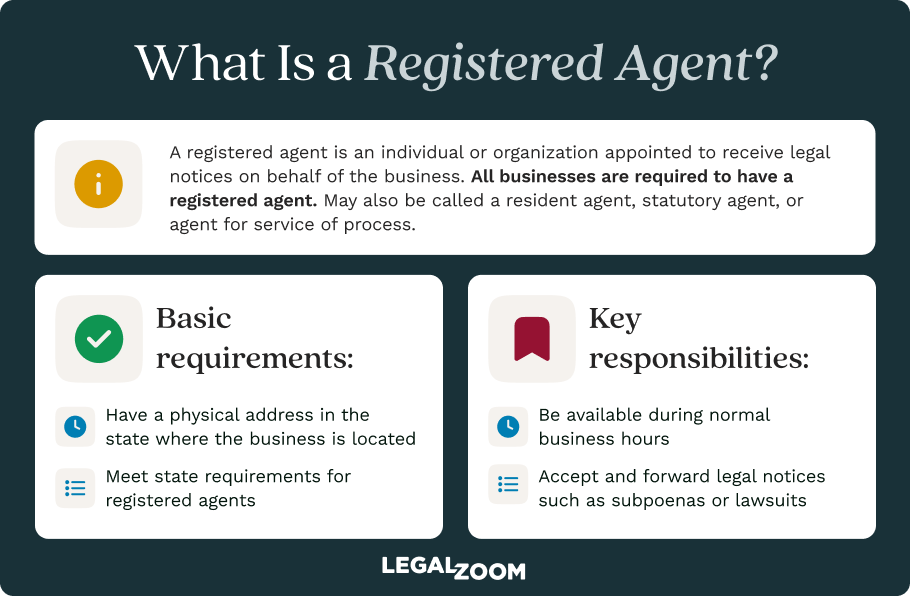
The SCC also allows you to appoint a law firm or registered agent service to perform the role. Many business owners will choose this option because it offers them more flexibility (you don't need to be in the office during normal business hours) and privacy (the registered office address is available to the public).
LegalZoom offers a Virginia Beach-based Registered Agent Service for $249 per year. We have a physical address in Virginia Beach where we can receive mail and service of process for your LLC. We'll send you notifications when important documents arrive and upload them to a secure server for you to access from anywhere.
Step 3: Prepare and file articles of organization
Next, you can file your paperwork with the SCC to register your Virginia LLC. Though it sounds like a big job, that really consists of filling out a relatively simple online form and submitting it. You can also send it by mail, but the state recommends filing online for a faster response.
Domestic LLCs file articles of organization (Form LLC1011 or LLC1103 for a professional LLC). This is the document that officially creates your business entity. Foreign LLCs file a certificate of registration (Form LLC1052), which gives the business authorization to operate in Virginia.
To prepare your articles, you'll need the following information:
- Your LLC’s name and principal office address
- The registered agent’s name, qualification (e.g., a member of the Virginia State Bar, a manager of the LLC, or an authorized business entity), and address
- Your licensed profession, such as architect, attorney, or pharmacist (only if registering a professional PLLC)
Foreign LLCs also need to include information about where and when they originally formed. Whether you fill out a paper application or apply online, you should first review the SCC’s instructions (found at the top of the first page of the application) to avoid mistakes or delays. Lastly, you or the person forming the LLC is required to sign the articles.
Once you file your articles, the SCC will review the filing. If approved, the state will issue an acceptance email or letter (depending on how you applied) that confirms the LLC formally exists. You should keep a copy of this confirmation, as you’ll need it to obtain an employer identification number (EIN), business licenses, and a business bank account.
If the SCC rejects your articles, you’ll receive an explanation of the error and how to correct it. To avoid delays, it’s important to carefully review your paperwork and ensure the details are correct.
Step 4: Create an operating agreement
An operating agreement is an internal legal document that outlines the way your LLC will conduct business, including its ownership structure and management rules. While Virginia doesn't require you to file an operating agreement, you should strongly consider creating one for various reasons.
For example, an operating agreement can help multi-member LLCs prevent or settle legal disputes by outlining member roles, rights, and responsibilities from the start. For single-member LLCs, an operating agreement can create a clear distinction between the business and its owners, which safeguards the LLC's limited liability protection and shields personal assets from business debts.
To create your document, you can simply use a Virginia LLC operating agreement template to get a structured head start and cover the basics, such as profit distribution, voting rights, and member responsibilities. However, it’s worth having a business attorney review and customize the final draft, particularly if your LLC involves complex arrangements.
An LLC operating agreement can include, but is not limited to, the following:
- Your LLC's name, duration, and principal address
- Name and address of the registered agent
- Copy of the articles of organization
- Purpose of the business
- Members and their contribution
- Allocation of business profits and losses
- Procedure for adding and removing business partners
- Management of the LLC
- Indemnification and liability clauses
Without an operating agreement in place, the courts make determinations based solely on Virginia law, not necessarily what is in the best interest of the LLC and its members. To prevent that, you can get an LLC operating agreement for as low as $99 through LegalZoom. This service is also included in most of our LLC formation plans.
Building a business is enough work as it is. We'll help you start your LLC with confidence.

Step 5: Get an EIN and open a business bank account
You can apply for an employer identification number through the IRS. An EIN is a nine-digit number that identifies your LLC for tax purposes, like a Social Security number for your LLC. You can obtain your EIN by mail or online, as well as through services like LegalZoom if you’d rather not do it yourself. (Note: This service is included in our paid formation packages.)
An EIN allows you to:
- File and manage federal and Virginia state taxes
- Open a business bank account
- Hire employees
- Avoid using your SSN when applying for business insurance, licenses, or signing contracts
After you receive an EIN, you can begin to research business bank accounts for your Virginia LLC. You can usually find options through big banks like JPMorgan Chase and Bank of America, or you might contact local credit unions in Virginia.
After formation: Ongoing compliance requirements for Virginia LLCs
Once your LLC is operational, there are a few more things you need to do to maintain compliance and set your business up for success.
Register for state taxes
All new LLCs in Virginia must register for state taxes through the Department of Taxation’s online portal. Be sure to read the instructions and gather all the required information, which includes the following:
- Your LLC’s EIN
- Your contact information and Social Security number
- General business information and NAICS code
- The tax types you’re registering for
Virginia follows the federal model for state income taxes, treating LLCs as pass-through entities by default. In other words, LLC taxes on income pass through to the member's individual tax returns. However, LLC owners can elect to be taxed at the entity level, which transfers the state income tax liability from the owners to the business. This lets LLC owners avoid self-employment taxes, but makes the business subject to corporate taxes. In addition, most LLCs must collect and remit an average combined sales tax of 5.77% to the state and local municipalities, as well as payroll taxes (see more in the next step).
Obtain Virginia business licenses and permits
As for permits, Virginia doesn’t have a general statewide business license for LLCs. However, many cities and counties have their own requirements, including general operational licenses, building occupancy permits, zoning permits, alcohol sales licenses, food handling licenses, and more. Be sure to check with your local government authorities, local Chamber of Commerce, or county/city office of economic development.
Certain professions must also obtain state-level certifications through the Virginia Department of Professional and Occupational Regulation, which provides a list of applicable occupations and their requirements. Businesses in certain industries may also need to obtain state or federal licenses. For instance, business activities related to nature, fisheries, wildlife, or chemical production may require your LLC to get an environmental license.
Alternatively, you can leave the license and permit search to LegalZoom, and we’ll find out exactly what you need at the local, state, and federal level, and provide you with a comprehensive list of resources.
Starting a business takes courage. LegalZoom makes sure the legal details don’t stand in your way, from the day you register until the day you retire.

Comply with employer obligations
If you hire employees for your new LLC, you’ll need to comply with the following requirements:
- Reporting employees. Employers must report new employees to the government within 20 days of their hire date.
- Withholding taxes. In Virginia, employers are required to withhold federal, state, and local income taxes from their employees' wages and forward what is collected to the government.
- Paying unemployment taxes. Employers in Virginia must pay taxes to the state unemployment fund and report employee wages quarterly to maintain compliance.
- Purchasing workers’ compensation insurance. In Virginia, most employers must purchase workers’ compensation insurance for work-related injuries.
If you have any specific questions about employer obligations, whether at the federal level or in Virginia, connect with a business attorney for tailored legal advice.
Pay your annual registration fee
Virginia doesn't require business entities to file annual reports. However, the SCC does impose an annual registration fee. For LLCs, this fee is $50, and the due date is the last date of the LLC's anniversary month. So, if you formed your business in January, you need to pay your annual registration fee by January 31 each year. Pay the fee through your account with the SCC.
The cost of forming an LLC in Virginia
Starting an LLC in Virginia costs at least $100, though the total costs may increase to around $600.
Here’s a breakdown:
- Virginia articles of organization filing fee: $100
- Reserve, renew, or transfer a reserved business name: $10 (if needed)
- Registered agent services: $0 to $500 annually, depending on whether you appoint yourself or use a professional service
- Operating agreement: $0 to $500 and up if attorney drafted
- Licenses and permits: Generally $30 to $100, though costs may be higher for specialized or heavily regulated industries.
However, these are just the initial and basic costs. Your LLC may have additional expenses based on its needs, such as professional fees or industry-specific certifications, so you’ll want to budget accordingly before you move forward.
How to start your Virginia LLC with LegalZoom
While you can follow the process above to start an LLC in Virginia, LegalZoom can make it easier by handling most of the paperwork and filings for you. Simply tell us about your business, provide us with your information, and we’ll file your articles of organization with the Virginia SCC. With our Pro and Premium packages, we'll even provide an EIN, operating agreement, and access to attorney consultations.
We also offer other services to help you stay compliant, from business and permit searches to amendment filings. But if you just need to register your LLC, you can partner with us for free and only pay the required state filing fee.
Find the right state to form an LLC
Find the right state to form an LLC
Every state has different rules, costs, and considerations for LLC formation.


LegalZoom can help you file your state's formation paperwork for as little as $0 + state filing fees.

FAQs about Virginia LLCs
How long does it take and how much does it cost to form an LLC in Virginia?
The Virginia SCC doesn’t provide an official time estimate to form a limited liability company, but it’s reasonable to expect the filing process to take up to 10 business days after submission. However, online LLC formation applications may process faster, and the SCC offers expedited services for same-day or next-day filing (available for an additional fee).
It costs at least $100 to start an LLC in Virginia, which is the state filing fee to register your business with the Virginia State Corporation Commission. However, there may be additional costs depending on your business activities, location, and other needs. Also, once your LLC is formed, it will need to pay the $50 annual registration fee.
How do I correct filing errors in Virginia?
If there’s an issue with your filing, the SCC will notify you, explain the error, and provide instructions on how to correct it. They will also show you how to resubmit the corrected filing, but if you have any questions, you can contact the Office of the Clerk of the Commission directly. You will also need to pay a $25 fee.
How do I dissolve an LLC in VA?
To dissolve your LLC in Virginia, simply file Form LLC1050 with the SCC. This can be done either online through the SCC’s website or by mail. Note that there’s a $25 filing fee associated with the business entity dissolution process.
What are common mistakes to avoid when forming a Virginia LLC?
Here are a few common mistakes small business owners should avoid:
- Mixing personal and business finances. When you use personal funds for business reasons or vice versa, you risk piercing the corporate veil. In turn, you could become personally responsible for business debts and liabilities.
- Not understanding registered agent qualification requirements. Some business owners choose to be their own registered agent without understanding what the role entails. If you're not available to receive service of process, you could miss a summons and lose an opportunity to defend yourself in court.
- Forgetting about the annual registration fee. Not only is there a $25 late fee, but continual failure to pay the registration fee could lead to the SCC cancelling your business entity.
- Skipping the operating agreement. An operating agreement saves you from future unnecessary hassles by allowing you to establish clear guidelines for how your business operates, member rights and responsibilities, voting procedures, and profit distributions from the start.
Can I form a single-member LLC in Virginia?
Yes, you can form a single-member LLC in Virginia that same way you would form a multi-member LLC, by filing articles of organization with the SCC. Single-member status would make your business a sole proprietorship for federal tax purposes, which means you would report LLC profits and losses through your individual tax return. Single-member LLCs are also responsible for employment taxes, such as Social Security and Medicare taxes by default.
What is a professional LLC (PLLC) in Virginia?
A professional limited liability company is a type of LLC that offers certain qualified professional services, :
- Architect
- Attorney at law
- Audiologist
- Certified interior designer
- Clinical nurse specialist
- Dentist
- Land surveyor
- Landscape architect
- Licensed insurance consultant
- Licensed physical therapist
- Licensed physical therapist assistant
- Nurse practitioner
- Optometrist
- Pharmacist
- Practitioner of the behavioral science profession
- Practitioner of the healing arts
- Professional engineer
- Public Accountant or Certified Public Accountant
- Speech pathologist
- Surgeon
- Veterinarian
If your profession isn't on this list or you don't hold a license or certification to provide the service, you can't form a professional limited liability company.
How do I register an out-of-state LLC in Virginia?
To register a foreign (out-of-state) LLC in Virginia, do the following:
- Make sure your LLC name is available in Virginia (if not, register an assumed or fictitious name).
- Appoint Virginia registered agent.
- File an Application for Certificate of Registration to Transact Business in Virginia (Form LLC1052) and pay the $100 fee.
Can my Virginia LLC elect S corp tax status?
Yes, an LLC can elect to file as an S corporation with the IRS by submitting an Entity Classification Election (Form 8832) and an Election by a Small Business Corporation (Form 2553). It's important to note that S corp status has tax implications, but it doesn't change the fact that your business entity is an LLC. Consult a tax professional to see if this classification is right for your business.
Miles Almadrones and Rudri Bhatt Patel contributed to this article.
'%20/%3e%3c/svg%3e)

'%3e%3cpath%20fill-rule='evenodd'%20clip-rule='evenodd'%20d='M9.31239%2025.5316H13.0679V14.1032H9.31239V25.5316ZM11.1913%208.46875C9.93945%208.46875%209%209.25086%209%2010.505C9%2011.5995%209.78211%2012.5389%2011.1913%2012.5389C12.6005%2012.5389%2013.3826%2011.5995%2013.3826%2010.505C13.3826%209.4082%2012.6005%208.46875%2011.1913%208.46875ZM27%2018.9577V25.5316H23.2445V19.4275C23.2445%2017.8609%2022.6174%2016.7664%2021.3679%2016.7664C20.2711%2016.7664%2019.644%2017.5463%2019.3316%2018.1756C19.1743%2018.488%2019.1743%2018.8004%2019.1743%2019.1128V25.5316H15.4165V13.9458H19.1743V15.5123C19.644%2014.7302%2020.5835%2013.6357%2022.6174%2013.6357C25.1234%2013.7908%2027%2015.3573%2027%2018.9577Z'%20fill='white'/%3e%3c/g%3e%3cdefs%3e%3cclipPath%20id='clip0_952_9489'%3e%3crect%20width='18'%20height='18'%20fill='white'%20transform='translate(9%208)'/%3e%3c/clipPath%3e%3c/defs%3e%3c/svg%3e)