




Starting a nonprofit in Arizona is as simple as filing with the state, but to reach tax-exempt status, you’ll have to coordinate across multiple agencies at the state and federal level. A small mistake or omission in your incorporation could cost you your federal 501(c)(3) status later, so it’s important to plan ahead and understand the requirements before you even get started.
This guide goes over how to form a nonprofit in Arizona, how to seek tax-exempt status, common hangups, possible solutions, and when to get help. Here’s what to expect.
Nonprofit vs. 501(c)(3)
A nonprofit is a type of business formed at the state level. When you incorporate as a nonprofit with the ACC, Arizona recognizes your organization as a nonprofit corporation. That means your organization exists legally and is structured to operate without distributing profits to founders or directors.
The term "501(c)(3) refers to a federal tax-exempt status granted by the IRS after it determines your organization qualifies as a charitable, educational, religious, or similar entity under Section 501(c)(3) of the Internal Revenue Code. This federal status allows donors and grant-makers to deduct their contributions on federal tax returns.
You can be an Arizona nonprofit corporation without ever applying for 501(c)(3) status, but if you plan to solicit charitable donations or pursue nonprofit grants, you'll want both.
Which agency does what?
There are four main agencies you’ll work with to form your nonprofit.
- Arizona Corporation Commission: The ACC accepts and processes articles of incorporation, maintains the official record of your nonprofit entity, and receives annual reports.
- IRS: The IRS issues employer identification numbers (EINs) and reviews and approves federal 501(c)(3) tax-exempt status through Form 1023 or Form 1023-EZ.
- Arizona Department of Revenue (ADOR): ADOR grants the Arizona state income tax exemption and transaction privilege tax (TPT) exemption after federal 501(c)(3) approval.
- Arizona Attorney General's office: The attorney general oversees charitable solicitation compliance; registers charitable veterans organizations that solicit in Arizona.
How to start a nonprofit in Arizona: Step-by-step
Step 1: Choose and clear your Arizona nonprofit name
Your nonprofit’s name must be distinguishable from all other entities on the ACC's records and must include a required corporate designator: "Corporation," "Incorporated," "Company," or an approved abbreviation such as "Corp.," "Inc.," or "Co."
Before you file anything, search the ACC's entity database to check name availability or use LegalZoom’s free name search tool below. If the name you want is available but you're not ready to file immediately, you can reserve it for 120 days by submitting an application to reserve your name to the ACC for a $10 fee.
Free Arizona Business Name Check
Starting a business? Use our free name check tool to check your business name against the Arizona Corporation Commission records.
By clicking "Check Availability," I agree to LegalZoom's Terms of Use. This search is a preliminary check of state databases and does not include variations or trademarks. Results do not guarantee name availability or compliance with legal requirements.
Step 2: Appoint a statutory agent in Arizona
A statutory agent is a person or business entity designated to receive legal documents, official government notices, and service of process on behalf of your nonprofit. Arizona law requires you to have one.
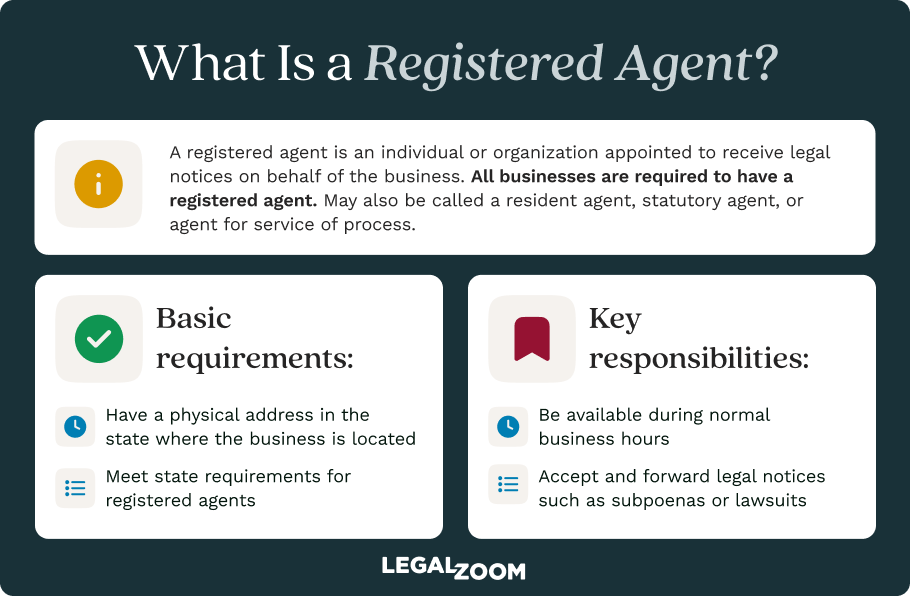
You can name yourself as a statutory agent if you're an Arizona resident, but many founders opt to use a professional service, because a professional service helps ensure legal notices are never missed and keeps your personal home address off the ACC's publicly accessible database.
Step 3: Prepare and file Arizona nonprofit articles of incorporation
Articles of incorporation are the foundational legal document that creates your nonprofit under Arizona law. You should file articles of incorporation alongside a certificate of disclosure, as the ACC will reject articles submitted without this form. Both forms can be filed through the ABC portal. If you’d prefer to file on a paper form, you can download them both through the ACC’s forms page.
When filing, make sure the following information is included:
- Entity name. Provide the exact name of the corporation, including the required designator.
- Character of affairs. Write a description of the organization's intended purpose. For 501(c)(3) eligibility, this must include IRS-required language limiting the organization's purposes to those described in Section 501(c)(3) of the Internal Revenue Code.
- Members. Provide a declaration of whether the corporation will or will not have members.
- Statutory agent information. Include the name and Arizona street address of your statutory agent. This cannot be a P.O. box.
- Known place of business address. This is the Arizona address where the nonprofit conducts business. It can be the same as your statutory agent address.
- Incorporator information. This includes name and address of each incorporator.
- Director information. This includes the name and address of each initial director, if known at the time of filing
Apart from what the ACC requires, you’ll also want to include the following clauses, as the IRS requires them for 501(c)(3) status.
- Purpose clause: The IRS requires language limiting your purposes to recognized exempt categories: charitable, educational, religious, scientific, or literary purposes, among others. Write the clause broadly enough to cover your full range of activities, but narrowly enough to confirm you operate exclusively for exempt purposes.
- Inurement clause: The certificate must state that the corporation will not issue stock or make distributions to its members, directors, or officers. This distinguishes a nonprofit from a for-profit business and is a prerequisite for 501(c)(3) eligibility.
- Dissolution clause: Include a clause stating that if the organization shuts down, remaining assets will be distributed to another tax-exempt organization or a government entity for a public purpose. The IRS specifically looks for this language before granting 501(c)(3) status. Without it, your application will likely be rejected or trigger a request for additional information.
Note: Arizona will accept your articles of incorporation without these clauses, but the IRS will not grant 501(c)(3) tax-exempt status without them.
The standard filing fee is $40 for articles of incorporation, and there is no separate fee for the certificate of disclosure included with your articles. You can pay more for faster processing, including next-day service, same-day service, or even two-hour service.
- Next-day service: $100
- Same-day service: $200
- Two-hour service: $400
Note: The certificate of disclosure requires each incorporator, officer, and director to disclose any prior felony convictions or involvement in entities that were administratively dissolved or had their authority revoked in Arizona within the past five years.
Step 4: Publish notice of incorporation in an Arizona newspaper
Under Arizona law, after the ACC approves your articles, you must then publish a notice of incorporation in a newspaper of general circulation in the county where your statutory agent's address is located.
The publication must run in three consecutive issues and must include the organization's name, the statutory agent's name and street address, and the character of affairs. After the three publications run, the newspaper provides an affidavit of publication, which you file with the ACC. You must complete this entire process within 60 days of ACC approval.
Do not publish any notifications until the ACC approves your articles. The approval letter you will receive from the Arizona Corporation Commission will contain information on how to publish.
Step 5: Hold an organizational meeting to adopt bylaws and appoint officers
Once the ACC approves your articles, your nonprofit legally exists as an Arizona corporation, and you’re ready to hold your organizational meeting, adopt bylaws, and appoint officers.
The organizational meeting is the first formal gathering of your incorporators or initial board, and is where foundational governance decisions get made and documented. At this meeting, your board should take the following actions:
- Formally adopt the bylaws.
- Elect officers, at minimum, a president (or chair), a secretary, and a treasurer. The secretary and the president cannot be the same person. The IRS prefers all officers be unique individuals who are not family or business partners outside of the nonprofit.
- Ratify any pre-incorporation actions, such as contracts signed or expenses incurred before the articles were approved.
- Authorize opening a bank account, as most banks require a board resolution.
- Record everything in written minutes.
Bylaws are your nonprofit's internal rulebook. Arizona does not require you to file them with the ACC or any other state agency, but you should still adopt them and maintain them as an official corporate record. The IRS will review your bylaws, and grant funders may also request a copy.
Well-drafted bylaws should address:
- Purpose and mission. Be consistent with the language in the articles of incorporation.
- Board composition. Describe the number of directors, term lengths, how vacancies are filled, and how directors are elected or appointed.
- Officer roles and responsibilities. Describe the roles and responsibilities of designated officers within the nonprofit.
- Meeting procedures. Propose the frequency, quorum requirements, and how meetings can be called.
- Notice requirements. Include the advance notice required to set a meeting.
- Voting procedures. Establish vote thresholds for major decisions.
- Conflict of interest policy. This policy should require directors and officers to disclose personal financial interests that could conflict with the organization's interests.
- Amendment procedures. Detail what steps need to be taken to amend your nonprofit bylaws.
- Dissolution procedures. These must be consistent with the dissolution clause in your articles.
The conflict of interest policy is particularly important; the IRS explicitly asks whether your organization adopted one on Form 1023. Skipping this policy can raise governance questions and slow the IRS review.
Step 6: Get an employer identification number (EIN)
An EIN is your nonprofit's federal tax identification number. You'll need an EIN before you can open a bank account, hire employees, or file for tax-exempt status with the IRS.
Applying for an EIN is free. Specifically, you need to file Form SS-4 electronically through the IRS website. In most instances, you will receive an EIN immediately. The IRS issues the EIN to the legal name of your organization exactly as it appears in your ACC-approved articles of incorporation, so use that exact name, including punctuation and the required corporate designator, to avoid discrepancies in subsequent filings.
Step 7: Apply for federal 501(c)(3) tax-exempt status
You can apply for 501(c)(3) tax-exempt status using one of two forms, depending on your organization's size and structure, but both are filed online via pay.gov.
- Form 1023-EZ (streamlined application): The EZ form is generally available to organizations projecting average annual gross receipts under $50,000 and total assets under $250,000, though certain hospitals, schools, churches, housing providers, and private foundations, must file the full Form 1023 regardless of size. It has a $275 fee and typically processes between two and four weeks.
- Form 1023: The full version is typically required for larger organizations and all types excluded from the EZ version. The user fee is $600, and the average processing time is around six months, though applications requiring additional information can take considerably longer.
The IRS will review your articles of incorporation and bylaws to verify that your governing documents legally restrict your activities to 501(c)(3)-exempt purposes.
When the IRS approves your application, it issues a determination letter, which is the official written confirmation of your 501(c)(3) status. Keep this document permanently. You'll need it to apply for Arizona state tax exemption, open certain bank accounts, and respond to grant funder requests. If your application is filed within 27 months of your incorporation date, the IRS generally makes the effective date of your exemption retroactive to the date of incorporation.
Step 8: Apply for Arizona state tax exemption
Federal 501(c)(3) tax-exempt status does not automatically exempt your organization from Arizona state taxes. You must still apply for Arizona state tax exempt status.
- Arizona state income tax exemption: The IRS granting your nonprofit 501(c)(3) status automatically exempts your nonprofit from Arizona state income tax, but there may be other taxes that still apply. Talk to a lawyer if you have questions.
- Transaction privilege tax exemption: TPT is the tax paid for the privilege of doing business in Arizona, and nonprofits are generally not exempt. Similar to a sales tax, nonprofits may qualify for exemption on qualifying purchases, but not all purchases automatically qualify, and the rules vary by transaction type and organizational activity.
Review ADOR's nonprofit exemption guidance, and consider working with an Arizona-licensed attorney or tax professional if your organization plans significant purchases or activities that might trigger TPT.
Ongoing compliance for Arizona nonprofits
To maintain your entity’s legal existence and tax-exempt status, you’ll need to keep up with a series of yearly filings and requirements.
Annual report to the Arizona Corporation Commission
Every Arizona nonprofit must file an annual report with the ACC to maintain good standing. The report is due on the anniversary of your initial formation. The ACC does not routinely send reminder notices, so you need to track this date yourself. You can find your precise due date in the ACC's eCorp database under "Entity Details."
IRS Form 990: Annual federal filing
Most charitable nonprofits must file IRS Form 990 by the 15th day of the fifth month after the end of the organization's accounting period. For a calendar-year organization, that deadline falls on May 15.
The version you file depends on annual revenue:
- Form 990-N (e-Postcard): Annual gross receipts normally $50,000 or less. Filed electronically only.
- Form 990-EZ: Gross receipts exceeding $50,000 but below the full Form 990 threshold.
- Form 990 (full return): Required for organizations with gross receipts of $200,000 or more, or total assets of $500,000 or more.
Form 990 is a public document. Grant funders and major donors routinely review it as part of due diligence.
The stakes are real. Failing to file Form 990 for three consecutive years triggers automatic revocation of tax-exempt status. Organizations that lose their status are no longer eligible to receive tax-deductible contributions and may owe corporate income tax. Reinstatement requires filing a new IRS application, which is the same process you completed to get the Determination Letter.
You can extend the due date by six months, without showing cause, by filing Form 8868 before the original due date.
Statutory agent updates
If your statutory agent changes for any reason, file a Statement of Change form with the ACC immediately. There is no fee. Don't wait for the annual report if the change is urgent. Take action right away since legal notices sent to an outdated address are still legally effective, even if you never receive them.
Board meeting minutes and corporate records
Arizona law requires nonprofits to maintain records of board meetings, and good governance practice calls for the full board to review the Form 990 prior to filing. Minutes from that review, along with minutes from any meeting where major financial decisions, officer elections, or policy changes were made, can be requested by auditors, grant funders, and the IRS.
Keep minutes accurate, dated, and signed. Maintain them alongside your articles of incorporation, bylaws, IRS determination letter, and copies of all filed annual reports and Forms 990.
How LegalZoom can help
Starting a nonprofit involves more paperwork, more agencies, and more sequencing decisions than most founders anticipate. LegalZoom has helped more than four million businesses get started, including more than 100,000 nonprofit organizations.
From preparing and filing your nonprofit articles of incorporation with the ACC to our suite of compliance services to help keep your organization in good standing year after year, LegalZoom handles the administrative work so you can focus on building your mission. And when it’s time to apply for federal tax exemption, we can help file your IRS Form 1023-EZ.
FAQs about nonprofits in Arizona
Does Arizona require nonprofits to register before soliciting contributions?
Generally speaking, Arizona does not require charitable organizations to register before soliciting contributions, whether Arizona-based or out-of-state.
However, Arizona requires charitable veterans organizations to register if they are soliciting in the state. If your nonprofit serves veterans and plans to solicit contributions under that mission, verify the current requirements before you fundraise.
Arizona's lack of a registration requirement only covers solicitations within Arizona. If your nonprofit solicits contributions from donors in other states, such as through a national email campaign, crowdfunding, direct mail, or online donation portals, then you may need to register in those states first.
How much does it cost to start a nonprofit in Arizona?
To start a nonprofit in Arizona, the baseline formation cost is $40 to file the articles of incorporation. That baseline cost can increase if you decide to use expedited processing, anywhere from an extra $35 to an extra $400.
There is also the cost with filing IRS Form 1023-EZ or Form 1023. The IRS filing fee will either be $275 or $600.
How long does it take to start a nonprofit in Arizona?
This depends on multiple factors, such as processing times. If, for example, you opt for standard processing, then it could take up to 60 days for your articles of incorporation to be processed. However, the formation timeline may be extended depending on how long it takes for the IRS to process your Form 1023. The total timeline from filing articles to receiving an IRS determination letter is typically between 3–12 months, depending on which IRS form is used and whether the IRS requests additional information.
'%20/%3e%3c/svg%3e)

'%3e%3cpath%20fill-rule='evenodd'%20clip-rule='evenodd'%20d='M9.31239%2025.5316H13.0679V14.1032H9.31239V25.5316ZM11.1913%208.46875C9.93945%208.46875%209%209.25086%209%2010.505C9%2011.5995%209.78211%2012.5389%2011.1913%2012.5389C12.6005%2012.5389%2013.3826%2011.5995%2013.3826%2010.505C13.3826%209.4082%2012.6005%208.46875%2011.1913%208.46875ZM27%2018.9577V25.5316H23.2445V19.4275C23.2445%2017.8609%2022.6174%2016.7664%2021.3679%2016.7664C20.2711%2016.7664%2019.644%2017.5463%2019.3316%2018.1756C19.1743%2018.488%2019.1743%2018.8004%2019.1743%2019.1128V25.5316H15.4165V13.9458H19.1743V15.5123C19.644%2014.7302%2020.5835%2013.6357%2022.6174%2013.6357C25.1234%2013.7908%2027%2015.3573%2027%2018.9577Z'%20fill='white'/%3e%3c/g%3e%3cdefs%3e%3cclipPath%20id='clip0_952_9489'%3e%3crect%20width='18'%20height='18'%20fill='white'%20transform='translate(9%208)'/%3e%3c/clipPath%3e%3c/defs%3e%3c/svg%3e)

