




Starting a nonprofit means navigating a few different state and federal agencies. First, you need to form a nonprofit corporation under Georgia law. Second, you need to apply to the IRS for federal 501(c)(3) tax-exempt status, which is the designation that lets donors deduct contributions and makes your organization eligible for most charitable grants.
This guide explains how to start a nonprofit in Georgia and covers all nine required steps in order, from choosing your organization's name through the ongoing compliance obligations that protect your nonprofit status after formation.
Nonprofit corporation vs. 501(c)(3)
Most founders use "nonprofit" and "501(c)(3)" interchangeably, but these terms actually describe two different statuses. A nonprofit corporation is a legal entity you form at the state level by filing articles of incorporation with the Georgia Secretary of State. That filing gives your organization legal existence, which means it can enter contracts, open a bank account, and limit its founders' personal liability. It does not exempt the organization from taxes or make donations tax-deductible.
In contrast, 501(c)(3) status is a federal tax designation granted by the IRS. Organizations classified as a 501(c)(3) are exempt from federal income tax, and contributions are generally tax-deductible for donors. You cannot apply for 501(c)(3) status until after your nonprofit corporation is officially active and formed, because the IRS requires your articles of incorporation as part of the application package.
Charitable solicitation registration is an additional requirement in Georgia. Any organization that asks the public for donations, including through online campaigns, must register with the Georgia Secretary of State's Charitable Solicitations Division before soliciting.
This sequence is fixed. You need to incorporate first, then apply for 501(c)(3) status, followed by solicitation registration. Skipping these steps, or taking them out of order, can create compliance issues before your organization has even raised even a single dollar.
How to start a nonprofit in Georgia: Step by step
Step 1: Choose a name for your Georgia nonprofit
Your nonprofit's name must not be deceptively similar to an existing entity registered in Georgia, and it must include a corporate designator, such as "Inc." or "Incorporated", to satisfy Georgia Secretary of State requirements. Search the Georgia Secretary of State's online name search tool to confirm availability, or use LegalZoom’s name search tool below.
If you find an available name but are not quite ready to incorporate, you can reserve a name for up to 30 days. For a deeper look, read our comprehensive guide to Georgia business names.
Free Georgia Business Name Check
Starting a business? Use our free name check tool to check your business name against the Georgia Secretary of State records.
By clicking "Check Availability," I agree to LegalZoom's Terms of Use. This search is a preliminary check of state databases and does not include variations or trademarks. Results do not guarantee name availability or compliance with legal requirements.
Step 2: Appoint a registered agent in Georgia
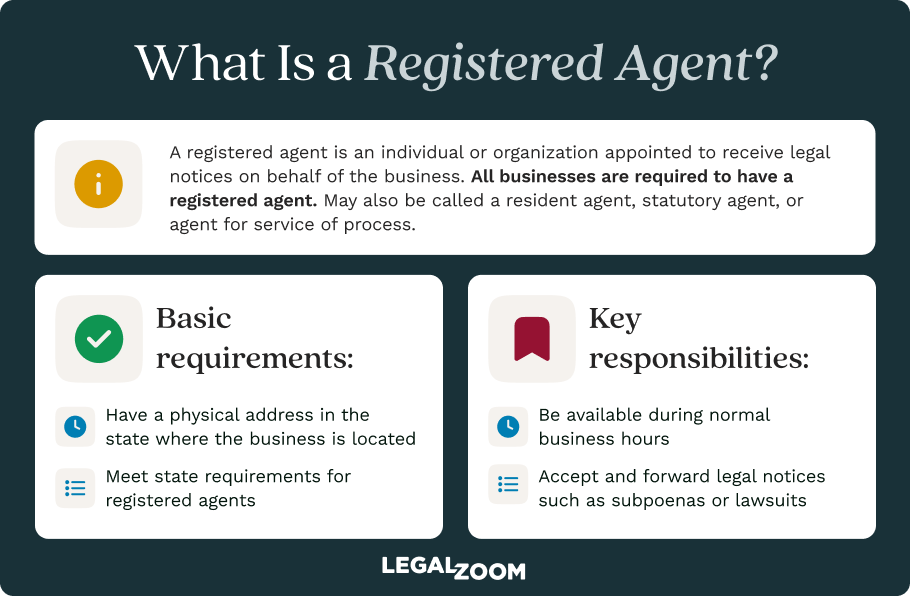
A registered agent is a person or entity designated to receive legal and official documents on behalf of your nonprofit. Georgia requires the agent to maintain a physical street address in Georgia, which means a P.O. box is insufficient. Your agent must be available during regular business hours.
The registered agent's name and address will appear in your public articles of incorporation, so choose someone reliable before you file. And if your registered agent changes at any point after incorporation, update the Georgia Secretary of State promptly, as an outdated agent means official legal correspondence may not reach your organization.
Step 3: Select your initial directors
A director is a member of the governing board who oversees the organization's activities.
Georgia law sets the minimum board size at one director, but most 501(c)(3) applicants benefit from at least three unrelated directors. The IRS scrutinizes applications where a single individual holds too much control, and independent directors demonstrate the governance structure the IRS expects from a public charity.
Identify your directors before filing your articles of incorporation, as their names may appear in the articles or be needed for the organizational meeting that follows.
Step 4: Prepare and file your Georgia nonprofit articles of incorporation
Articles of incorporation are the foundational legal document that creates your nonprofit corporation. The language you include will also determine whether the IRS approves your 501(c)(3) application, so getting both sets of requirements right the first time matters.
Georgia law requires the following in your articles of incorporation:
- The nonprofit's name (including a corporate designator)
- The statement, “The corporation is organized pursuant to the Georgia Nonprofit Corporation Code.” You should use this exact sentence.
- The registered agent's name and physical Georgia address
- The incorporator's name and address
- A statement saying whether or not the corporation will have members
- The mailing address of your nonprofit
- A signed witness statement
The state will accept your nonprofit articles if they meet the above requirements, but the IRS will not grant 501(c)(3) recognition unless your articles or bylaws contain a few specific provisions.
- Exempt purpose clause. This clause states that your organization's activities are limited to one or more purposes listed in the Internal Revenue Code Section 501(c)(3).
- Dissolution clause. This clause directs that, upon dissolution, remaining assets will be distributed to another 501(c)(3) or to a federal, state, or local government entity for a public purpose.
- Inurement clause. This states that the nonprofit’s purpose is for public benefit and is not intended to benefit or enrich any individual person.
You can file your articles online for a fee of $100, though no matter how you file, there will be a $10 service fee, effectively making the total $110. You can pay it online via the Georgia Secretary of State's Corporations Division portal. Generally speaking, the amount of time to process the paperwork for online filings is between 5–7 business days
Step 5: Publish your notice of incorporation and file the initial annual registration
Georgia law requires nonprofits to publish a notice of intent to incorporate once a week for two consecutive weeks in the official legal account of the county where the registered office is located. The notice and a publication fee payment should be forwarded directly to the newspaper no later than the next business day after filing articles of incorporation with the Secretary of State.
Publication fees vary by county, so make sure to contact your County Clerk’s office to confirm the current rate and submission process.
Additionally, within 90 days of incorporation, Georgia nonprofits must file an initial annual registration with the Secretary of State. The fee is $40. If you miss this 90-day window, your nonprofit falls out of compliance before it even completes formation.
Step 6: Draft your nonprofit bylaws and hold an organizational meeting
Bylaws are the internal governance rules that control how your nonprofit operates. You do not file them with the Georgia Secretary of State, but your board must adopt them at your organizational meeting and keep them in your permanent records. The IRS requires you to submit bylaws with your 501(c)(3) application, so draft them clearly and with all the required language.
Georgia nonprofit bylaws should address the following:
- Purpose and mission. Be consistent with the language in the articles of incorporation.
- Board composition. Describe the number of directors, term lengths, how vacancies are filled, and how directors are elected or appointed.
- Officer roles and responsibilities. Describe the roles and responsibilities of designated officers within the nonprofit.
- Meeting procedures. Propose the frequency, quorum requirements, and how meetings can be called.
- Notice requirements. Include the advance notice required to set a meeting.
- Voting procedures. Establish vote thresholds for major decisions.
- Conflict of interest policy. This policy should require directors and officers to disclose personal financial interests that could conflict with the organization's interests.
- Amendment procedures. Detail what steps need to be taken to amend your nonprofit bylaws.
- Dissolution procedures. These must be consistent with the dissolution clause in your articles.
The organizational meeting is the initial gathering of your directors to formally launch the organization. Directors adopt the bylaws, elect officers, authorize the EIN application, and pass any resolutions needed to open a bank account or begin operations. Keep the minutes in your permanent records.
Step 7: Obtain an employer identification number (EIN) from the IRS
An EIN is a nine-digit federal tax identification number assigned by the IRS. Your nonprofit needs one before it can apply for 501(c)(3) status, open a bank account, or hire employees. You can apply online at no cost, or use LegalZoom’s EIN filing service if you want someone to take it off your plate.
Step 8: Apply for 501(c)(3) status with the IRS
501(c)(3) status exempts your organization from federal income tax and makes donations tax-deductible. It unlocks charitable grants, government funding, and donor trust. There are two application paths, and yours is determined based on the projected size of your nonprofit.
| Form 1023 | Form 1023-EZ | |
|---|---|---|
| Who should use it | Orgs whose projected gross receipts exceed $50,000 and total assets exceed $250,000 | Orgs with projected annual gross receipts under $50,000 and total assets under $250,000 |
| Filing fee | $600 | $275 |
| Average IRS processing time | Between 3–6+ months | Between 2–4 weeks |
If you think your nonprofit qualifies for the 1023-EZ form, make sure to go through the eligibility checklist first. Even one “yes” answer means that the full form is required.
When the IRS approves your application, the agency will issue a determination letter, which is the document that proves your 501(c)(3) status to donors, grantors, state agencies, and banks. Keep this letter permanently since it is required to complete Step 9 (see below).
Step 9: Apply for Georgia state tax exemption and register for charitable solicitation
Once the IRS issues your determination letter, submit it to the Georgia Department of Revenue to apply for exemption from Georgia corporate income tax. No separate state application form is required.
Note: Any nonprofit that solicits charitable contributions from Georgia residents, including through online fundraising, must also register with the Georgia Secretary of State's Charitable Solicitations Division before any sort of solicitation takes place.
To register for solicitation, submit your articles of incorporation, bylaws, IRS determination letter, and financial statements. The registration fee is $35 and is valid for 24 months, after which it can be renewed.
Fundraising before you register is a compliance violation. The Georgia Attorney General's office holds oversight authority and can investigate organizations that solicit without proper registration, but the registration itself runs through the Secretary of State.
Georgia nonprofit cost and timeline
The base fee to create a nonprofit in Georgia is $175, which accounts for the $110 articles of incorporation filing fee, the $30 fee for your first annual registration, and $35 to apply for charitable solicitation. Your required publication costs will vary depending on your county.
However, the main factor in timing and cost is what form you use for the 501(c)(3) application. Organizations qualifying for Form 1023-EZ will pay $275 to the IRS, but those filing the full Form 1023 will pay $600.
State-level steps can be completed within a few weeks if you file online and your documents are in order. Form 1023-EZ applications typically resolve in two to four weeks; full Form 1023 applications average three to six months, and complex applications can take longer.
Realistically, plan for three to twelve months from filing your articles of incorporation to receiving your IRS determination letter.
Georgia nonprofit ongoing compliance
Your IRS determination letter is the starting point for recurring compliance obligations that keep your nonprofit in good standing. Missing a deadline or regulatory filing can trigger administrative dissolution or revocation of your tax-exempt status, either of which can be difficult and expensive to reverse.
Annual registration with the Georgia Secretary of State
File each year between January 1 and April 1. The state provides multiple options for how to file your annual registration, and no matter which path you take, the fee is $60. Failure to file results in administrative dissolution, which effectively terminates your organization's legal existence in Georgia until the issues are fixed.
Charitable solicitation renewal
In order to continue soliciting donations, you must renew your charitable solicitation registration every two years for a $20 fee. A lapsed registration means you are no longer authorized to solicit donations from Georgia residents, including through online campaigns.
IRS Form 990 (annual information return)
Tax-exempt status does not mean tax-filing exempt. You will need to file a version of the IRS Form 990 annually, and which version you file depends on gross receipts.
- Form 990-N (e-Postcard): Gross receipts under $50,000
- Form 990-EZ: Gross receipts between $50,000 and $200,000
- Form 990 (full): Gross receipts over $200,000
Missing three consecutive years of Form 990 filings automatically revokes your 501(c)(3) status. The IRS will not notify you before this happens.
Additional maintenance
As you continue operating your nonprofit, there are a few other compliance tasks to consider:
- Keep a current registered agent with a physical Georgia street address at all times and update the Secretary of State promptly if the agent changes.
- Nonprofits must keep records of board meetings, including attendance, motions, votes, and resolutions. Retain these permanently; they may be requested during audits, grant applications, or regulatory reviews.
- Monitor guidance from the Georgia Department of Revenue for updates affecting exempt organizations. Changes to your activities or revenue sources could affect your state tax obligations.
How LegalZoom can help
LegalZoom can handle your nonprofit formation paperwork, including your state articles of incorporation, 501(c)(3) Form 1023-EZ preparation, and ongoing compliance management. Our proven process has helped over 100,000 nonprofits start living their mission.
Georgia nonprofit FAQs
Can I start a nonprofit by myself in Georgia?
Yes. Georgia requires only one director, and a single person can serve as incorporator, director, and officer simultaneously. However, the IRS scrutinizes applications where one individual holds unchecked control, and most grantors require diverse leadership before awarding funds. Appoint at least three unrelated board members to help significantly strengthen the approval odds of your 501(c)(3) application.
Can I pay myself if I run a nonprofit?
Yes. The IRS permits 501(c)(3) organizations to pay reasonable compensation to officers, executives, and employees, including founders. However, be careful of private inurement, which is when you distribute profits to insiders the way a for-profit business pays dividends.
A nonprofit organization that engages in private inurement can result in the revocation of their tax-exempt status. Compensation should be approved by a disinterested board, documented in meeting minutes, and benchmarked against comparable positions.
What is the 33% rule for nonprofits?
The 33% rule is the IRS public support test: At least one-third of a nonprofit's total support over a rolling five-year period must come from the general public or program revenue, distinguishing public charities from private foundations. If public support falls below 10%, the IRS reclassifies the organization as a private foundation, which carries stricter operating rules and less favorable donor deductibility limits. Between 10% and 33%, the IRS may apply a facts-and-circumstances test to evaluate continued public charity status.
What are the annual compliance obligations for a Georgia nonprofit after formation?
File an annual registration with the Secretary of State each year before April 1, renew charitable solicitation registration every 24 months, and file an IRS Form 990 annually (version determined by gross receipts). Maintain a current registered agent and keep board meeting minutes. Missing three consecutive Form 990 filings automatically revokes 501(c)(3) status without IRS notice.
What does a Georgia nonprofit have to publish after incorporating, and where?
Georgia law requires nonprofits to publish a notice of intent to incorporate once a week for two consecutive weeks in the official legal organ of the county where the registered office is located. Publication fees vary by county, so make sure to contact the relevant newspaper directly to confirm the current rate.
What is the initial annual registration for a Georgia nonprofit and when is it due?
A required filing with the Georgia Secretary of State is due within 90 days of incorporation. The fee is $30. This filing is important since it establishes your organization in the state's ongoing compliance system and is separate from the articles of incorporation filing.
'%20/%3e%3c/svg%3e)

'%3e%3cpath%20fill-rule='evenodd'%20clip-rule='evenodd'%20d='M9.31239%2025.5316H13.0679V14.1032H9.31239V25.5316ZM11.1913%208.46875C9.93945%208.46875%209%209.25086%209%2010.505C9%2011.5995%209.78211%2012.5389%2011.1913%2012.5389C12.6005%2012.5389%2013.3826%2011.5995%2013.3826%2010.505C13.3826%209.4082%2012.6005%208.46875%2011.1913%208.46875ZM27%2018.9577V25.5316H23.2445V19.4275C23.2445%2017.8609%2022.6174%2016.7664%2021.3679%2016.7664C20.2711%2016.7664%2019.644%2017.5463%2019.3316%2018.1756C19.1743%2018.488%2019.1743%2018.8004%2019.1743%2019.1128V25.5316H15.4165V13.9458H19.1743V15.5123C19.644%2014.7302%2020.5835%2013.6357%2022.6174%2013.6357C25.1234%2013.7908%2027%2015.3573%2027%2018.9577Z'%20fill='white'/%3e%3c/g%3e%3cdefs%3e%3cclipPath%20id='clip0_952_9489'%3e%3crect%20width='18'%20height='18'%20fill='white'%20transform='translate(9%208)'/%3e%3c/clipPath%3e%3c/defs%3e%3c/svg%3e)

