




To start a nonprofit in Kansas, you need to complete distinct legal processes with different state and federal agencies. First, incorporate under Kansas state law, then obtain federal 501(c)(3) tax-exempt status from the IRS. Once you have tax-exempt status, you can register with the state for additional exemptions.
Four agencies govern the process: the Kansas Secretary of State, the IRS, the Kansas Department of Revenue, and the Kansas Attorney General's office, each with its own forms, fees, and deadlines. Here’s what to expect when forming your nonprofit—and when to ask for help.
Nonprofit corporation vs. 501(c)(3): What's the difference?
A nonprofit corporation is a legal entity you create under Kansas state law by filing articles of incorporation with the Kansas Secretary of State. Incorporation establishes your organization's legal existence, including the right to enter contracts, open bank accounts, and shield founders from personal liability.
501(c)(3) status is a separate federal tax designation granted by the IRS. It exempts your organization from federal income tax and allows donors to deduct their contributions.
These two processes are sequential. You must incorporate in Kansas before you can apply for 501(c)(3) recognition. A Kansas nonprofit corporation that never applies to the IRS owes federal income tax. An organization with 501(c)(3) status that skipped state incorporation doesn’t carry the limited liability or other legal protections a nonprofit corporation offers.
How to start a nonprofit in Kansas: Step by step
Step 1: Choose a name for your Kansas nonprofit
Your nonprofit's name must be distinguishable from every other entity on record with the Kansas Secretary of State and must include a word or abbreviation identifying it as a legal entity. Acceptable options include "association," "corporation," "foundation," "incorporated," and "institute," or standard abbreviations of them. For a full list of name requirements, read our comprehensive guide to Kansas business names.
Search the Kansas Secretary of State's business entity database or LegalZoom’s name check tool below to confirm availability. If the name you want is in use, you must submit a Consent to Use of Similar Business Name with your formation documents.
Free Kansas Business Name Check
Starting a business? Use our free name check tool to check your business name against the Kansas Secretary of State records.
By clicking "Check Availability," I agree to LegalZoom's Terms of Use. This search is a preliminary check of state databases and does not include variations or trademarks. Results do not guarantee name availability or compliance with legal requirements.
If you are not ready to incorporate immediately, a temporary name reservation holds your preferred name while you finalize your documents.
Step 2: Appoint incorporators, initial directors, and a registered agent
Before you file your articles, you need to appoint a few initial positions.
- Incorporators file the articles of incorporation with the state. Their responsibilities end once the organization is established. Kansas requires at least one incorporator.
- Directors make up the board, the governing body responsible for the organization's decisions and oversight. The IRS looks favorably on 501(c)(3) applicants with at least three independent, unrelated directors. A board of three or more makes it easier to demonstrate that no single person controls the organization.
- A resident agent (called a "registered agent" in other states) is a person or entity authorized to accept service of process on behalf of your organization. The agent must be a Kansas resident or a corporation authorized to do business in the state, available at a physical Kansas street address during normal business hours.
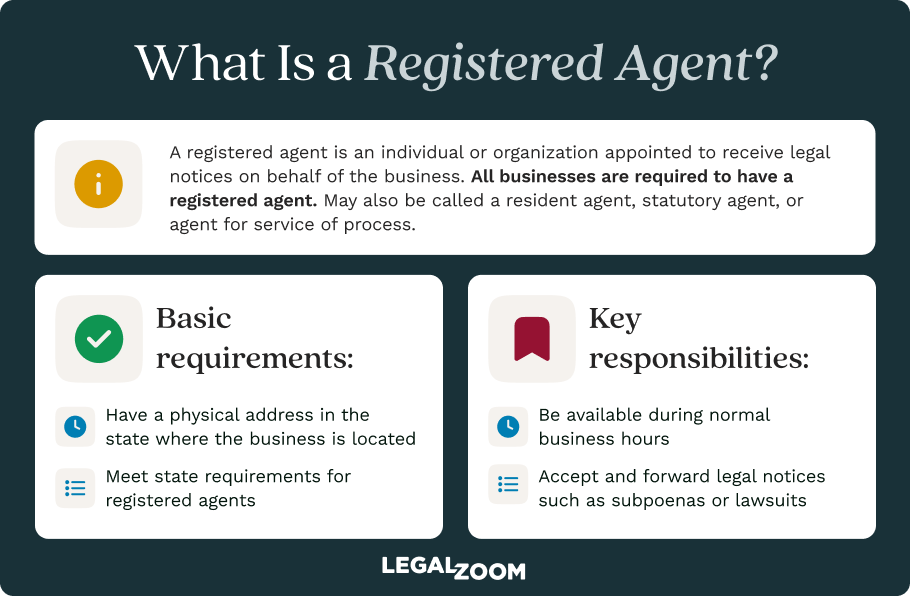
LegalZoom can serve as your resident agent in Kansas, keeping a personal address off the public record and ensuring consistent availability during business hours.
Step 3: File nonprofit articles of incorporation with the Kansas Secretary of State
Next comes filing articles of incorporation, which is the document that legally forms your nonprofit. The Kansas Secretary of State will accept articles that omit IRS-required language, but the IRS will not approve your exemption application until those provisions are in place.
Be prepared to provide the following information:
- Organization name. Enter it exactly as you want it registered, including the required corporate designator. Must be distinguishable from all existing entities on the Secretary of State's records.
- Resident agent name and address. This must be a physical Kansas street address where the agent is available during normal business hours. P.O. boxes are not acceptable.
- Incorporator name and address. The incorporator's role ends once the organization is formed.
- Statement of nonprofit purpose. Kansas requires only a brief description of what the organization does. For 501(c)(3) eligibility, the IRS requires articles to state that the organization is organized exclusively for one or more exempt purposes under Section 501(c)(3), such as charitable, educational, religious, or scientific purposes. Use language that mirrors the IRS' own statutory categories.
Additionally, the IRS requires more to be eligible for 501(c)(3) status. Include these two provisions with the filing:
- Dissolution clause. Must state that upon dissolution, remaining assets will be distributed to another 501(c)(3) organization or to a federal, state, or local government for a public purpose. The IRS will not grant 501(c)(3) status without this clause.
- Inurement clause. Must prohibit any part of the organization's net earnings from benefiting any private individual, including founders, directors, and officers. Omitting it means amending your articles before your federal application can move forward.
You can file online or by mail with a $20 fee. Online filings receive a near-immediate response. Mail filings can be sent to the address below and typically process in 3–5 business days.
Office of the Secretary of State
Memorial Hall, 1st Floor
120 S.W. 10th Avenue
Topeka, KS 66612
Getting the purpose clause, dissolution clause, and no-private-inurement clause right at this stage is the most important thing you can do to avoid delays in your 501(c)(3) application.
Step 4: Hold your organizational meeting and adopt bylaws
Once the state accepts your articles, your initial directors need to hold an organizational meeting to formally adopt bylaws, elect officers, and authorize the organization to open bank accounts and apply for tax-exempt status.
Bylaws are your organization's internal operating rules. They are not filed with the Kansas Secretary of State, but the IRS may request them as part of your 501(c)(3) application and grant programs may also request them. Your bylaws should cover:
- Organization name and purpose. Mirror the language in your articles of incorporation.
- Board composition. Number of directors, how they are elected, term lengths.
- Voting procedures. Quorum requirements and vote thresholds for major decisions.
- Officer roles and responsibilities. President, treasurer, secretary, and any others. One person may hold multiple offices.
- Meeting frequency. How often the board meets and provisions for calling them.
- Conflict of interest policy. A written procedure for how directors handle decisions where they have a personal financial interest. This is distinct from the inurement clause in your articles, as the conflict of interest policy documents the process your board follows when a potential conflict arises. The IRS requires both.
- Amendment procedures. How the bylaws can be changed
- Dissolution procedures. Must align with the dissolution clause in your articles, directing remaining assets to another tax-exempt organization
Step 5: Get an EIN from the IRS
An employer identification number (EIN) is a federal tax identification number you need to open a bank account, hire employees, and apply for 501(c)(3) status. You can apply at IRS.gov, select "corporation" as the entity type, and receive your number immediately. There is no fee.
Step 6: Apply for 501(c)(3) status
To file for tax-exempt status with the IRS, you’ll need to fill out one of the two possible forms.
- Form 1023 (full application): This is required for most organizations. Its fee is $600, and processing typically takes about six months. The standard Form 1023 must be submitted electronically through Pay.gov.
- Form 1023-EZ (streamlined application): To qualify for Form 1023-EZ, you must attest that annual gross receipts did not exceed $50,000 in any of the past three years, that projected gross receipts will not exceed $50,000 in any of the next three years, and that total assets have a fair market value of no more than $250,000. Its fee is $275, and it’s typically processed within 22 days.
Form 1023-EZ is not available to churches, schools, hospitals, or medical research organizations, regardless of size. If you're unsure which form applies, complete the IRS eligibility worksheet in the Form 1023-EZ instructions before deciding.
The IRS will issue a determination letter confirming your 501(c)(3) status. Keep it permanently—you will need it to open accounts, apply for grants, and prove tax-exempt status to donors.
The 27-month rule: If you file your 501(c)(3) application within 27 months after the end of the month in which you were legally formed and the IRS approves it, your exemption is effective retroactively to your date of incorporation. This means donations received from day one are tax-deductible. Miss that window and the effective date is the date you filed. Build your timeline around this deadline from the moment you incorporate.
Step 7: Confirm your Kansas state tax exemptions
Kansas treats income tax and sales tax differently.
- Income tax: Once the IRS approves your 501(c)(3) status, your organization is automatically exempt from Kansas income tax. There's nothing to file with the state, unless your corporation receives unrelated income. Unrelated business income of a non-profit organization that is subject to federal income tax and reported on a federal Form 990-T is subject to Kansas income tax.
- Sales & use tax: Kansas does not exempt every nonprofit from sales tax. If your organization qualifies, apply through the Kansas Department of Revenue to receive a numbered exemption certificate, then give a signed copy of the certificate to each vendor when making a tax-exempt purchase.
Step 8: Register for charitable solicitation if you plan to fundraise
If your organization will solicit charitable contributions from Kansas residents, you must register with the Kansas Attorney General's office before starting, unless your organization qualifies for one of the law's exemptions, which many new nonprofits do.
The registration form requires information about your organization's location, purpose, the individuals responsible for its conduct, and a financial statement. The current filing fee is $25.
Not every organization must register. Exemptions include small all-volunteer organizations raising $10,000 or less per year, organizations with no more than 100 contributors, religious organizations, and certain schools and membership groups. Outgrow an exemption and you must register with the Attorney General. When in doubt, register.
Kansas nonprofit startup costs and timeline
| Item | Cost | Estimated Time |
|---|---|---|
| Articles of Incorporation (online) | $20 | Immediate |
| Articles of Incorporation (mail) | $20 | 3–5 business days |
| IRS Form 1023 user fee | $600 | 3–6 months or longer |
| IRS Form 1023-EZ user fee | $275 | 2–4 weeks |
| Kansas charitable solicitation registration | $25 | Varies, check with the Attorney General |
Verify current fees and timelines with the appropriate offices.
Ongoing compliance for Kansas nonprofits
Missing the wrong deadline can mean administrative dissolution or automatic loss of 501(c)(3) recognition at the federal level. While recoverable, both cost time and money better spent on your mission.
Kansas biennial report
Kansas requires all nonprofit corporations to file an information report every two years to maintain good standing. This applies regardless of size, revenue, or activity status. For a complete walkthrough of the filing process, deadlines, and fees, see our guide on how to file a Kansas biennial report.
Nonprofits formed in even-numbered years file in each succeeding even-numbered year; those formed in odd-numbered years file in odd-numbered years. The report costs $80 and is due by June 15 of your designated filing year.
If you do not file within the three-month delinquency window (by September 15 for most nonprofits), your organization loses its legal standing in Kansas and cannot file any documents with the Secretary of State until reinstatement is complete. Reinstatement requires submitting all past-due reports along with applicable fees.
IRS Form 990
Every 501(c)(3) organization must file an annual information return with the IRS. The version depends on your organization’s gross receipts:
- Form 990-N (e-Postcard): Gross receipts of $50,000 or less
- Form 990-EZ: Gross receipts between $50,001 and $200,000 and total assets under $500,000
- Form 990 (full): Gross receipts over $200,000 or total assets exceeding $500,000
The return is due by the 15th day of the fifth month after the close of your tax year (May 15 for calendar-year organizations). A six-month extension is available by filing Form 8868 before the due date.
Organizations that fail to file for three consecutive years automatically lose their tax-exempt status. Reinstatement requires a new application and another user fee. There is no grace period once three years pass.
Charitable solicitation registration renewal
Kansas nonprofits that solicit funds from the public must renew their charitable solicitation registration with the Kansas Attorney General on an annual basis. Letting it lapse means soliciting without legal authorization, exposing your organization to enforcement action under the Kansas Charitable Organizations and Solicitations Act. Confirm current requirements with the Attorney General before each renewal cycle.
Start your Kansas nonprofit with LegalZoom
LegalZoom has helped form more than 100,000 nonprofit corporations get up and running. If you’re ready to get started, LegalZoom’s nonprofit business formation service can be a partner in your corner. When you’re ready to file for 501(c)(3) status, we can help you fill out and submit your paperwork as well.
100% Accurate Filing Guarantee
100% Accurate Filing Guarantee
We're committed to the highest quality and accuracy. If your filing is rejected or incorrect
due to our error, we'll correct it with the government agency at no additional cost to you.
We're committed to the highest quality and accuracy. If your filing is rejected or incorrect due to our error, we'll correct it with the government agency at no additional cost to you.
FAQs about starting a nonprofit in Kansas
Can I pay myself a salary from my Kansas nonprofit?
Yes. Founders and employees can receive reasonable compensation for services they actually perform. "Nonprofit" means the organization does not distribute profits to owners or shareholders, not that no one gets paid. Document all compensation decisions in board meeting minutes to demonstrate compliance with the no-private-inurement rule.
What is the 33% rule for nonprofits?
The 33% rule is a public support test that 501(c)(3) public charities must meet to avoid reclassification as a private foundation, a category subject to stricter IRS rules and additional taxes. At least one-third of the organization's total support must come from broad public sources—individual donations, government grants, and similar contributions—rather than from a small number of large donors. Most new nonprofits are automatically classified as public charities for their first five years, giving them time to build their funding base.
What is the difference between a nonprofit corporation and a 501(c)(3)?
A nonprofit corporation is a legal entity created under Kansas state law. 501(c)(3) status is a separate federal tax designation granted by the IRS that exempts the organization from federal income tax and makes donations tax-deductible. Incorporation comes first; the IRS application follows.
Do Kansas nonprofits need to register with the state before they can apply for grants?
Most grant-makers require active 501(c)(3) status, good standing with the Kansas Secretary of State, a current charitable solicitation registration, and some require at least one Form 990 on file. Requirements vary by funder—review each one's eligibility criteria before applying. Find grants for Kansas businesses with LegalZoom’s grant-search tool.
Is an LLC better than a nonprofit for a community organization?
An LLC is a for-profit entity that cannot receive tax-deductible donations and is not eligible for 501(c)(3) status. A nonprofit corporation is the right structure if your goal is to serve a public or charitable mission, accept tax-deductible contributions, and apply for grants. If your primary goal is running a mission-driven business that generates profit, an LLC or benefit corporation may be worth exploring with an attorney.
What are the required provisions in Kansas nonprofit articles of incorporation?
Kansas requires the organization name, registered agent name and address, and incorporator name and address. For 501(c)(3) eligibility, the IRS additionally requires a purpose clause stating the organization is organized exclusively for exempt purposes, a dissolution clause directing remaining assets to another tax-exempt organization, and a no-private-inurement clause. The Kansas Secretary of State will accept articles without the IRS-required language, but the IRS will not approve your exemption application until those provisions are present.
How do I get a Kansas sales tax exemption for my nonprofit?
First, confirm your organization qualifies. Kansas grants sales tax exemption only to entity types, such as schools, religious organizations, and certain health, museum, and youth organizations. If your organization qualifies, apply through the Kansas Department of Revenue's online Customer Service Center. Upon approval, the Department issues a numbered Tax-Entity Exemption Certificate. You must provide a signed copy of that certificate to each vendor at the time of a tax-exempt purchase.
'%20/%3e%3c/svg%3e)

'%3e%3cpath%20fill-rule='evenodd'%20clip-rule='evenodd'%20d='M9.31239%2025.5316H13.0679V14.1032H9.31239V25.5316ZM11.1913%208.46875C9.93945%208.46875%209%209.25086%209%2010.505C9%2011.5995%209.78211%2012.5389%2011.1913%2012.5389C12.6005%2012.5389%2013.3826%2011.5995%2013.3826%2010.505C13.3826%209.4082%2012.6005%208.46875%2011.1913%208.46875ZM27%2018.9577V25.5316H23.2445V19.4275C23.2445%2017.8609%2022.6174%2016.7664%2021.3679%2016.7664C20.2711%2016.7664%2019.644%2017.5463%2019.3316%2018.1756C19.1743%2018.488%2019.1743%2018.8004%2019.1743%2019.1128V25.5316H15.4165V13.9458H19.1743V15.5123C19.644%2014.7302%2020.5835%2013.6357%2022.6174%2013.6357C25.1234%2013.7908%2027%2015.3573%2027%2018.9577Z'%20fill='white'/%3e%3c/g%3e%3cdefs%3e%3cclipPath%20id='clip0_952_9489'%3e%3crect%20width='18'%20height='18'%20fill='white'%20transform='translate(9%208)'/%3e%3c/clipPath%3e%3c/defs%3e%3c/svg%3e)

