




Starting a nonprofit in New Jersey means completing three separate government processes with different agencies: state incorporation, federal tax-exempt status, and registration with the New Jersey Attorney General’s office.
This article walks through every step in that sequence, from naming your organization to ongoing annual compliance obligations. Each step identifies the agency, form, and fee involved so you can map your budget and timeline.
Nonprofit vs. 501(c)(3): Understanding the difference
“Nonprofit” and “501(c)(3)” don’t mean the same thing. They are two separate designations, granted by two different government agencies, through two different processes.
A nonprofit corporation is a legal entity created under state law. Forming one means filing paperwork with the state, adopting governing documents, and operating under rules designed for organizations that don’t distribute profits to owners or shareholders. “Nonprofit” describes this corporate structure, but it doesn’t say anything about your tax status.
501(c)(3) status is a federal tax designation granted by the IRS. It tells the federal government that your organization qualifies as a charitable, educational, religious, scientific, or similar entity, exempting it from federal income tax. Donors who give to a 501(c)(3) nonprofit can also deduct their contributions on federal tax returns.
New Jersey nonprofit formation: Step by step
Step 1: Choose a name for your New Jersey nonprofit
Your name must be distinguishable from every other entity on record with the New Jersey Division of Revenue and Enterprise Services and must contain “A New Jersey nonprofit corporation,” “incorporated,” or an accepted abbreviation. Check availability through the Division’s online business entity search or LegalZoom’s name search tool below before you file.
Free New Jersey Business Name Check
Starting a business? Use our free name check tool to see if your business name is available according to state records.
By clicking "Check Availability," I agree to LegalZoom's Terms of Use. This search is a preliminary check of state databases and does not include variations or trademarks. Results do not guarantee name availability or compliance with legal requirements.
If you’re not ready to file immediately, you can reserve your chosen name while you prepare formation documents. Name reservation is optional, but it ensures that no other entity can claim your name for 120 days. The reservation fee is $50.
For a deeper dive on names, read our comprehensive guide to New Jersey business names.
Step 2: Recruit incorporators and appoint initial directors
An incorporator is the person who signs and files the certificate of incorporation. Their legal function ends once the certificate is filed. The incorporator must be at least 18 years old but need not be a U.S. citizen or New Jersey resident.
In New Jersey, directors of a nonprofit are formally called trustees under state law. New Jersey requires at least three trustees to sit on the “Board of Trustees,” each age 18 or older, with no citizenship or state residency requirements. During evaluation by the IRS, three or more independent trustees tend to signal governance credibility and simplify the 501(c)(3) application.
A trustee board member can also serve as a paid employee. However, the more board seats that are filled by paid insiders, the less independent the board may look to the IRS. Document every trustee compensation decision in board minutes.
Step 3: Appoint a registered agent in New Jersey
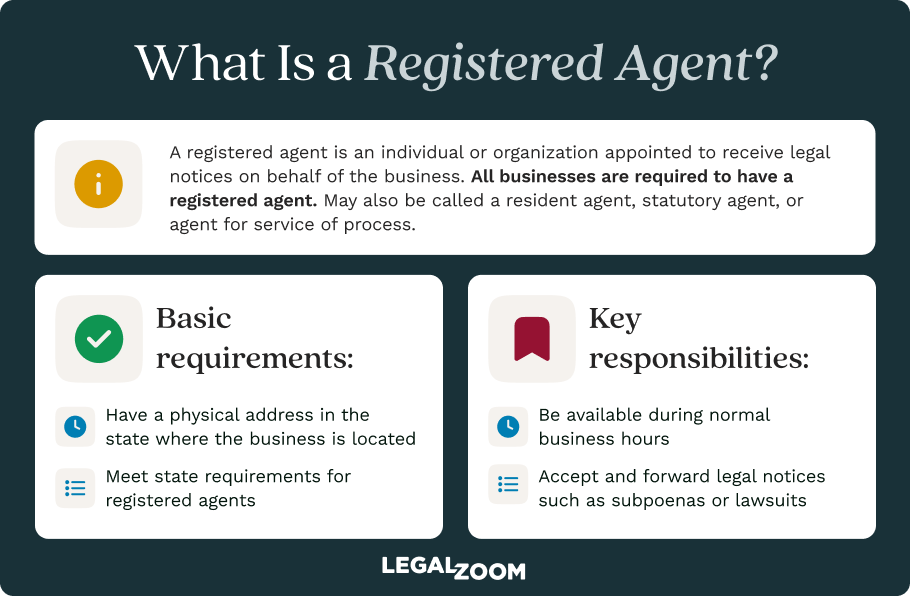
Nonprofits in New Jersey are required to appoint a registered agent. A registered agent is a person or entity designated to receive legal documents and official state correspondence on your nonprofit’s behalf, including service of process, tax notices, and compliance reminders. You’ll appoint a registered agent by naming them on your certificate of incorporation form with the state.
The address must be a physical New Jersey street address. An officer or director with a New Jersey address can serve in this role, but many nonprofits choose to use a professional registered agent service, as the agent’s name and address become part of your public record with the state.
Step 4: File the certificate of incorporation with New Jersey
Filing a certificate of incorporation with the state legally creates your nonprofit corporation. Submit it to the New Jersey Division of Revenue and Enterprise Services through the state’s online business formation portal. The current filing fee is $75.
The IRS adds requirements beyond New Jersey’s for organizations seeking 501(c)(3) status. Draft your certificate to satisfy both from the start—amending it later adds time and cost.
- Organization name: Enter it exactly as it will appear on all official documents.
- Registered agent name and New Jersey street address: A P.O. box is not sufficient.
- Statement of nonprofit purpose: Language such as “organized exclusively for charitable, educational, religious, or scientific purposes within the meaning of Section 501(c)(3) of the Internal Revenue Code” is standard.
- Dissolution clause: State that upon dissolution, remaining assets will be distributed to another 501(c)(3) organization or a government entity.
- Private benefit prohibition: Include a statement that no part of net earnings will inure to the benefit of any private individual.
- Name and address of each incorporator: You only need one, but you can have more.
- Names and addresses of the three initial trustees: They do not need to be New Jersey residents.
- Nonprofit structure: Include a statement on whether or not the nonprofit will have members. A nonprofit without members is governed entirely by its board.
Pay special attention to the purpose clause and dissolution clause, as the IRS may reject a 501(c)(3) application if either is missing or too vague. The dissolution clause permanently dedicates your assets to recognized exempt purposes, while the statement of purpose restricts your organization to those purposes in the first place.
You’ll be prompted to attach “Other Provisions” to your filing, which is how you can add the 501(c)(3) language that the standard form leaves out. Consider working with an attorney to ensure these clauses meet IRS requirements.
Step 5: Draft bylaws and hold your organizational meeting
Bylaws are your nonprofit’s internal rulebook, governing how the board makes decisions, how officers are elected, what happens at meetings, and how the organization handles conflicts of interest. You are not required to file bylaws with the state, but the IRS will want to review them as part of your 501(c)(3) application.
Your bylaws should cover the following:
- Organization name and principal office address.
- Statement of mission and purpose. Keep it consistent with the certificate of incorporation.
- Board of trustees. Include the number of trustees, term lengths, election, and removal procedures.
- Officer titles and duties. Appoint, at minimum, a president, secretary, and treasurer.
- Meeting requirements. Determine frequency, quorum requirements, and notice periods.
- Conflict of interest policy. The IRS specifically requires this.
- Amendment procedures. Explain how and by what vote the bylaws can be changed.
- Dissolution procedures. Write it to be consistent with the dissolution clause in the certificate of incorporation.
The first organizational meeting is where the board formally adopts the bylaws, elects officers, and approves initial policies, including authorizing the employer identification number (EIN) application. Make sure to keep minutes in your corporate records book since the IRS may request them.
Step 6: Obtain an EIN from the IRS
An EIN is a federal tax ID number—the organizational equivalent of a Social Security number. You’ll need it to open a bank account and submit the 501(c)(3) application. You can apply for an EIN directly on the IRS website or by using an EIN service.
Step 7: Apply for 501(c)(3) tax-exempt status
The 501(c)(3) application is a federal process through the IRS, not the state of New Jersey. You apply only after your nonprofit is incorporated at the state level.
- Form 1023-EZ: Form 1023-EZ is available to organizations projecting gross receipts of $50,000 or less annually and total assets under $250,000. The filing fee is $275, and most applications are processed in less than a month. Before filing, complete the IRS eligibility worksheet included in the Form 1023-EZ instructions and keep it for your records.
- Form 1023 (full application): Larger organizations file Form 1023. The filing fee is $600, and most applications are processed in about six months, though it could take longer. Churches, schools, hospitals, and certain other organizations must use Form 1023 regardless of size.
The IRS filing fee is non-refundable regardless of which form you choose.
If your application is approved, the IRS will issue a determination letter. If you receive a determination letter, retain it with your nonprofit’s records—you’ll need it to demonstrate 501(c)(3) status.
Note: Your organization can operate and accept donations while the application is pending. However, you can’t promise donors that they’ll receive a tax deduction for contributions until the IRS approves the application. But, if you file within 27 months of incorporation, approval is retroactive to your incorporation date, meaning donations made during the pending period are treated as tax-deductible once the determination letter arrives.
Step 8: Apply for New Jersey state tax exemptions
New Jersey corporations are subject to several types of taxes, including the Corporation Business Tax and the Sales and Use Tax. Under New Jersey law, properly formed nonprofits are automatically exempt from the Corporation Business Tax. However, exemption from Sales and Use Tax requires a separate application.
Form REG-1E requires your organization to submit its bylaws, officer information, and IRS determination letter. Because most charitable nonprofits must include their IRS determination letter, you’ll generally apply after receiving 501(c)(3) approval. If your exemption application is approved, your organization will receive an exempt organization certificate, exempting it from New Jersey sales tax on purchases for the organization’s nonprofit work.
There is no filing fee, and processing typically takes six to eight weeks. Filing REG-1E also serves as your nonprofit’s New Jersey tax registration, so you don’t need to file a separate NJ-REG.
Step 9: Register for charitable solicitation
Before your nonprofit asks a single New Jersey resident for a donation—including through email, social media, or your website—you must register with the New Jersey Attorney General’s office. Organizations taking in less than $10,000 in annual contributions that conduct all fundraising through volunteers are exempt from registration. Religious organizations and schools with curricula approved by the Department of Education are also exempt.
Organizations with gross contributions under $25,000 may file Form CRI-200. Organizations exceeding this amount, or those who contract with professional fundraisers, must use Form CRI-150I. The Attorney General mandates that charities register through its online solicitation portal, which generates the correct form as you complete the application.
To register, you’ll need your bylaws, certificate of incorporation, IRS determination letter, and most recently filed IRS Form 990. If you can’t produce any of those materials, such as if your IRS determination is pending, you’ll need to state the reason in a cover letter.
How much does it cost to start a nonprofit in New Jersey?
| Step | Fee |
|---|---|
| Certificate of incorporation | $75 |
| IRS Form 1023 (full application) | $600 |
| IRS Form 1023-EZ (streamlined) |
$275 |
| NJ state tax exemption (REG-1E) |
Free |
| Charitable solicitation registration | $30–$250/year |
An organization that qualifies for Form 1023-EZ and uses a director as its registered agent faces a minimum outlay of about $350. An organization filing Form 1023 with a professional registered agent could spend $1,000 or more, before any legal fees.
Ongoing compliance for New Jersey nonprofits
Formation gets your organization off the ground. Staying compliant keeps it there.
- Annual report: This is filed online with the New Jersey Division of Revenue and Enterprise Services and due each year by the last day of your anniversary month with a filing fee of $30.
- Form 990: Most 501(c)(3) organizations, except churches and other select entities, must file annually. Organizations with gross receipts of $50,000 or less file Form 990-N; those with gross receipts under $200,000 and total assets under $500,000 may file Form 990-EZ; larger organizations file the full Form 990. No matter the version, it’s due on the 15th day of the fifth month after your fiscal year ends, with an extension available via Form 8868. Three consecutive years without filing results in automatic revocation of tax-exempt status.
- Charitable solicitation renewal: File an annual registration form and financial report with the Attorney General’s Office of Charities Registration and Investigation within 180 days of fiscal year-end. A $25 late fee applies to renewals filed after the due date.
- State tax exemption maintenance: If your organization changes its name, address, or structure, notify the NJ Division of Taxation.
- Board meeting minutes: Maintain written records of all board meetings and major decisions. They’re not filed with any agency but are essential for demonstrating governance compliance if the IRS, state, or grant program ever inquires.
How LegalZoom can help
LegalZoom has helped over 100,000 nonprofit organizations get started. Whether you need help filing your nonprofit articles of incorporation, preparing your bylaws, or working through the IRS Form 1023-EZ application, LegalZoom's nonprofit formation and 501(c)(3) application services handle the paperwork so you can focus on your mission.
New Jersey nonprofit FAQs
Is it better to have an LLC or a nonprofit?
For a charitable mission, a nonprofit corporation is generally the right structure. An LLC can only qualify for 501(c)(3) status in limited cases, making tax-deductible donations and grant qualification harder. The nonprofit structure is designed to support the function of a nonprofit mission and invites less scrutiny than a nontraditional structure.
Can I pay myself if I run a nonprofit?
Yes. Founders and executives can receive reasonable compensation for services rendered. “Reasonable” means comparable to what similar organizations pay for similar roles. What is prohibited is private inurement: paying insiders above fair market value in a way that personally enriches them at the organization’s expense.
What is the 80/20 rule for nonprofits?
The 80/20 rule is a fundraising benchmark, not a legal requirement, suggesting nonprofits spend at least 80% of revenue on program activities and no more than 20% on administrative and fundraising costs. New Jersey law does not codify it, but organizations with high overhead relative to program spending may face donor and regulatory scrutiny.
Can a New Jersey nonprofit apply for grants before receiving 501(c)(3) status?
Some funders require 501(c)(3) status, while others do not. For organizations still awaiting IRS approval, fiscal sponsorship is a common solution—an established 501(c)(3) receives and administers grant funds on the new organization’s behalf while the application is pending. Confirm each funder’s eligibility requirements before applying. Some grants specifically target nonprofit startups but they are highly competitive and you will need to do some digging.
'%20/%3e%3c/svg%3e)

'%3e%3cpath%20fill-rule='evenodd'%20clip-rule='evenodd'%20d='M9.31239%2025.5316H13.0679V14.1032H9.31239V25.5316ZM11.1913%208.46875C9.93945%208.46875%209%209.25086%209%2010.505C9%2011.5995%209.78211%2012.5389%2011.1913%2012.5389C12.6005%2012.5389%2013.3826%2011.5995%2013.3826%2010.505C13.3826%209.4082%2012.6005%208.46875%2011.1913%208.46875ZM27%2018.9577V25.5316H23.2445V19.4275C23.2445%2017.8609%2022.6174%2016.7664%2021.3679%2016.7664C20.2711%2016.7664%2019.644%2017.5463%2019.3316%2018.1756C19.1743%2018.488%2019.1743%2018.8004%2019.1743%2019.1128V25.5316H15.4165V13.9458H19.1743V15.5123C19.644%2014.7302%2020.5835%2013.6357%2022.6174%2013.6357C25.1234%2013.7908%2027%2015.3573%2027%2018.9577Z'%20fill='white'/%3e%3c/g%3e%3cdefs%3e%3cclipPath%20id='clip0_952_9489'%3e%3crect%20width='18'%20height='18'%20fill='white'%20transform='translate(9%208)'/%3e%3c/clipPath%3e%3c/defs%3e%3c/svg%3e)

